
A 10% discount on a product with a 30% gross margin wipes out a third of the profit on every order. To break even on that choice, the store needs roughly 50% more volume. That math is why learning how to increase e-commerce sales without touching price is one of the most valuable skills a store owner can build. Discounts feel fast. They also train shoppers to wait for the next sale, erode brand value, and shrink the budget available for ads, product development, and service.
The better path is less dramatic but far more durable: fix the leaks in the buying experience, make the brand easier to trust, and give existing customers reasons to come back. Stores that do this well grow revenue while margins hold steady or improve.
Why Price Cuts Are the Costliest Growth Lever
Price is the only lever that takes money directly out of profit. Everything else, better product pages, faster checkout, smarter email, costs time or a one-off investment and then keeps paying.
There is also a branding cost. When a store runs frequent promotions, shoppers learn the rhythm. They stop buying at full price, and the “real” price quietly becomes the sale price. Premium and DTC brands are especially vulnerable, because perceived value is part of what they sell.
Discounts buy a transaction. Experience improvements buy a customer.
The practical alternative is conversion rate optimization (CRO): increasing the share of visitors who buy, and the amount they spend, using the traffic already arriving today.
The Three Numbers That Actually Move Revenue
Revenue comes down to three inputs:
| Input | What it means | Non-price ways to improve it |
|---|---|---|
| Traffic | Visitors reaching the store | SEO, content, partnerships, paid media efficiency |
| Conversion rate | Share of visitors who buy | UX fixes, checkout simplification, trust signals, personalization |
| Average order value (AOV) | Spend per order | Bundles, free-shipping thresholds, cross-sells, upgrades |
Most stores obsess over the first input and neglect the other two, which is exactly where discount-free growth lives.
How to Increase E-commerce Sales Through Conversion Optimization
Conversion optimization and user experience are the primary growth levers for online retail in 2026. The reason is simple: traffic costs more every year, so the stores that win are the ones that waste less of it.
Remove Friction From Checkout
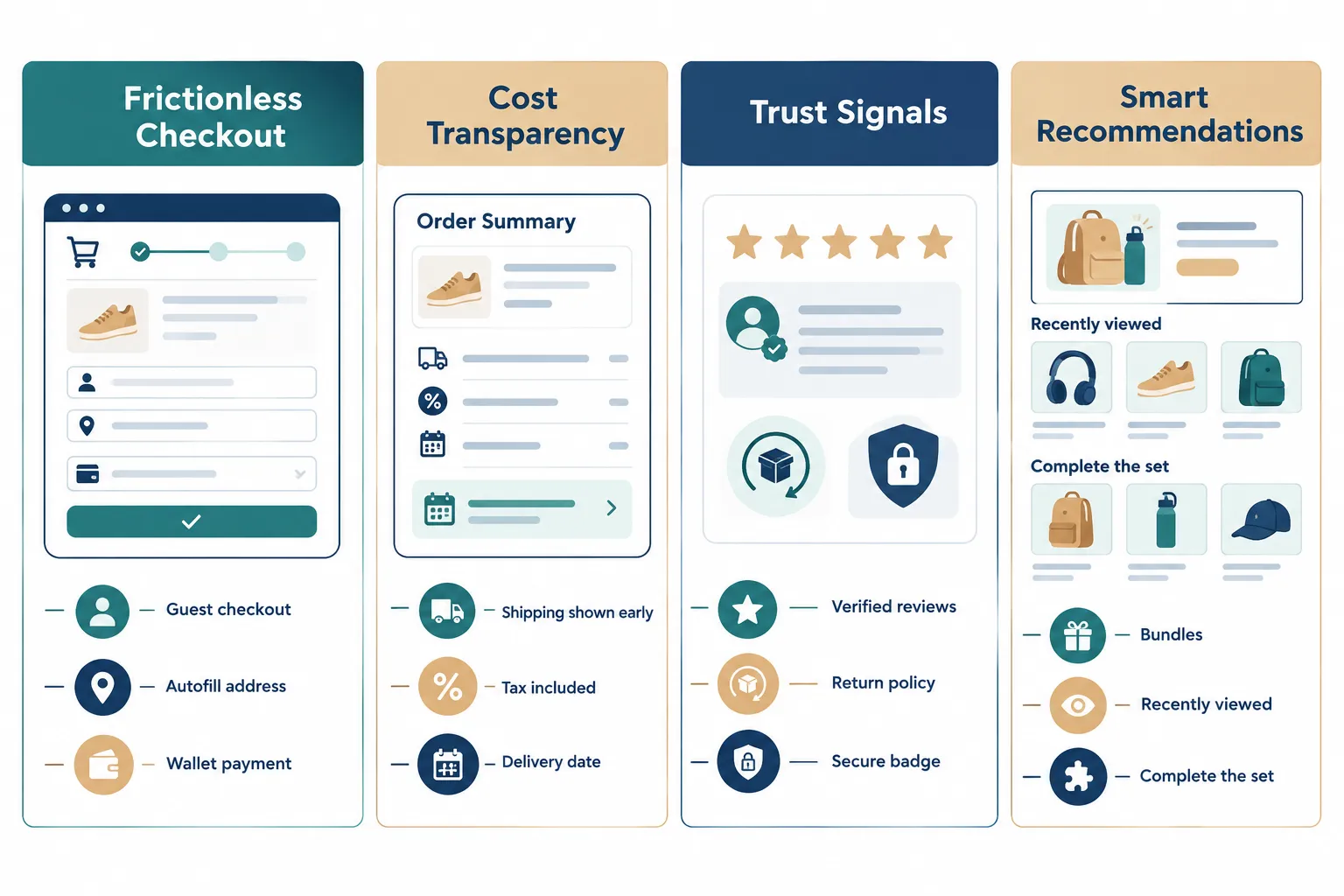
Checkout is where intent turns into revenue, or dies. Short, low-friction checkout flows can lift completed purchases by 20-40%. Common fixes:
- Allow guest checkout. Forcing account creation is one of the oldest and most expensive mistakes in e-commerce.
- Cut form fields. Ask only for what is needed to ship and charge. Use address autocomplete.
- Show progress. A clear two- or three-step indicator reduces the feeling of an endless form.
- Offer the payment methods your audience uses, including digital wallets that skip typing entirely.
- Test mobile first. If buttons are small or the keyboard covers a field, mobile revenue leaks silently.
Make Costs Transparent Early
Surprise fees at the final step are a leading cause of abandoned carts. Showing taxes, shipping cost, and an estimated delivery date before checkout reduces abandonment and increases trust. A shipping calculator on the cart page, or a clear banner stating the free-shipping threshold, works better than hiding the number until the last click.
Strengthen Product Pages
Product pages carry the weight of the sale. The highest-impact improvements rarely involve price:
- Multiple images including scale shots, detail shots, and in-use photography
- Short video showing the product in motion
- Specifications laid out in a scannable table
- A clear, confident return policy stated near the add-to-cart button
- Answers to the three objections that come up most in support tickets
Build a Testing Habit
Structured experimentation is no longer optional. Map the funnel, landing page, collection page, product page, cart, checkout, confirmation, and measure drop-off at each stage. Then run A/B tests on the single biggest leak, not on whatever seems interesting.
Rules that keep testing honest:
- Test one meaningful change at a time
- Run until the sample is large enough to trust
- Record losing tests; they prevent repeat mistakes
- Prioritize by expected impact divided by effort
How to Increase E-commerce Sales With Trust and Social Proof
Trust signals remain among the highest-impact non-price conversion boosters. A shopper who believes the product will arrive, work, and be supported does not need a coupon.
Social Proof That Works
- Reviews with photos. Customer images outperform polished studio shots for credibility.
- Review volume on collection pages, not just product pages, so shoppers self-select toward proven winners.
- Specific testimonials. “Fits a 15-inch laptop with room for a charger” beats “Great bag!”
- User-generated content in email and on site, with permission.
- Third-party validation: press mentions, certifications, lab results, warranty details.
Reduce Perceived Risk
Risk reversal is a powerful non-price lever. Free returns, a generous trial window, a clear warranty, or a satisfaction guarantee all lower the cost of saying yes. These programs have real expense, but unlike discounts they only cost money when a customer is unhappy, not on every single order.
Make Support Visible
A visible contact method, live chat during business hours, and a thorough FAQ reassure hesitant buyers. Customer service and the post-purchase experience are strategic differentiators, not cost centers. Fast, human responses create repeat buyers and reviews that drive future sales.
Personalization, Bundling, and Average Order Value
On-site personalization and AI-driven recommendations have become core non-discount levers. Instead of lowering price, these tactics raise relevance and basket size.
Smart Recommendations
- Complementary cross-sells on the product page (“pairs with”)
- Post-add-to-cart suggestions rather than interruptions before the add
- Recently viewed modules to recover lost consideration
- Behavior-based homepage merchandising for returning visitors
Personalization works best when it feels useful, not surveillance-like. Keep it based on on-site behavior and purchase history, and keep it easy to ignore.
Bundles and Thresholds
| Tactic | How it lifts revenue | Margin impact |
|---|---|---|
| Product bundles | Higher units per order; perceived value without unit discount | Neutral to positive |
| Free-shipping threshold | Pushes AOV just above the cutoff | Positive if threshold is set above current AOV |
| Tiered gift-with-purchase | Rewards larger baskets with product, not price | Controlled, one-time cost |
| Subscription or refill option | Predictable repeat revenue | Strongly positive |
| Premium tier or upgrade | Shifts mix upward | Positive |
A free-shipping threshold set roughly 15-25% above current average order value tends to lift AOV without hurting conversion.
Email, Lead Capture, and Abandonment Recovery
Email remains one of the highest-return channels, and it does not require discount codes to perform. Loyalty-and-trust-led email, education, styling guides, founder notes, restock alerts, product care tips, drives sales while protecting price integrity.
Capture More of the Traffic You Already Have
On-site lead capture is the bridge between anonymous traffic and owned revenue. Offer something other than a coupon:
- A fit or size guide
- A short quiz with a personalized recommendation
- Early access to new releases
- A practical checklist or how-to resource
Cart and browse abandonment flows then recover revenue that would otherwise disappear. Effective recovery sequences lead with reassurance, shipping speed, return policy, reviews, before ever considering an incentive.
Segment by Behavior, Not Just Demographics
Segmentation and targeting by behavior and traffic source maximize non-discount ROI. Useful segments:
- First-time visitors vs. returning browsers
- One-time buyers vs. repeat customers
- High-AOV customers vs. threshold shoppers
- Product-category affinity
- Source channel (organic search behaves differently from paid social)
A repeat customer who has bought three times should never receive the same message as a cold visitor.
Customer Research: The Input Everything Else Depends On
Deep customer research guides every non-price improvement. Without it, teams test random ideas and call it optimization.
Three research inputs worth running continuously:
- Behavior analytics. Session recordings, heatmaps, and funnel reports show where shoppers hesitate, rage-click, or exit.
- Direct feedback. A one-question post-purchase survey (“What almost stopped you from buying?”) surfaces objections in plain language.
- Support ticket mining. The top ten repeated questions belong on product pages and in email flows.
The copy that converts best is usually the customer’s own words, repeated back.
A 90-Day Non-Discount Growth Plan
| Phase | Focus | Core actions |
|---|---|---|
| Days 1-30 | Diagnose | Map the funnel, install behavior analytics, run a post-purchase survey, audit mobile checkout |
| Days 31-60 | Fix friction | Enable guest checkout, cut form fields, surface shipping and delivery dates, add trust signals and reviews |
| Days 61-90 | Grow value | Launch bundles, set a free-shipping threshold, deploy abandonment and browse flows, start structured A/B tests |
Measure margin-aware metrics throughout: conversion rate, AOV, contribution margin per order, repeat purchase rate, and 90-day customer value. Revenue alone can rise while profit falls, the whole point of this approach is to avoid that trap.
Final Thoughts
Learning how to increase e-commerce sales without cutting prices comes down to a shift in where effort is spent. Instead of buying volume with margin, the goal is to convert more of the traffic already arriving, raise the value of each order, and keep customers coming back.
Start with these next steps:
- Audit checkout on a phone today. Count the taps and form fields from cart to confirmation, then remove whatever is not essential.
- Expose costs early. Add shipping estimates, tax clarity, and delivery dates before the final step.
- Install behavior analytics and ask one post-purchase question. Let real data choose the next test.
- Add social proof where hesitation happens, especially on collection pages and near the add-to-cart button.
- Set a free-shipping threshold above current AOV and build two or three logical bundles.
- Launch a non-discount email program with abandonment recovery, education, and loyalty messaging.
Each of these holds price steady, protects brand value, and compounds over time. That is the difference between a discount, which ends when the sale ends, and an experience improvement, which keeps earning.