
Most online stores lose roughly seven out of every ten shoppers who add something to a cart. That single leak costs more revenue than most paid ad budgets ever produce. The brands winning in 2026 are not the ones spending the most on ads, they are the ones using E-commerce Marketing Strategies built around the full customer lifecycle, where every visit, email, and repeat purchase compounds.
Global online retail keeps expanding, which means the opportunity is real, but so is the competition. The gap between a store that plateaus and one that doubles usually comes down to a handful of disciplined moves, not luck.
This guide breaks down what actually moves revenue now: owned channels, AI-powered personalization, conversion-focused product pages, social commerce, and smart retargeting.
Why Lifecycle Thinking Should Anchor Your E-commerce Marketing Strategies
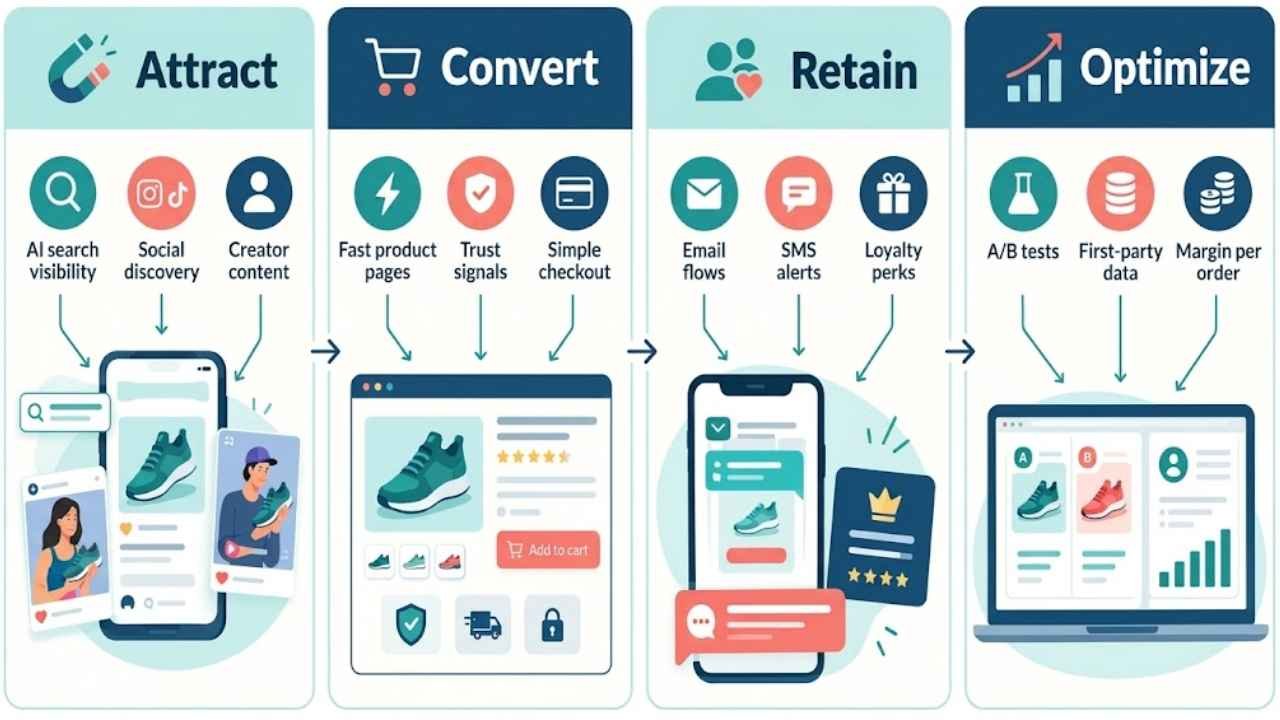
Scattered tactics create scattered results. A smarter approach treats marketing as one connected loop with four jobs: bring in qualified traffic, turn that traffic into buyers, keep those buyers coming back, and use data to improve each step.
Here is how the four stages map to practical work:
| Stage | Main Goal | Core Channels | Key Metric |
|---|---|---|---|
| Attract | Reach new qualified shoppers | SEO, AI search, social, creators | Cost per new visitor |
| Convert | Turn interest into orders | Product pages, UX, retargeting | Conversion rate |
| Retain | Earn repeat purchases | Email, SMS, loyalty, support | Repeat purchase rate |
| Optimize | Improve economics | Testing, analytics, first-party data | Profit per order |
A store that fixes retention before scaling ads almost always ends up more profitable than one that does the reverse.
The reason is simple math. If each customer buys twice instead of once, the budget available to acquire the next customer effectively doubles.
Attract: Getting Found Where Shoppers Actually Look
Product discovery has shifted. Shoppers now ask AI assistants for recommendations, search inside social apps, and trust creators more than brand ads.
Optimize for AI Search and Traditional SEO Together
AI answer engines pull from clear, well-structured content. That means your product and category pages need more than keywords.
- Write original product descriptions that answer real questions about fit, use, materials, and care.
- Add structured data (product schema, reviews, FAQs) so machines understand your catalog.
- Build helpful comparison and buying-guide content that names specific use cases.
- Keep page speed fast and mobile layouts clean, slow pages lose both rankings and buyers.
- Use natural, spoken-style phrasing in FAQs to capture voice search queries.
Lean Into Social Commerce and Creator Content
Short-form video and shoppable posts now function as storefronts. The most effective approach blends three content types:
- Creator partnerships, micro-influencers with engaged niche audiences often outperform large accounts.
- User-generated content (UGC), real customer photos and videos raise trust and lift conversion when placed on product pages.
- Community building, private groups, text clubs, and early-access lists turn buyers into advocates.
Live commerce is also growing fast. A scheduled live product demo with limited-time offers can compress weeks of consideration into minutes.
Paid Performance That Earns Its Place
Paid media still matters, but its job has narrowed. Use it to recapture intent and scale proven winners, not to fix a weak offer.
- Retarget cart and product-view audiences with specific items, not generic brand ads.
- Feed platforms clean first-party data so algorithms optimize against real buyers.
- Kill creative fast, keep budget on the top two or three performers.
Convert: Turning Traffic Into Orders
Traffic without conversion is an expensive hobby. Small UX and messaging improvements often produce bigger gains than new ad channels.
Product Page Optimization Fundamentals
The product page is where the sale is won or lost. Strong pages share the same elements:
- Clear, benefit-led title plus specifications a shopper can scan.
- Multiple image types: studio shots, in-use photos, scale references, short video.
- Reviews near the buy button, including photos and sizing feedback.
- Visible trust signals: shipping timelines, return policy, secure payment, real contact info.
- Honest urgency such as true low-stock counts, fake timers damage credibility.
Reduce Checkout Friction
Each extra step costs orders. A quick audit checklist:
| Friction Point | Fix |
|---|---|
| Forced account creation | Offer guest checkout |
| Surprise shipping cost | Show estimates early |
| Limited payment options | Add wallets and installments |
| Long forms | Use address autofill |
| No progress clarity | Show a simple step indicator |
Behavioral Marketing and On-Site Nudges
Behavioral triggers respond to what a shopper is doing right now. Exit-intent offers, “back in stock” alerts, viewed-item reminders, and smart bundle suggestions all recover demand that would otherwise disappear.
Retain: The Highest-ROI E-commerce Marketing Strategies
Acquisition gets attention; retention produces profit. Keeping an existing customer typically costs a fraction of winning a new one, and repeat buyers spend more per order over time.
Email and SMS Automation
Owned channels remain the most reliable revenue lever because you control access to the audience. A minimum automation stack:
- Welcome series, introduce the brand, deliver the first-order incentive, set expectations.
- Abandoned cart and browse abandonment, short sequences with product-specific reminders.
- Post-purchase flow, shipping updates, usage tips, review requests.
- Replenishment reminders, timed to typical product lifespan for consumables.
- Win-back campaigns, targeted offers for lapsed buyers at 60, 90, and 180 days.
SMS works best for time-sensitive messages: restocks, shipping alerts, flash promotions. Keep frequency low and value high.
Automated flows run continuously and improve every month you refine them. Paid ads stop the moment the budget stops.
Loyalty, Subscriptions, and Community
Loyalty programs work when rewards feel attainable and the perks match what customers actually want, early access, free shipping tiers, member-only products. Subscriptions add predictable revenue, but only where repurchase is natural. Community channels, meanwhile, give customers a reason to stay connected between purchases.
Service as a Growth Channel
Fast, helpful support protects lifetime value. AI chat assistants can resolve routine questions instantly, while complex issues route to humans. Quick resolution of a shipping problem often creates a more loyal customer than a discount ever will.
Optimize: Personalization, Data, and AI-Driven E-commerce Marketing Strategies
Personalization has moved past “Hi, [First Name].” The current standard is real-time, signal-based experiences that adapt within a single session.
From Static Segments to Live Signals
Older systems assigned shoppers to fixed segments. Newer systems read behavior as it happens: which category was browsed, how long a page was viewed, what was filtered out, whether the visitor is new or returning. That data reshapes recommendations, homepage merchandising, and even search results instantly.
Practical applications include:
- Dynamic product recommendations on home, category, and cart pages.
- Personalized search ranking that promotes items matching observed intent.
- Adaptive offers that reserve discounts for shoppers who need them to convert.
- Tailored email content built from recent browsing rather than last month’s purchase.
AI Merchant Assistants
A growing category of tools acts like an always-on merchandiser. These assistants monitor catalog performance, flag underperforming products, suggest bundle opportunities, rewrite weak product copy, and reorder collection pages based on what converts. For small teams, this replaces hours of manual analysis each week.
First-Party Data Is the Foundation
With third-party tracking continuing to erode, the brands with the richest owned data win. Build it deliberately:
- Trade genuine value for information, quizzes, size finders, early access lists.
- Centralize data from your store, email platform, support desk, and ads.
- Use preference centers so customers tell you what they want.
- Respect consent clearly; trust is part of the asset.
Testing Discipline
Optimization without measurement is guessing. Run one meaningful test at a time, define the metric before launching, and give it enough traffic to reach a clear result. Prioritize tests on high-traffic pages: homepage hero, top product pages, cart, and checkout.
Emerging Differentiators Worth Watching
These tactics are not yet table stakes, which is exactly why they create an edge.
| Tactic | What It Does | Best Fit |
|---|---|---|
| AR try-on and 3D views | Reduces sizing and fit returns | Apparel, eyewear, furniture, beauty |
| Live shopping events | Compresses decision time, builds urgency | Fashion, collectibles, launches |
| Voice search optimization | Captures conversational queries | Replenishable, simple-spec products |
| Immersive virtual showrooms | Explains complex or premium products | High-ticket, considered purchases |
Start small. One AR-enabled hero product or one monthly live event provides enough data to judge whether the format deserves more investment.
A 90-Day Action Plan
Strategy only counts when it ships. A practical sequence:
Days 1-30: Fix the leaks
- Audit the top five product pages against the conversion checklist.
- Launch or rebuild welcome, cart abandonment, and post-purchase flows.
- Remove one step from checkout.
Days 31-60: Strengthen discovery
- Add structured data and rewrite thin product descriptions.
- Publish two comparison or buying guides targeting real questions.
- Test three creator partnerships with UGC usage rights included.
Days 61-90: Compound the gains
- Turn on real-time product recommendations.
- Launch a simple loyalty or replenishment program.
- Begin a structured A/B testing calendar.
- Review profit per order, not just revenue.
Final Thoughts
The most effective E-commerce Marketing Strategies in 2026 are not exotic. They are disciplined: attract shoppers where discovery actually happens, remove friction from the path to purchase, build owned channels you control, and let AI-driven personalization and testing sharpen the whole system over time.
The next steps are concrete. Pick the single weakest stage of your lifecycle, most stores find it is retention or product page conversion, and commit the next 30 days to fixing it. Measure one metric that matters, build the automation that supports it, then move to the next stage. Compounding small improvements across attract, convert, retain, and optimize will outperform any single campaign, and it will keep working long after this quarter’s ad budget runs out.