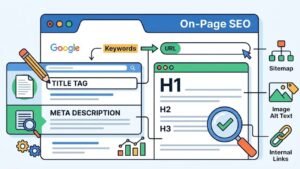

Most websites that lose organic traffic were never hit by a penalty. They simply kept doing five or six small things wrong for two years straight. That is the uncomfortable truth behind nearly every “Google killed my traffic” story, and it is why learning the common SEO mistakes to avoid is faster and cheaper than chasing the next algorithm rumor.
Search engines have changed dramatically, AI answers now sit above the blue links, and Google’s helpful-content systems quietly filter out pages that do not satisfy readers. The errors below are the ones costing real businesses real rankings right now, and almost all of them are fixable in weeks, not years.
Content and Intent: The Common SEO Mistakes to Avoid First
Content errors cause the most damage because they are invisible in a technical audit. The site looks healthy. The pages are indexed. The traffic just never comes.
1. Writing for Keywords Instead of People
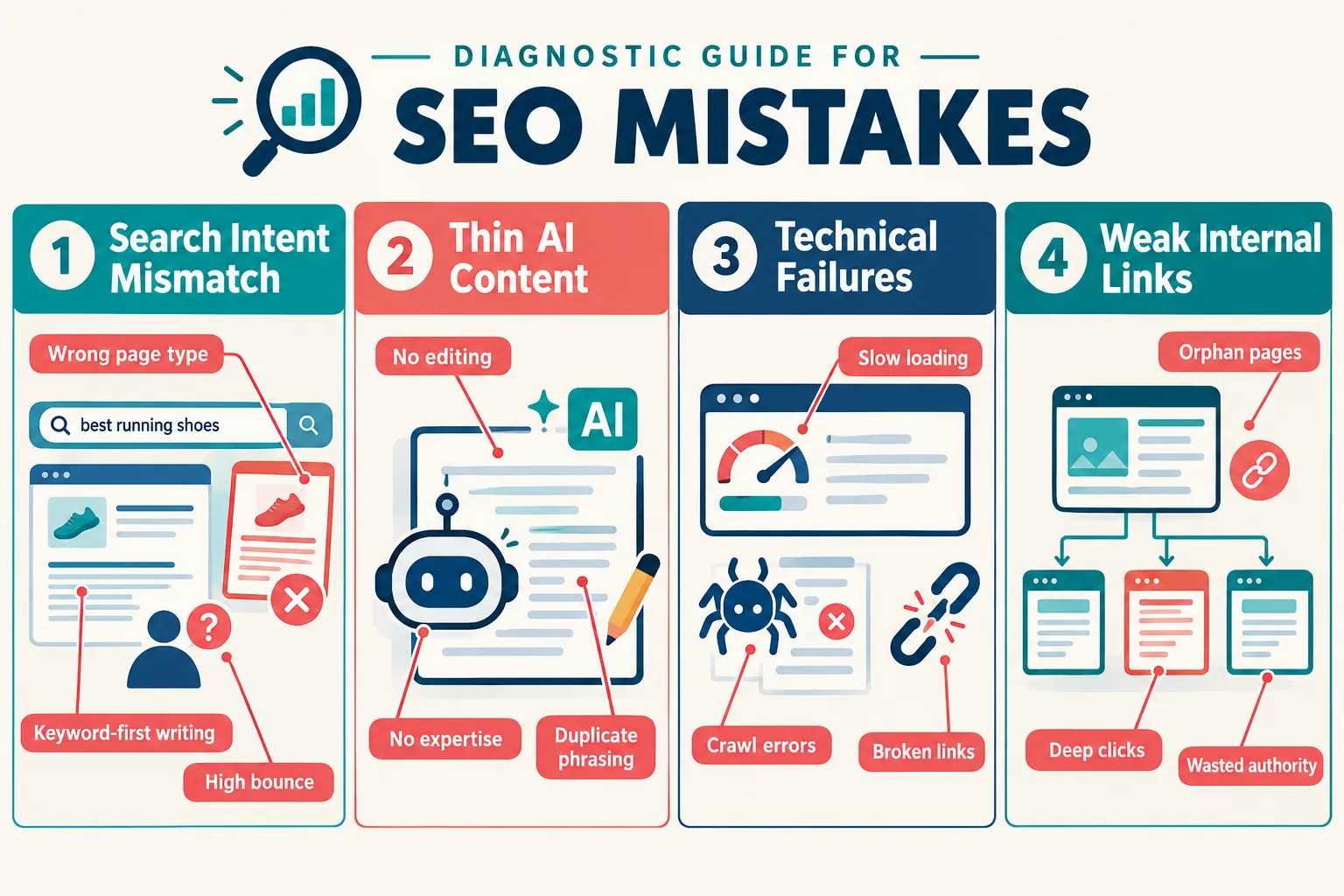
This is now the number one SEO mistake, full stop. A page targeting “best running shoes” that reads like a brand brochure will lose to a page that actually compares shoes, names tradeoffs, and helps someone decide.
Before writing, check what already ranks. If the top ten results are all comparison lists, a sales page will not break in. Match the format, depth, and angle searchers already reward.
Search intent is the contract. Your page either fulfills it or it does not, and Google measures the difference through behavior, not word count.
2. Publishing Thin or Unedited AI Content
AI drafting is fine. Shipping raw AI output is not. Pages that summarize what is already on page one, without adding data, examples, or genuine expertise, get filtered by helpful-content systems designed to detect low-value output at scale.
Fix it by adding what a machine cannot: original screenshots, customer numbers, process details, real quotes, and opinions earned through experience.
3. Ignoring Content Freshness and Updates
Content decays. Statistics age, screenshots break, and competitors publish something newer. Pages that once drove steady traffic slide quietly to position 15 because nobody touched them.
Build a simple quarterly refresh routine:
| Review Signal | Action to Take |
|---|---|
| Traffic down 30% year over year | Rewrite intro, update stats, add new sections |
| Rankings stuck on page 2 | Compare against top 3 results, close content gaps |
| Outdated year in title | Update year, dates, and examples |
| Broken or dead links | Replace with current sources |
4. Keyword Stuffing and Other Vintage Tactics
Repeating a phrase 40 times, hiding text, and cramming keywords into footers were obsolete a decade ago, yet these tactics are still surprisingly common, and increasingly risky. Modern search engines understand synonyms, entities, and topics. Natural writing with related terms outperforms forced repetition every single time.
5. Chasing Title-Tag Keywords While Skipping Real Expertise
Plenty of site owners obsess over title tags and meta descriptions while publishing shallow content underneath. Titles matter, but they are a small lever. What moves rankings now is content that satisfies the question completely and demonstrates who wrote it and why they are qualified.
Add author bios with credentials. Cite sources. Show your work.
Technical Common SEO Mistakes to Avoid During Any Audit
Technical problems rarely announce themselves. They just quietly cap how much traffic a site can earn.
6. Failing Core Web Vitals and Page Speed
Slow pages lose visitors before they read a word. Oversized images, bloated plugins, render-blocking scripts, and cheap hosting are the usual culprits.
Quick wins that almost always help:
- Compress and convert images to WebP
- Enable caching and a content delivery network
- Remove plugins you no longer use
- Defer non-critical JavaScript
- Set explicit image dimensions to stop layout shift
7. Treating Mobile as an Afterthought
Google indexes the mobile version of your site. If buttons are too small, text requires pinching, pop-ups cover content, or navigation breaks on a phone, rankings suffer across all devices. Test real pages on a real phone, not just a desktop browser resized.
8. Ignoring Crawl Errors and Broken Links
Crawl budget is finite. When search bots waste visits on 404s, redirect chains, and blocked resources, your important pages get crawled less often.
Check monthly for:
- 404 errors on pages that previously had links
- Redirect chains longer than one hop
- Pages accidentally blocked in robots.txt
- Noindex tags left on live pages after a redesign
- Broken outbound links in older posts
9. Mishandling Canonicals, Redirects, and Duplicate Content
This is one of the most underestimated common SEO mistakes to avoid. Duplicate URLs created by filters, parameters, pagination, and both HTTP and HTTPS versions split ranking signals across copies of the same page.
Make sure every piece of content has one canonical URL, that redirects point directly to the final destination, and that staging or print versions are not indexed.
10. Skipping Structured Data
Schema markup helps search engines, and AI answer engines, understand what your page is about. Missing schema for articles, products, FAQs, reviews, and local businesses means losing rich results that competitors are collecting.
Structure, Links, and Local Common SEO Mistakes to Avoid
11. Poor Site Architecture and Weak Internal Linking
A flat, logical structure helps both users and crawlers. Problems appear when categories sprawl, important pages sit five clicks deep, and new posts receive no internal links at all.
| Architecture Problem | Why It Hurts | Fix |
|---|---|---|
| Orphan pages | No link equity reaches them | Link from relevant hub pages |
| Pages 5+ clicks deep | Crawled rarely, seen as low priority | Flatten to 3 clicks or fewer |
| Generic anchor text | No topical signal | Use descriptive, natural anchors |
| No topic clusters | Authority stays scattered | Build pillar pages with supporting posts |
Aim for three to six contextual internal links per new article, pointing both to and from related content.
12. Buying Cheap, Bulk Backlinks
Low-quality link packages are easier to detect than ever, and spam-focused updates keep tightening. A hundred links from unrelated directories and private blog networks carry less value than three genuine mentions from respected industry sites, and they carry real risk.
Earn links instead through original research, useful free tools, expert commentary, and relationships with publications your audience already reads.
13. Neglecting Local SEO Basics
For any business serving a geographic area, this is the biggest missed opportunity on the list. An incomplete Google Business Profile alone can cost more traffic than a dozen blog posts could generate.
Local essentials worth fixing this week:
- Claim and fully complete your Google Business Profile
- Keep name, address, and phone consistent across every directory
- Add location-specific service and landing pages
- Request reviews steadily and reply to all of them
- Upload real photos regularly, not stock images
Strategy and Measurement Mistakes
14. Measuring Rankings Instead of Results
Ranking first for a keyword nobody converts on is a vanity metric. Traffic that never becomes an inquiry, signup, or sale does not grow a business.
Track these alongside positions:
- Organic conversions and conversion rate by landing page
- Assisted conversions from organic sessions
- Revenue or lead value per page
- Engaged sessions and scroll depth
- Branded search volume growth over time
15. Not Optimizing for AI Search and Answer Experiences
AI overviews, chat assistants, and answer engines increasingly intercept clicks before users reach a website. Pages built only for traditional blue links are losing visibility they never see in a rank tracker.
To stay visible in AI-driven results:
- Answer the core question clearly in the first 60 to 80 words
- Use descriptive headings phrased as real questions
- Add concise definitions, comparison tables, and step lists that are easy to extract
- Publish original data and specific examples that AI systems cite
- Keep entity information consistent across your site, profiles, and listings
A Simple 30-Day Correction Plan
Fixing everything at once is unrealistic. Sequence the work by impact.
| Week | Focus | Priority Actions |
|---|---|---|
| 1 | Technical triage | Fix crawl errors, broken links, redirect chains, indexing issues |
| 2 | Speed and mobile | Compress images, enable caching, test key pages on phones |
| 3 | Content audit | Identify decaying pages, match intent, refresh top 10 posts |
| 4 | Links and tracking | Add internal links, complete local profiles, set up conversion goals |
Final Thoughts
Organic growth rarely comes from one clever tactic. It comes from removing the friction that is already holding a site back, mismatched intent, thin pages, slow loading, broken links, scattered authority, and goals measured in the wrong currency. Every mistake on this list is self-inflicted, which means every one is within your control.
Start with a crawl of your own site this week. List every error you find, then rank the list by how many pages each problem touches. Fix the widest problems first, refresh your five highest-potential pages next, and add conversion tracking so you can prove what is working. Review progress every 30 days and reinvest in whatever moved the needle.
Search engines reward sites that make themselves easy to crawl, easy to understand, and genuinely worth reading. Avoid these mistakes consistently, and the traffic tends to follow faster than most people expect.