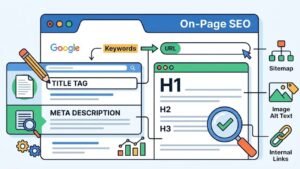

Content and search engine optimization generate roughly three times more leads than cold outbound at about 62% lower cost. That single data point explains why the most effective marketing strategies for startups rarely start with a big ad budget. They start with clarity, one channel, and a willingness to measure what real people actually do.
Most early-stage companies get this backwards. They spread a tiny budget across six platforms, post inconsistently on all of them, and conclude that “marketing doesn’t work.” The startups that break through do the opposite. They pick one audience, one channel, one offer, and they grind until the numbers move.
Why Most Marketing Strategies for Startups Fail
The failure is almost never the tactic. It’s the lack of focus. A founder reads that LinkedIn works, TikTok works, cold email works, and SEO works. All true. But a two-person team running four channels at 25% effort produces four weak channels. Nothing compounds. Nothing reaches the threshold where it starts to pay back.
The goal in year one is not to be everywhere. It’s to find one channel that works, then make it work twice as hard.
The second common failure is chasing vanity metrics. Impressions, followers, and page views feel good. They rarely predict revenue. Clicks, sign-ups, demo bookings, and trial-to-paid conversion do.
Build Your Minimum Viable Marketing Stack
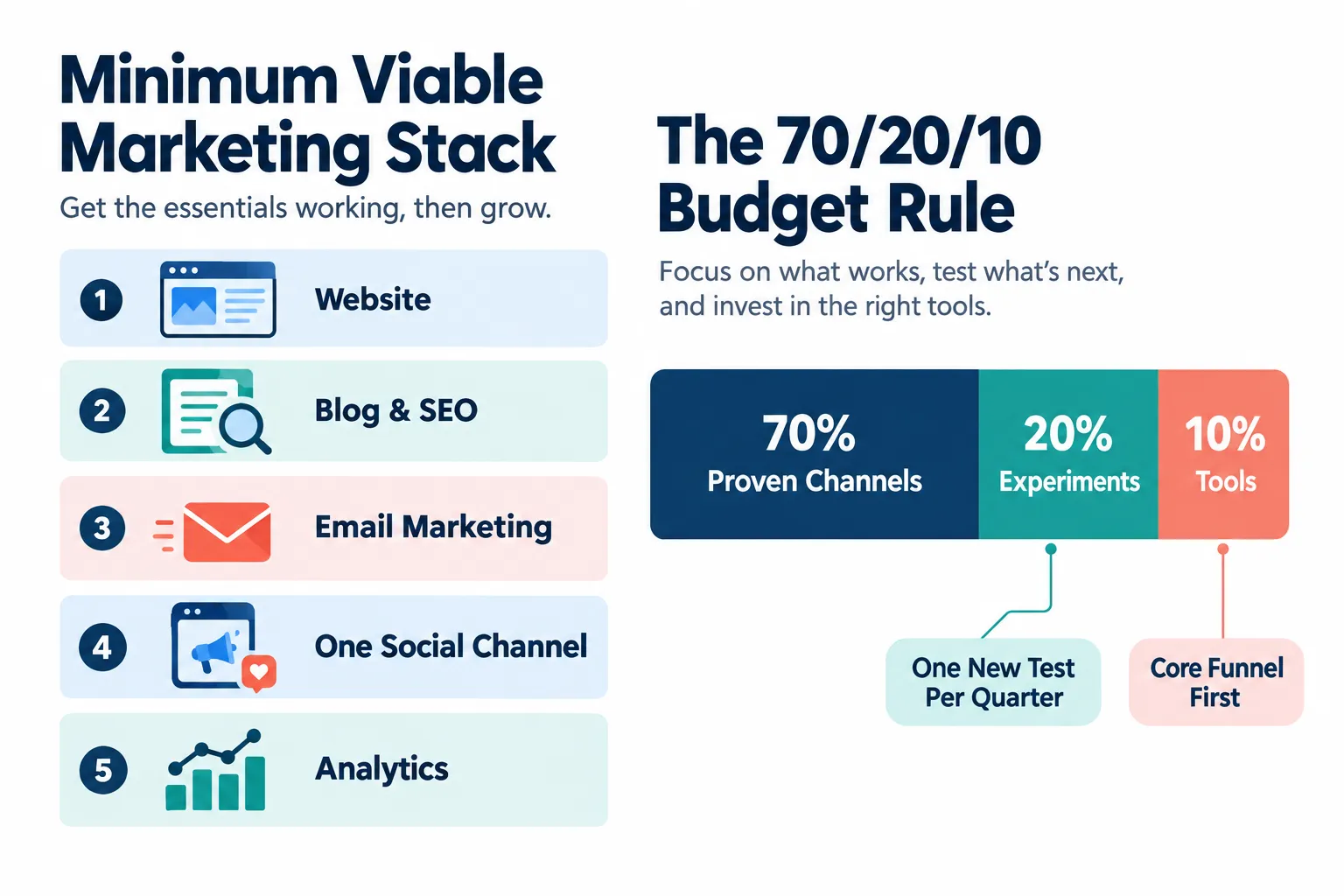
Before any clever tactic, you need infrastructure. The baseline stack for a bootstrapped startup in 2026 is simple and deliberately small.
| Stack Element | Purpose | Priority |
|---|---|---|
| Fast, clear website | Converts interest into action | First |
| Blog with SEO basics | Compounding organic traffic | First |
| Email list and automation | Owned audience, nurture | Second |
| One or two social channels | Distribution and credibility | Second |
| Basic analytics | Tells you what to repeat | Ongoing |
Recent data shows the website, blog, and SEO combination producing the strongest return of any channel group. Email marketing is tied as the second-most-used channel and ranks fifth for overall ROI, while paid social delivers the second-highest ROI when budgets are tight.
Notice what’s missing: a podcast, a community, six social profiles, and a billboard. Those can come later. Expand gradually, not all at once.
Pick One Systematic Content Channel
A useful rule: start with exactly one content channel, either a blog or LinkedIn, not both. Running two from day one almost always means both get sloppy. Once you can prove your team holds quality and cadence for 90 days straight, add the second.
The Focus-First Framework
The strongest playbooks share a design principle that’s easy to say and hard to follow.
- One core audience: Not “small businesses.” Something like “operations managers at 20-to-80-person logistics firms.”
- One primary acquisition channel: Where that audience already spends attention.
- One supporting retention channel: Usually email, sometimes a private community.
- One clear offer: A single next step with an obvious reason to take it.
From there, run tight loops: form a hypothesis, build the smallest possible test, measure real behavior, decide. One landing page. One outreach sequence. One content angle. Measure clicks, sign-ups, and demos, then double down on whatever earns its keep.
Validation Comes Before Promotion
If you haven’t had roughly 30 real conversations with target customers, marketing is premature. Those conversations give you the exact language your buyers use to describe their problem. That language becomes your headlines, your ad copy, and your keyword list. Skipping this step is why so many startup websites sound identical and convert poorly.
Content Marketing Strategies for Startups That Compound
Random blogging doesn’t compound. Structured content systems do.
Build two or three core topic clusters. Each cluster gets one pillar page covering the broad topic, plus 10 to 20 supporting articles targeting specific long-tail questions. Anchor every cluster to your main value proposition, so traffic you earn is traffic that can actually convert.
Three content types deserve priority:
- Problem-solving content: Names the pain sharply, before the reader is shopping for a solution. This creates demand.
- Decision-stage content: Compares approaches, tools, or categories. This captures demand that already exists.
- Execution content: Shows exactly how to implement the solution with less friction. This builds trust and reduces buying hesitation.
Optimize for AI Search, Not Just Google
Search results increasingly include AI-generated answers. Answer engine optimization (AEO) means structuring content so machines can extract and cite it: clear question-based headings, direct answers in the first two sentences of a section, short definitions, comparison tables, and clean formatting. Startups that ignore this will slowly lose discoverability even if their traditional rankings hold.
Target Low-Difficulty, High-Intent Keywords
Don’t fight established competitors for broad head terms. Find long-tail phrases with low competition and obvious buying intent. A smart extra move: use those same keyword topics as the hook for cold outreach messaging. Your search content and your outbound then reinforce each other instead of running on separate tracks.
Positioning First, Pipeline Second, SEO Third
For B2B SaaS and similar startups, the recommended order is blunt: nail positioning first, build pipeline second, build SEO third. Positioning means answering two questions in one sentence each: who exactly do you serve, and why are you different? Get this from interviews, not a brainstorm. Then use cold outbound for near-term revenue while SEO content compounds quietly in the background for the next six to twelve months.
Four pillars show up repeatedly in B2B startup marketing that works:
- Clear positioning that a stranger can repeat after one read.
- Multi-channel presence where buyers already are: LinkedIn, industry newsletters, webinars.
- Data-driven personalization, using behavior to time your outreach.
- Relationship-building through value-first content, not constant pitching.
Consistency in two buyer-specific channels beats scattered activity across eight trendy platforms.
Budget Allocation: The 70/20/10 Rule
Lean budgets need discipline more than creativity. The allocation that holds up:
| Share | Goes Toward | Examples |
|---|---|---|
| 70% | Proven high-ROI channels | Content, SEO, email |
| 20% | Emerging or experimental | Influencer, community, AEO tools, paid social tests |
| 10% | Tools and infrastructure | Analytics, CRM, automation |
One more guardrail: reserve 10 to 20% of total marketing spend to test exactly one new channel per quarter. One at a time. This keeps experiments from cannibalizing the acquisition you already depend on, and it gives each test enough budget to produce a real signal.
Balance Paid, Earned and Owned Media
Each media type does a different job, and relying on one creates fragility.
- Paid media buys immediate visibility. Fast, but stops when spending stops.
- Earned media (PR, word of mouth, reviews) buys credibility you can’t manufacture.
- Owned media (website, email list, evergreen content) builds durable assets that compound.
Test across all three until one channel proves it can act as a genuine growth lever. Then double down hard, and let the others support that engine rather than compete with it.
Scale with Referrals, Partnerships, and Paid
Once organic presence produces steady traction, layer on amplifiers:
- Referral programs that reward existing users for bringing peers.
- Influencer and creator partnerships with niche voices your buyers already trust.
- Paid ads pointed at your highest-converting pages, not your homepage.
- Offline promotion: targeted events, meetups, and industry gatherings where your ICP gathers.
The sequence matters. Paid amplification applied to a broken funnel just burns cash faster.
Shift from Lead Volume to Buyer Conviction
Here’s a change worth planning around. B2B sales cycles shortened from 25 weeks to 19 weeks in a single year. Contract structures loosened too: sub-one-year deals climbed from 4% to 13%, while three-year contracts fell from 28% to 23%.
Buyers are moving faster but committing to less. That rewards marketing built on conviction, not volume. Practically, that means investing in:
- Case studies with specific, named outcomes.
- ROI narratives that quantify the cost of inaction.
- Differentiation messaging that makes the choice obvious in under a minute.
Optimize the Funnel, Not Just the Traffic
Once traffic exists, the highest-leverage work moves downstream. This is where founders graduate from “more visitors” thinking to “better economics” thinking, which investors increasingly expect.
Core moves:
- Conversion rate optimization and A/B testing on landing pages, headlines, and calls to action.
- LTV:CAC tracking so you know whether growth is profitable or just expensive.
- Personalized subject lines and automated nurture sequences that walk prospects from validation to consideration to purchase.
- Simple KPIs reviewed weekly: traffic, click-through, sign-ups, activation, trial-to-paid.
A 1% to 3% lift in conversion often beats a 30% traffic increase, and it costs far less to achieve.
Final Thoughts
The best marketing strategies for startups aren’t exotic. They’re focused, measured, and repeated long enough to compound. Content and SEO form the foundation because they generate more leads at lower cost than almost anything else available to a lean team. Everything else should support that engine.