Only 0.63% of Google searchers click on a result from page two. That single statistic explains why so many business owners pour resources into SEO, and why the question of how long does SEO take to show results keeps them up at night.
The honest answer is more nuanced than most agencies admit: early signals can appear within weeks, but the meaningful traffic and revenue growth that justify the investment typically take six to twelve months to materialize. Understanding exactly what happens at each stage of that journey is the difference between staying the course and pulling the plug too soon.
Why There Is No Single Answer to How Long Does SEO Take to Show Results
SEO does not work like paid advertising, where spending money today produces clicks tomorrow. Search engines need time to crawl, index, and evaluate content before ranking it. Several variables determine how quickly that process unfolds.
The main factors that affect your timeline:
- Domain age and authority: A brand-new domain with zero backlinks starts from scratch. An established site with existing authority can see results in weeks rather than months.
- Technical health: Sites with crawl errors, slow page speed, or duplicate content force search engines to work harder. Fixing these issues first is not optional, it is foundational.
- Content quality and volume: Thin, outdated, or missing content means there is nothing for Google to rank. A robust content library gives the algorithm more to work with.
- Competition level: Ranking for “plumber in Austin” is a different challenge than ranking for “best CRM software.” Competitive niches require more time and resources.
- Starting condition: A site that has never been optimized will see faster early gains than one that has already captured the low-hanging fruit.
“The single biggest mistake business owners make is judging SEO by month-two results. The compounding returns do not start until month six.”
A Month-by-Month SEO Timeline: What to Expect
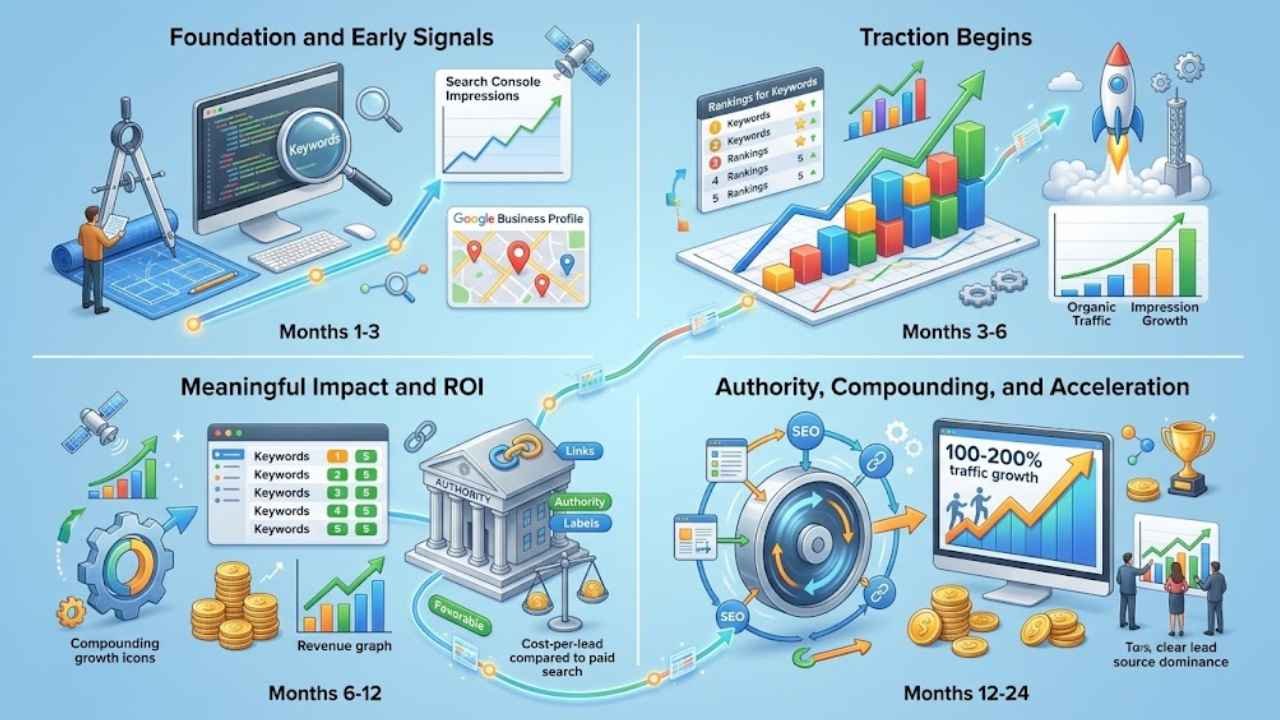
Breaking the journey into phases makes the process far less abstract. Here is what a well-executed SEO program typically looks like from launch through the end of year two.
Months 1-3: Foundation and Early Signals
This phase is mostly invisible to the casual observer, but it is the most critical. During this window, the focus is on technical audits, keyword research, on-page optimization, and initial content creation.
What typically happens:
- Google begins re-crawling and re-indexing updated pages
- Impressions in Google Search Console start to climb
- A handful of long-tail keywords may enter the top 50 rankings
- Local listings (Google Business Profile) begin showing early map pack signals within four to twelve weeks
Traffic gains in this phase are modest. A 10-20% lift in organic impressions is a realistic and positive early indicator. Do not expect phone calls to spike yet.
Months 3-6: Traction Begins
This is where the work starts to pay off in visible ways. Rankings for target keywords begin moving into the top 20 and, for less competitive terms, into the top 10.
Benchmarks to watch:
| Metric | Realistic Range (Months 3-6) |
|---|---|
| Organic traffic lift | 20-50% above baseline |
| Impression growth | 50-100% above baseline |
| Keywords in top 20 | Noticeable increase |
| Local lead flow | Early to moderate growth |
For local businesses, months four through nine are when Google Maps rankings tend to solidify and lead flow becomes consistent. This is also when content published in months one and two starts earning backlinks organically.
Months 6-12: Meaningful Impact and ROI
The six-month mark is a turning point. Sites that have executed consistently start seeing compounding returns. Authority builds on itself. Content that ranked at position 15 in month four may reach position four or five by month nine.
What strong execution looks like in this phase:
- Organic traffic lifts of 50-80% above pre-SEO baseline
- Impression growth of 100-150% or more
- Multiple keywords ranking in the top five positions
- Measurable revenue attribution to organic search
- Backlink profile growing steadily
This is also when the ROI calculation starts to look favorable. Businesses that stuck with their SEO strategy through the difficult early months begin to see cost-per-lead figures that compare favorably to paid channels.
Months 12-24: Authority, Compounding, and Acceleration
Year two is where SEO truly separates itself from other marketing channels. Authority compounds. Pages that ranked well begin earning more backlinks, which pushes rankings higher, which earns more traffic, which attracts more links. This flywheel effect is why mature SEO programs often deliver their best returns in years two and three, not year one.
Traffic growth of 100-200% above the original baseline is achievable for sites that have invested consistently. At this stage, organic search often becomes the single largest traffic and lead source for small and mid-sized businesses.
How Starting Conditions Change Everything
Two businesses can launch SEO programs on the same day and see wildly different timelines. Starting conditions are the primary reason why.
- Scenario A, New Website, New Domain: Expect six to twelve months before meaningful rankings appear. Google applies an informal trust-building period to new domains. Early months should focus heavily on technical setup, content creation, and earning initial backlinks.
- Scenario B, Established Site, No Prior SEO: An older domain with existing traffic but no optimization work is a different opportunity. Quick wins from fixing technical issues and optimizing existing pages can produce visible results in sixty to ninety days.
- Scenario C, Competitive Niche, Established Site: Even with domain authority, competing in a crowded vertical takes time. Expect the full three-to-six-month window before meaningful movement, with strong results arriving closer to month nine or twelve.
Local SEO vs National SEO: Different Clocks
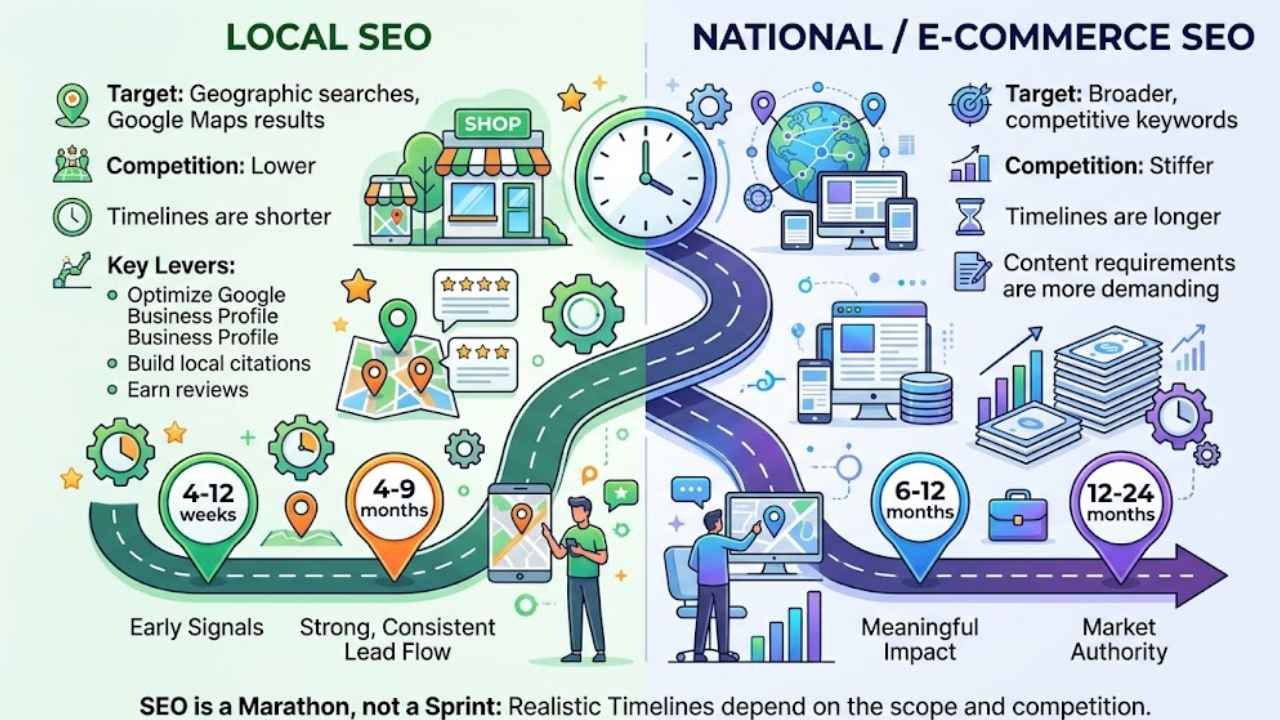
Local SEO and national (or e-commerce) SEO operate on different timelines.
Local SEO targets geographic searches and Google Maps results. Because competition is typically lower and the ranking signals are more localized, early signals can appear in four to twelve weeks. Strong, consistent lead flow usually arrives between months four and nine. Optimizing a Google Business Profile, building local citations, and earning reviews are the fastest-moving levers available to local businesses.
National or e-commerce SEO targets broader, more competitive keywords. The timeline is longer because the competition is stiffer and the content requirements are more demanding. Realistic expectations sit at six to twelve months for meaningful impact and twelve to twenty-four months for market authority.
What About AI and Faster Indexing in 2026?
AI-powered SEO tools and faster indexing pipelines have changed some of the mechanics, but they have not rewritten the fundamental timeline. Early signals, initial impressions, crawl activity, a few long-tail rankings, can now appear in as little as two to four weeks with well-structured, authoritative content.
However, sustained authority still takes three to six or more months to build. Search engines are evaluating trust, relevance, and user engagement signals over time. No tool or tactic shortcuts that evaluation process entirely. The 2026 consensus among practitioners and agencies remains consistent: three to six months for initial results, six to twelve months for meaningful impact.
Red Flags and Realistic Expectations
Be cautious of any agency or consultant that promises:
- First-page rankings in thirty days for competitive keywords
- Guaranteed traffic numbers before auditing your site
- Results without a content strategy
Healthy early indicators that work is progressing:
- Rising impressions in Google Search Console
- Crawl errors decreasing month over month
- New keywords appearing in tracking tools
- Page speed scores improving
- Backlink count growing steadily
Final Thoughts
The question of how long does SEO take to show results has a clear, evidence-based answer for 2026: plan for three to six months to see early movement, six to twelve months for meaningful ROI, and twelve to twenty-four months for compounding authority that outperforms most other marketing channels.
Actionable next steps to start today:
- Run a technical audit to identify and fix crawl errors, speed issues, and indexing problems
- Conduct keyword research focused on terms your target customers actually search
- Publish high-quality, search-optimized content consistently, at minimum two to four pieces per month
- Claim and optimize your Google Business Profile if you serve a local market
- Track progress monthly using Google Search Console, not just traffic dashboards
- Set internal expectations with leadership or clients using the phase-based timeline above
Businesses that treat SEO as a long-term asset rather than a short-term campaign are the ones that dominate search results two years from now. The compounding returns are real, but only for those who stay consistent long enough to earn them.