Fewer than 1% of Google searchers click to page two of results, which means if your pages are not ranking on page one, they are effectively invisible. For website owners and marketers trying to grow without paying for every click, learning how to increase organic traffic is not optional. It is the difference between a site that compounds value over time and one that flatlines the moment ad budgets run dry.
The search landscape in 2026 looks meaningfully different from even two years ago. AI Overviews now answer many commercial queries before a user ever clicks a link. Core and spam updates have punished thin, aggregated content. And topical authority has replaced keyword stuffing as the primary signal separating winners from losers. This guide breaks down exactly what works right now.
Why Organic Traffic Still Matters in 2026
Paid traffic stops the moment the budget stops. Organic traffic, built correctly, keeps compounding. A well-ranked page can generate qualified visitors for months or years with no additional spend.
That said, the rules have shifted. Google’s 2026 core updates heavily favor authoritative, first-party content over thin aggregators. Sites that relied on scaled, low-value AI output have seen significant ranking drops after the June and August 2026 spam updates. The opportunity is real, but only for sites that earn it.
“Organic growth in 2026 is a long game that rewards depth, trust, and genuine usefulness, not volume.”
How to Increase Organic Traffic Through Topical Authority
One of the most reliable ways to grow organic traffic today is to become the definitive resource on a topic, not just a page that mentions it.
What topical authority means in practice:
- Cover a subject end-to-end with interconnected content
- Answer the full range of questions a reader might have, from beginner to advanced
- Cluster related articles together and link them intentionally
Search engines in 2026 evaluate whether a site genuinely owns a topic. A single well-written article rarely outranks a site with 15 tightly clustered, interlinked pieces on the same subject.
Content Clustering: The Architecture of Authority
A content cluster has three parts:
| Component | Role | Example |
|---|---|---|
| Pillar page | Broad overview of the main topic | “Complete Guide to Content Marketing” |
| Cluster pages | Deep dives into subtopics | “How to Write a Content Brief” |
| Internal links | Connect cluster to pillar and vice versa | Contextual anchor text links |
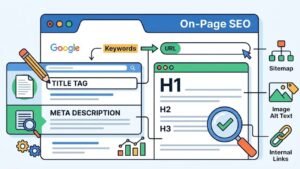
Strong internal linking is one of the most underused levers for organic growth. It distributes page authority, helps search engines understand site structure, and keeps users engaged longer.
Fix Before You Publish: The Content Audit Advantage
Most sites already have content that could rank, it just needs work. Auditing and improving existing pages often delivers faster traffic gains than writing new ones from scratch.
Signs a page needs attention:
- Ranking in positions 8-20 but not converting (low-hanging fruit for optimization)
- High impressions in Search Console but low click-through rates
- Outdated statistics, broken links, or thin word counts
- Missing schema markup or meta descriptions
A structured content audit should happen at least twice per year. Prioritize pages with existing impressions first, they are already partially trusted by search engines.
E-E-A-T and Entity Signals: The Trust Layer
Google’s E-E-A-T framework (Experience, Expertise, Authoritativeness, Trustworthiness) is not a ranking factor in isolation, it is a lens through which content quality is evaluated. In 2026, entity signals matter alongside traditional links.
How to strengthen E-E-A-T signals:
- Add detailed author bios with credentials and real names
- Include first-hand experience, original data, or proprietary research
- Earn brand mentions across trusted publications, even without a link
- Use original visuals, charts, and photography instead of stock images
- Build a consistent brand presence that generates direct search demand
Branded search volume, people searching for your company or product by name, is increasingly treated as a trust signal. Growing branded demand through PR, community engagement, and social presence feeds back into organic rankings.
How to Increase Organic Traffic With Keyword Strategy in 2026
Keyword research has not disappeared, it has evolved. The goal is no longer to target isolated keywords but to map intent comprehensively.
Target Emerging and Hyper-Local Keywords
Capturing demand before it peaks is a significant competitive advantage. Tools like Google Trends, Reddit, and niche forums surface rising topics weeks or months before mainstream keyword tools reflect them.
Hyper-local and community-intent keywords are also underutilized. Searches like “best accountant for freelancers in Austin” or “gluten-free bakery near downtown Denver” have lower competition and higher conversion intent than broad national terms.
Optimize for AI Overviews and Featured Snippets
AI Overviews are now a permanent fixture in search results. They pull from authoritative, well-structured content. To appear in them:
- Use clear question-and-answer formatting
- Include concise definitions and summaries near the top of articles
- Structure content with descriptive H2 and H3 headings
- Add FAQ sections where relevant
Being cited in an AI Overview does not always generate a direct click, but it builds brand visibility and trust at scale.
Technical SEO: The Foundation That Cannot Be Skipped
No content strategy works on a slow, poorly structured site. Technical SEO creates the conditions for everything else to succeed.
Core technical priorities in 2026:
- Core Web Vitals, page speed, interactivity, and visual stability remain ranking signals
- Mobile-first indexing, Google indexes the mobile version of pages first
- Crawl budget management, ensure search engines are not wasting crawl time on low-value URLs
- Structured data/schema, helps search engines understand content type and context
- HTTPS and site security, a baseline requirement, not a differentiator
Run a technical audit using tools like Google Search Console, Screaming Frog, or Ahrefs at least quarterly. Fix crawl errors and redirect chains before investing in new content.
External Signals: Links, Mentions, and AI Citations
Link building remains important, but the definition of “external signal” has expanded. In 2026, search engines evaluate:
- Traditional backlinks from relevant, authoritative domains
- Unlinked brand mentions across the web
- Citations within AI search ecosystems, being referenced in AI-generated answers builds entity authority
The most durable link-building strategies focus on earning links through original research, data-driven content, expert commentary, and digital PR. Buying links or using private blog networks remains a fast path to penalties.
Measurement and Diagnosis: How to Increase Organic Traffic Intelligently
Reacting to every algorithm update with sweeping site changes is one of the most common, and costly, mistakes. A diagnosis-first approach protects against unnecessary churn.
Build a measurement baseline:
- Track organic sessions, impressions, clicks, and average position by page segment
- Segment branded vs. non-branded traffic separately
- Monitor Core Web Vitals scores over time
- Set up rank tracking for your top 20-30 target keywords
When traffic drops, diagnose before acting. Was it a core update? A technical issue? A SERP feature change that reduced clicks without reducing impressions? The answer determines the response.
“Data tells you what changed. Diagnosis tells you why. Only then can you decide what to do.”
Ecommerce and Merchant Considerations
For ecommerce sites and merchants, organic strategy in 2026 must extend beyond standard SEO. Google’s AI-driven shopping results pull data directly from Merchant Center feeds. Keeping product titles, descriptions, pricing, and availability accurate and optimized in Merchant Center is now part of organic visibility, not just paid shopping.
Product page SEO should also align with the same E-E-A-T principles as editorial content: original product photography, detailed specifications, genuine customer reviews, and clear return policies all contribute to trust signals.
Final Thoughts
Growing organic traffic in 2026 requires a disciplined, multi-layered approach. The sites gaining ground are those that invest in topical depth, fix what already exists, earn genuine trust signals, and measure with precision before making changes.
Actionable next steps to start this week:
- Run a content audit in Google Search Console, identify pages ranking 8-20 and prioritize them for optimization
- Map your top five topics into content clusters and identify gaps
- Audit internal links on your highest-traffic pages and add contextual links to related content
- Review author bios and on-page trust signals across key landing pages
- Check Core Web Vitals scores and fix any pages flagged as “Poor”
Organic growth is not a sprint. It is a compounding asset. Every improvement made today builds the foundation for traffic that arrives months and years from now, without paying for every click.