Every second you spend in combat, a number is quietly running in the background, tracking exactly how hard you hit, how fast you hit, and whether your team can win. That number is DPS, and understanding it can change how you play almost any game.
DPS in gaming is one of the most used terms across RPGs, MMOs, MOBAs, and competitive shooters. Yet many players hear it daily without fully grasping what it means. This guide breaks it all down clearly.
The Three Meanings of DPS in Gaming
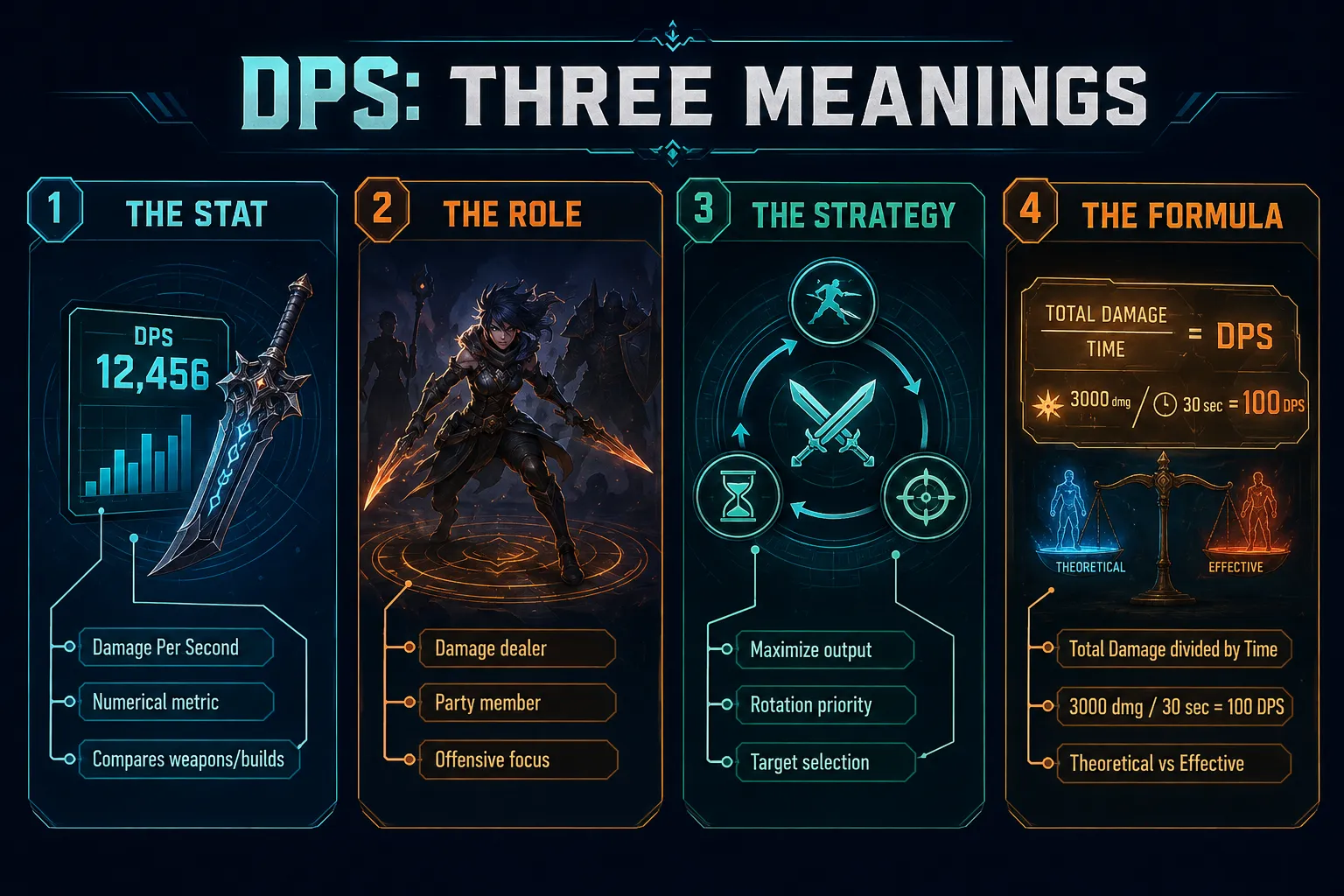
Most gaming terms have one definition. DPS has three, and knowing all three is what separates casual players from informed ones.
1. DPS as a Stat: At its core, DPS means damage per second. It is a number that tells you how much damage a weapon, skill, or character deals on average every single second. A sword that deals 3,000 damage over 30 seconds has a DPS of 100. Simple math, powerful insight.
This stat lets players compare gear, abilities, and builds side by side. Instead of guessing which weapon is stronger, you can look at DPS and know instantly.
2. DPS as a Role: In multiplayer games, especially MMORPGs, “a DPS” refers to a player whose job is to deal damage. This is distinct from a tank (who absorbs hits) or a healer (who keeps the group alive). The DPS player focuses almost entirely on killing enemies as fast as possible.
When someone posts “LFG as DPS” in a group chat, they are not sharing a number. They are saying: I play the damage role, and I am looking for a team.
3. DPS as a Strategy: Some guides describe DPS as a playstyle, a strategic approach that puts offensive output above survival or utility. A DPS-focused build sacrifices defense or crowd control to maximize raw damage. This is a deliberate choice that shapes how an entire character is built and played.
How DPS is Calculated
Understanding the math behind DPS helps players make smarter decisions about gear and builds.
The basic formula is straightforward:
DPS = Total Damage / Time (in seconds)
So if a character deals 500 damage in 5 seconds, their DPS is 100.
Players can test this in-game by attacking a training dummy or enemy for a fixed window, say, 10 seconds, then dividing the total damage shown by 10. Many games include built-in damage meters or combat logs that do this automatically.
Theoretical DPS vs. Effective DPS
Here is where things get more interesting. There are two types of DPS every player should know:
| Type | What It Measures | Real-World Accuracy |
|---|---|---|
| Theoretical DPS | Maximum output under perfect conditions | Low, assumes no downtime |
| Effective DPS | Actual output during real gameplay | High, accounts for real conditions |
Theoretical DPS assumes a player is always attacking, never moving, never dying, and never switching targets. In reality, that never happens.
Effective DPS accounts for:
- Time spent moving or repositioning
- Deaths and respawn delays
- Crowd control effects (stuns, freezes)
- Target switching mid-fight
- Latency and input lag
A character with 200 theoretical DPS but constant movement penalties may actually deliver less damage than a character with 150 theoretical DPS but smooth, uninterrupted rotations. The lower number wins in practice.
This is why experienced players treat DPS as a diagnostic tool rather than a trophy. High numbers on a meter mean little if positioning is poor or ability rotations are sloppy.
DPS and the Holy Trinity of Team Roles
Almost every team-based game is built around three core roles. This structure is called the “holy trinity” and it has been a foundation of MMORPG design since the early days of World of Warcraft.
- Tank, Absorbs damage, holds enemy attention, protects the group
- Healer, Restores health, removes debuffs, keeps the team alive
- DPS, Deals damage, eliminates enemies, drives offensive progress
DPS players carry most of the offensive workload. Without them, a group can survive but cannot win. Without tanks and healers, DPS players die before they can deal meaningful damage.
This interdependence is why team composition matters so much. A group stacked entirely with DPS characters will melt through enemies but fall apart the moment a boss hits back hard.
DPS Across Different Game Genres
The term originated in MMORPGs but has since spread across nearly every genre.
- MMORPGs (World of Warcraft, Final Fantasy XIV): DPS is deeply embedded here. Damage meters and combat logs let players track DPS across entire boss fights. Raid groups often require a specific number of DPS players to meet damage thresholds before timers expire.
- MOBAs (League of Legends, Dota 2): Certain champions or heroes are classified as DPS or “carries”, characters built to deal sustained damage, especially in late-game team fights.
- Hero Shooters (Overwatch): The community groups many offense and defense heroes under the DPS label, even when official role names differ. The core idea remains the same: these characters exist to eliminate opponents.
- Action RPGs and Looter Shooters: DPS comparisons drive gear decisions. Players constantly min-max builds to squeeze out higher damage numbers.
Some communities use the term “DD” (damage dealer) interchangeably with DPS, but damage per second remains the dominant and more precise term across all genres.
Tips for Playing the DPS Role Effectively
Being a strong DPS player goes beyond picking the highest damage number on a stat sheet.
- Master your rotation, Most DPS characters have an optimal sequence of abilities. Learn it and practice until it becomes automatic.
- Prioritize the right targets, High DPS means nothing if you are attacking the wrong enemy. Focus on priority targets that threaten your team.
- Manage positioning, Staying in range while avoiding damage keeps your uptime high and your effective DPS close to theoretical.
- Use damage meters as feedback, Tools like combat logs show where output drops. Use that data to improve, not to brag.
- Communicate with your tank and healer, DPS players depend on support. Acknowledging that dependency makes the whole team better.
Final Thoughts
DPS in gaming is more than a three-letter abbreviation. It is a measurement, a role, and a way of thinking about combat. Whether comparing two weapons, filling a slot in a raid group, or optimizing a build for ranked play, DPS shapes decisions at every level of the game.
The most actionable next step is simple: open your game’s combat log or equip a damage meter if one is available. Watch your DPS across a few fights. Notice where numbers drop and ask why. That habit, treating DPS as a diagnostic tool rather than a score, is what separates players who grow from players who plateau.
Start tracking. Start improving. The numbers will tell you exactly where to go next.