
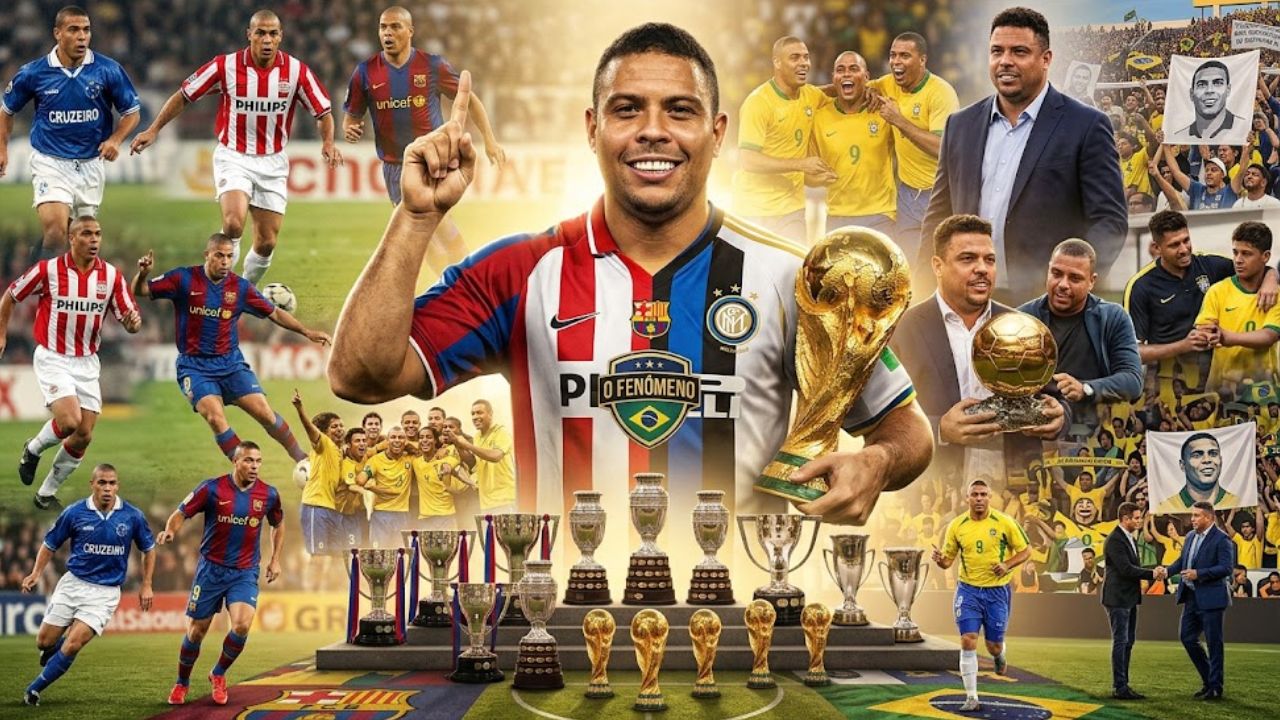
At age 17, Ronaldo Nazário scored 44 goals in 47 games for Cruzeiro, a rate that most professional strikers never approach across an entire career. That single statistic captures something essential about the Ronaldo Nazário career: it was not merely great, it was historically explosive, producing numbers that analysts still use as benchmarks for peak striker performance in the modern era.
From a favela in Bento Ribeiro, Rio de Janeiro, to back-to-back World Cup winner’s medals, Ronaldo’s journey reshaped what football fans believed a centre-forward could do. His story is one of extraordinary talent, devastating injuries, remarkable comebacks, and a legacy that continues to influence the sport in 2026.
Early Life and the Making of a Prodigy
Ronaldo Luís Nazário de Lima was born on September 18, 1976, in Rio de Janeiro, Brazil. Growing up in modest circumstances, he found football as both escape and calling. By his early teens, it was clear he possessed something rare: a combination of explosive pace, natural finishing instinct, and low centre of gravity that made him almost impossible to defend in one-on-one situations.
He joined Cruzeiro as a teenager and immediately produced numbers that defied belief. In the 1993-94 season, he registered 44 goals in 47 games, helping the club win the Copa do Brasil. Those performances earned him a place in Brazil’s 1994 World Cup squad, where he was a non-playing member of the championship-winning team, a detail that would add a quiet footnote to his eventual two-winner’s-medal tally.
Ronaldo Nazário Career at PSV and Barcelona: A Star Is Born
PSV Eindhoven (1994-1996)
After the 1994 World Cup, Ronaldo moved to PSV Eindhoven in the Netherlands. The transition to European football did nothing to slow him down. In his first PSV season, he scored 35 goals in 36 games, then followed that with 19 goals in 21 games the following campaign before Barcelona came calling. He also won the KNVB Cup during his time in Eindhoven, adding silverware to his growing reputation.
Barcelona (1996-97): The Greatest Single Season
The 1996-97 Ronaldo Nazário career chapter at Barcelona stands apart from almost anything else in football history. Across all competitions, he scored approximately 47 goals in 49 appearances, a rate that even the most prolific modern forwards rarely sustain over a full season.
That year, Barcelona won three major trophies: the Copa del Rey, the UEFA Cup Winners’ Cup, and the Supercopa de España. Ronaldo was the driving force behind all three, collecting his first Ballon d’Or and FIFA World Player of the Year award in the process.
“His 1996-97 Barcelona campaign, roughly 47 goals in 49 games, remains a cornerstone data point in any serious debate about the greatest strikers of all time.”
Despite this extraordinary season, a contractual dispute led to his departure after just one year. Barcelona’s loss would become Inter Milan’s gain.
Inter Milan and the Peak of “O Fenômeno”
Ronaldo joined Inter Milan in the summer of 1997 for what was then a world-record transfer fee. The 1997-98 season at Inter showed he had lost nothing in the move: 34 goals in 47 appearances, plus a UEFA Cup title. He won his second Ballon d’Or that year, cementing his status as the best player on the planet.
| Club | Season | Apps | Goals |
|---|---|---|---|
| Cruzeiro | 1993-94 | 47 | 44 |
| PSV Eindhoven | 1994-95 | 36 | 35 |
| Barcelona | 1996-97 | 49 | 47 |
| Inter Milan | 1997-98 | 47 | 34 |
Then came the injuries. A series of devastating knee problems, beginning with a patellar tendon rupture in 1999, robbed Ronaldo of what should have been his most dominant years. He missed nearly three full seasons, underwent multiple surgeries, and faced genuine uncertainty about whether he would ever play at the top level again.
The 1998 World Cup: Triumph, Tragedy, and Mystery
The 1998 FIFA World Cup in France brought Ronaldo to the world’s largest stage, but it also produced one of football’s most enduring mysteries. He scored 4 goals in 7 matches as Brazil reached the final against host nation France.
On the eve of the final, Ronaldo suffered a convulsive episode, was briefly left off the team sheet, then reinstated. Brazil lost 3-0 to France. The exact circumstances of that night have never been fully explained, and they remain a haunting footnote to an otherwise brilliant tournament for the young striker.
Ronaldo Nazário Career Resurrection: The 2002 World Cup
No chapter of the Ronaldo Nazário career is more celebrated than his performance at the 2002 FIFA World Cup in South Korea and Japan. Having fought back from multiple knee surgeries, he arrived at the tournament carrying doubt from many corners of the media. What followed was a masterclass in finishing.
Ronaldo scored 8 goals in 7 matches, including both goals in the final against Germany. He won the Golden Boot as the tournament’s top scorer, Brazil won the championship, and the famous two-line haircut became one of the most recognizable images in World Cup history.
Key 2002 World Cup facts:
- 8 goals in 7 matches, the tournament’s top scorer
- Both goals in the 2-0 final victory over Germany
- Won the Golden Boot and Golden Ball
- Ended Brazil’s four-year wait for a fifth World Cup title
At the 2006 World Cup in Germany, Ronaldo added 3 more goals in 5 matches, bringing his all-time World Cup total to 15 goals, a record that stood until Germany’s Miroslav Klose surpassed it in 2014.
Real Madrid and the Final Club Years
Ronaldo joined Real Madrid in 2002 as part of the Galácticos project. Despite ongoing battles with injuries and weight fluctuations, he still managed to contribute significantly, scoring 83 goals in 127 appearances for the club and winning La Liga in 2002-03.
His later career took him to AC Milan, Corinthians (where he won the Brazilian league title), and a brief stint at Flamengo before retirement in 2011. Across top-five domestic leagues in Europe, primarily La Liga and Serie A, StatMuse credits him with 175 goals in 252 appearances, a goals-per-game rate of approximately 0.69.
In the UEFA Champions League, his record stands at 14 goals in 40 matches, relatively modest numbers that analysts consistently attribute to injury absences rather than any decline in quality during fit periods.
Brazil Career and International Legacy
For the Seleção, Ronaldo earned 98 caps and scored 62 goals, making him Brazil’s second-highest scorer at the time of his retirement, behind only Pelé. Across major international tournaments, World Cups, Copa América, and the Confederations Cup, he scored 26 goals in 33 finals matches, a rate that underscores his ability to perform when the stakes were highest.
Brazil career highlights:
- 98 international caps, 62 goals
- Two World Cup winner’s medals (1994 as squad member, 2002 as decisive star)
- 1997 and 1999 Copa América winner
- 15 World Cup goals, a record at the time of his retirement
Trophies, Honours, and Career Statistics
A consolidated view of the Ronaldo Nazário career shows approximately 616 total club appearances, 414 goals, 134 assists, and a goals-per-game ratio of 0.7. Different databases produce slightly varying tallies, one prominent profile estimates 518 club appearances and 352 goals , reflecting differences in which competitions are counted, but all sources agree on his elite output.
Career honours summary:
- 2 FIFA World Cup winner’s medals (1994, 2002)
- 2 Ballons d’Or (1997, 2002)
- 2 FIFA World Player of the Year awards (additional years)
- 2 World Cup Golden Boots
- 4 league titles across multiple countries
- UEFA Cup winner (Inter Milan, 1998)
- Copa del Rey, UEFA Cup Winners’ Cup, Supercopa de España (Barcelona, 1997)
Notably absent from this list is the UEFA Champions League, a trophy he never won despite representing Barcelona, Inter Milan, Real Madrid, and AC Milan. That gap is frequently cited in GOAT debates but rarely diminishes the overall assessment of his impact.
The Human Cost: Injuries, Mental Health, and Public Perception
The Ronaldo Nazário career cannot be fully understood without acknowledging what injuries took from him. In a widely cited 2026 interview with Mundo Deportivo, Ronaldo spoke openly about suffering from severe depression during his injury years, describing the experience as feeling like he had “lost someone close.” The weight gain that became a tabloid fixture in his later years was, in his own account, deeply connected to those mental health struggles.
This candid self-reflection has reshaped how many supporters and analysts view his post-peak image. Rather than a cautionary tale about physical decline, his story is increasingly read as a testament to resilience, a player who returned from conditions that ended other careers to win a World Cup and break scoring records.
Ronaldo Nazário in 2026: Mentor, Commentator, and Public Figure
The Ronaldo Nazário career did not end with retirement. In 2026, he has been an active presence at the FIFA World Cup, most notably championing young Brazilian forward Endrick and urging patience from fans and media as the teenager developed on the international stage. His advocacy positions him as a protective elder statesman for Brazil’s attacking tradition.
He has also been vocal on broader football culture. In a 2026 feature, Ronaldo offered sharp criticism of Cristiano Ronaldo’s pursuit of 1,000 career goals, framing it as a symptom of modern football’s obsession with longevity and statistics over peak performance, a perspective that reflects his own career philosophy.
His public commentary has not been without controversy. A report suggested he strongly criticized coach Carlo Ancelotti following Brazil’s 2026 World Cup elimination, but Brazilian outlet UAI quickly flagged the circulating quotes as fake news, emphasizing the importance of verified sourcing when assessing his public positions.
On the governance front, Ronaldo announced plans to run for the presidency of the Brazilian Football Confederation (CBF) in late 2024, positioning himself as a reform candidate. He subsequently withdrew from the race, leaving questions about his future role in football administration open but unresolved.
Final Thoughts
The Ronaldo Nazário career stands as one of the most compelling arguments in football history for valuing peak performance alongside career longevity. His numbers, 47 goals in 49 games at Barcelona, 8 goals in a single World Cup, a 0.7 goals-per-game ratio across hundreds of club appearances, represent a level of explosive efficiency that few players in any era have matched.
Actionable next steps for readers:
- Explore the full statistical record on platforms such as StatMuse, Soccerway, and Flashscore to appreciate the depth of his scoring output across different leagues and competitions.
- Watch archival footage of his 1996-97 Barcelona season and the 2002 World Cup to understand why analysts consistently describe those performances as the gold standard for centre-forward play.
- Follow credible, verified sources when tracking Ronaldo’s current commentary on football, the 2026 fake-news episode around the Ancelotti story is a reminder that his name attracts misinformation.
- Consider his career as a framework for understanding how injuries, mental health, and physical demands shape even the most gifted athletes, a conversation that remains highly relevant in modern sport.
O Fenômeno was not just a footballer. He was a demonstration of what the position of centre-forward could be at its absolute best, and that demonstration, compressed into a career shorter than it should have been, has lost none of its power to astonish.