
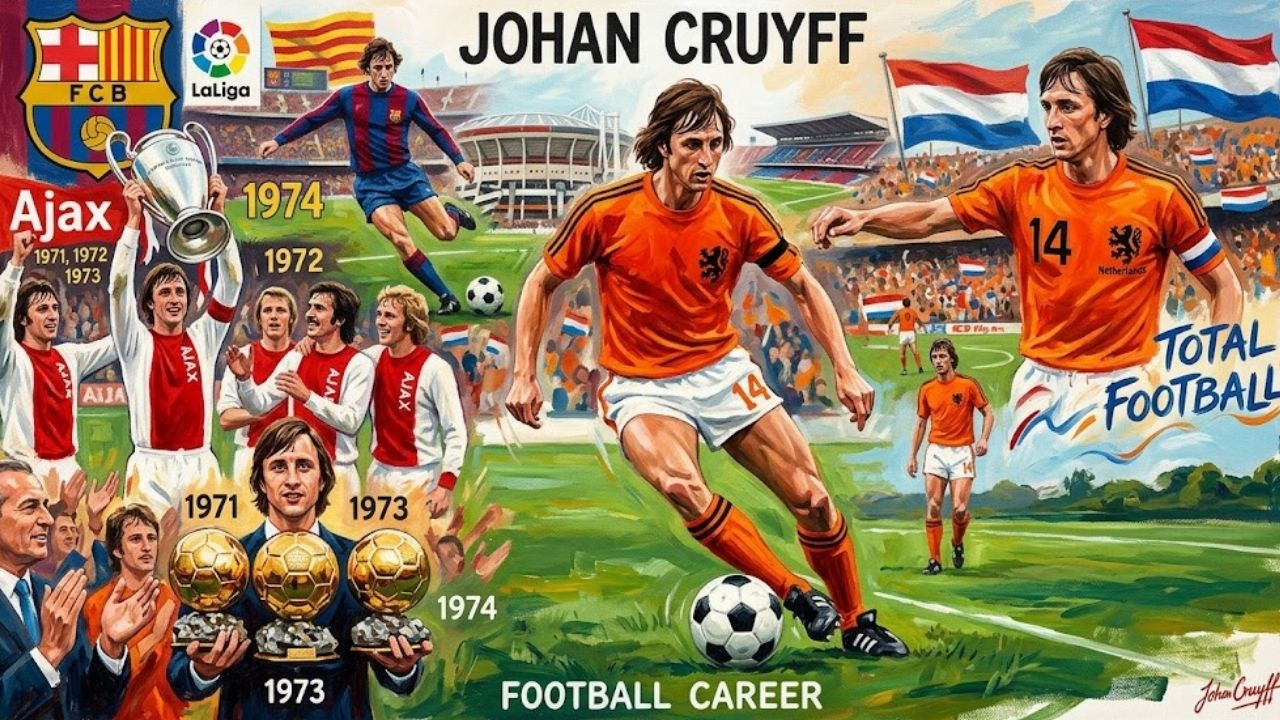
Johan Cruyff football career redefined the sport through an unmatched blend of individual brilliance, tactical innovation, and serial success. Rising from the Ajax academy, the Dutch maestro pioneered “Total Football”—a fluid, space-oriented tactical system—leading Ajax to three consecutive European Cups (1971–1973) and securing a historic 1974 La Liga title with FC Barcelona.
A three-time Ballon d’Or winner (1971, 1973, 1974), Cruyff captained the Netherlands to the 1974 FIFA World Cup Final, captivating the world with his iconic “Cruyff Turn.” Beyond his 400+ career goals and domestic dominance across Europe and North America, his football career created the ideological blueprint that continues to govern modern coaching, positional play, and elite tactical development worldwide.
Who Was Johan Cruyff?
Hendrik Johannes “Johan” Cruyff (1947-2016) was a Dutch professional football player and coach, widely regarded as one of the greatest and most influential figures in the sport’s history. His career was built on a foundation of exceptional technical ability, vision, and a deep tactical understanding that set him apart. The johan cruyff football career is not just a story of trophies won, but of a philosophy that reshaped the game itself.
Cruyff’s impact is felt in two distinct but connected phases: his time as a world-class player and his subsequent career as a visionary manager. In both roles, he championed an attacking, possession-based style that prioritized creativity and intelligence over pure physicality.
What Was “Total Football” and How Did Cruyff Embody It?
“Total Football” is a tactical philosophy where players are not restricted to a single, fixed position; instead, they are encouraged to fluidly interchange roles throughout a match. This system, pioneered by coach Rinus Michels and perfected by the Dutch national team and Ajax in the 1970s, requires every player to be technically proficient and tactically astute enough to play as an attacker, midfielder, or defender.
Cruyff was the on-field conductor of this orchestra. His exceptional game intelligence and spatial awareness allowed him to appear wherever he was most needed, directing play and exploiting weaknesses in the opposition. He wasn’t just a forward; he was a “total footballer” who organized the team’s press, dropped deep to collect the ball, and created chances from anywhere on the pitch.
A common mistake is to think of Total Football as chaotic. In reality, it was highly organized, relying on a disciplined positional structure. If a defender moved upfield to attack, a midfielder or forward would rotate to cover their defensive position, maintaining the team’s overall shape.
A Legendary Playing Career: Trophies and Stats
The johan cruyff football career was filled with remarkable achievements and accolades at both the club and international levels. He combined individual brilliance with collective success, leaving an indelible mark on every team he represented.
Dominance with Ajax
At his boyhood club Ajax, Cruyff became the focal point of one of the greatest club sides in history. Between 1964 and 1973, he led the Amsterdam-based team to unprecedented success.
- Eredivisie Titles: 8
- KNVB Cups: 5
- European Cups: 3 (1971, 1972, 1973)
His crowning achievement was winning three consecutive European Cups, a feat that cemented Ajax’s and Cruyff’s legendary status.
International Stardom with the Netherlands
Cruyff was the captain and star of the Dutch national team that captivated the world at the 1974 FIFA World Cup. Though they narrowly lost to West Germany in the final, their brand of Total Football left a lasting legacy. Cruyff was named the Player of the Tournament for his mesmerizing performances.
Revitalizing Barcelona
In 1973, Cruyff joined FC Barcelona for a world-record transfer fee. His arrival was transformative. In his very first season, he led the club to its first La Liga title in 14 years, instantly becoming a club icon. His presence did more than just win a trophy; it instilled a new sense of identity and belief in the Catalan club.
How Did Johan Cruyff’s Football Career Shape FC Barcelona’s Identity?
Johan Cruyff’s influence at FC Barcelona is arguably the most profound of any single individual in a club’s history, establishing a philosophy that defines them to this day. His impact began as a player in 1974 but was fully realized when he returned as manager in 1988. As the club noted in 2026, a decade after his passing, Cruyff is the central figure who shaped their modern identity.
As manager, he built the legendary “Dream Team” that won four consecutive La Liga titles and the club’s first-ever European Cup in 1992. More importantly, he implemented a club-wide playing style based on his Total Football principles. This philosophy was ingrained from the senior team all the way down through the youth academy, La Masia.
The principles he established, technical excellence, possession-based football, and promoting youth talent, became the bedrock of Barcelona’s identity. This “Cruyffian” DNA directly led to the success of future managers like Pep Guardiola and the golden generation of players including Lionel Messi, Xavi Hernández, and Andrés Iniesta.
What is the Lasting Impact of Cruyff’s Philosophy on Modern Football?
The ideas Johan Cruyff championed are more relevant today than ever. His emphasis on proactive, attacking football, high pressing, and technical skill over physical size has become a blueprint for many of the world’s most successful teams.
- Positional Play: The modern tactical concept of Juego de Posición (Positional Play), famously used by Pep Guardiola’s teams, is a direct evolution of Cruyff’s Total Football. It focuses on creating numerical superiority and finding the “free man” through structured positioning and quick ball circulation.
- Influence on Coaching: A generation of top coaches, including Guardiola, Ronald Koeman, and Mauricio Pochettino, were either coached by Cruyff or are direct disciples of his philosophy.
- Player Development: His focus on nurturing intelligent, technically gifted players has changed how academies worldwide identify and develop talent, prioritizing game understanding alongside physical attributes.
The “Cruyff Turn”: A Signature Move
No discussion of the johan cruyff football career is complete without mentioning his iconic skill move: the Cruyff Turn. First showcased to a global audience at the 1974 World Cup, the move is a masterclass in simplicity and deception.
While appearing to pass or cross the ball, Cruyff would instead drag the ball behind his standing leg with the inside of his foot, sharply turning 180 degrees and accelerating away from the defender. The move perfectly encapsulated his genius: it was elegant, intelligent, and devastatingly effective. It remains a fundamental skill taught to young players everywhere.
Final Thoughts
Johan Cruyff was more than a footballer; he was an artist, a philosopher, and a revolutionary who saw the game in a different dimension. His playing career brought him every major honor, but his legacy is defined by the ideas he left behind. He proved that football could be both beautiful and successful, and that how you win is just as important as the victory itself.
His principles of Total Football and his foundational work at Ajax and Barcelona created a blueprint for success that continues to shape the modern game. For anyone looking to understand the tactical evolution of football, studying the career and philosophy of Johan Cruyff is the essential first step.
Frequently Asked Questions (FAQ)
How many Ballon d’Or did Johan Cruyff win?
Johan Cruyff won the Ballon d’Or, awarded to the best European footballer, three times: in 1971, 1973, and 1974.
What teams did Johan Cruyff play for?
His most famous spells were with Ajax and FC Barcelona. He also played for the Los Angeles Aztecs, Washington Diplomats, Levante, and ended his career at Feyenoord.
Why is Johan Cruyff so important to Barcelona?
As a player, he won a historic league title. As a manager, he won their first European Cup and established the playing philosophy that still defines the club and its La Masia academy today.
What is Total Football?
It is a tactical system where players can interchange positions fluidly, requiring every player to be skilled in both attacking and defending. Cruyff was its most famous practitioner.
Did Johan Cruyff win the World Cup?
No, he did not. He led the Netherlands to the 1974 FIFA World Cup final, where they lost to West Germany, but his team is remembered as one of the greatest never to win the trophy.
What was Johan Cruyff’s famous quote?
One of his most famous quotes encapsulates his philosophy: “Playing football is very simple, but playing simple football is the hardest thing there is.”