
Every time a loot chest drops a legendary weapon against all odds, or a boss lands three critical hits in a row to end a run, the same invisible force is at work. That force is RNG, and understanding it changes how you think about almost every game you play. So, what is RNG in gaming, and why does it matter so much?
RNG stands for Random Number Generator. It is the system that produces unpredictable outcomes inside a video game, from the rarity of a dropped item to whether an attack lands a critical hit. In 2026, RNG is embedded in nearly every genre of game, and the term has become one of the most commonly used words in gaming culture.
What is RNG in Gaming: The Core Definition
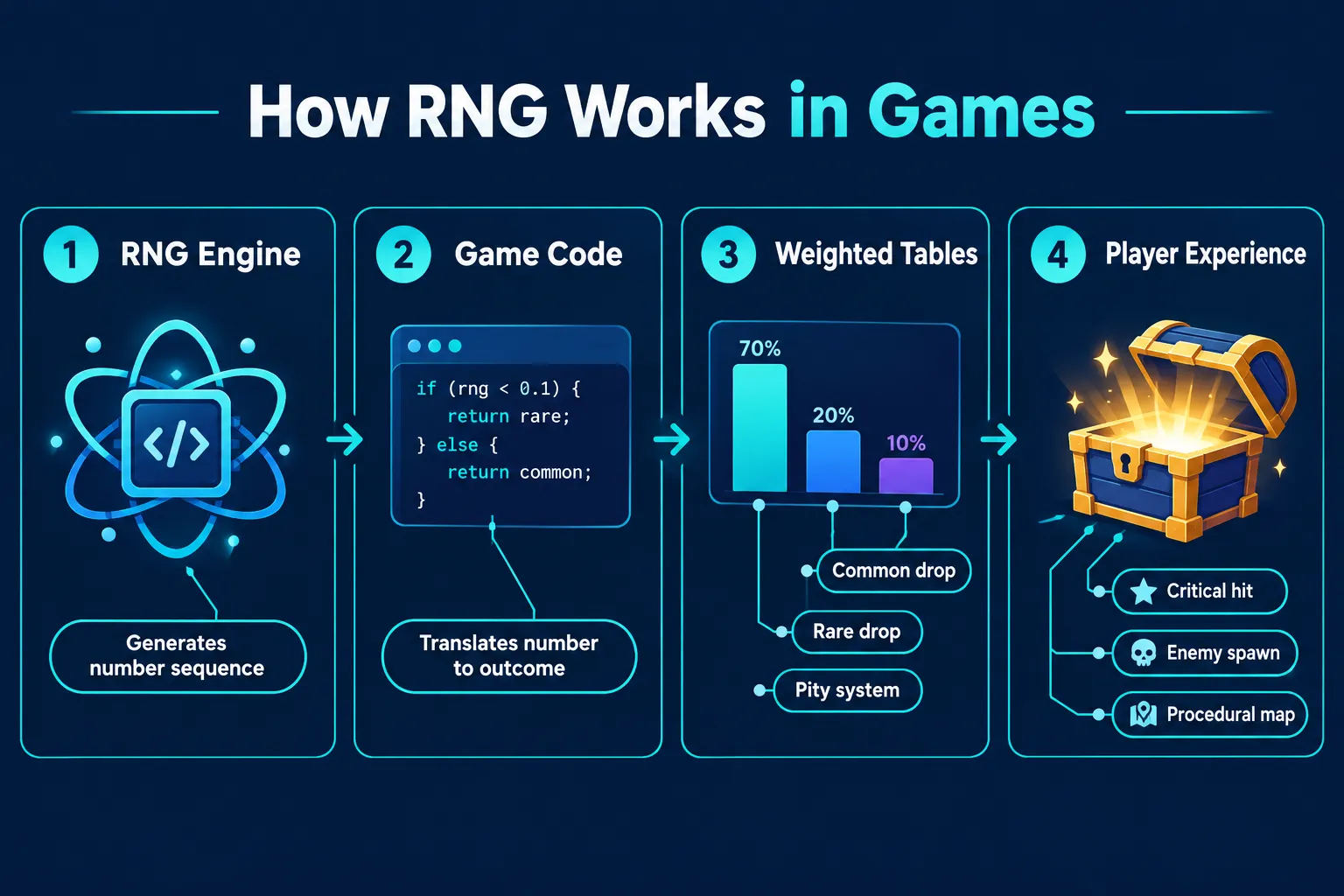
At its most basic level, RNG is a process or algorithm that generates a sequence of numbers with no predictable pattern. The game’s code then reads those numbers and converts them into real outcomes, a hit or a miss, a common item or a rare one, a sunny map or a stormy one.
Think of it like a digital dice roll happening thousands of times per second behind the scenes. Players never see the numbers themselves. They only see the results: the sword that finally dropped after fifty runs, or the enemy that spawned right behind them.
Gaming glossaries and education sites consistently describe RNG as foundational to modern game design, not an optional feature, but a core building block. It has been part of video games for nearly as long as games have existed, and its role has only grown larger over time.
True Random vs. Pseudo-Random
Here is an important detail most players never learn: most game RNGs are pseudo-random, not truly random. True randomness requires a physical source, like atmospheric noise or radioactive decay. Pseudo-random algorithms use a mathematical formula and a starting value called a seed to produce a sequence that looks random but is technically reproducible if you know the seed.
For everyday gaming purposes, pseudo-random is more than good enough. Players cannot predict or exploit the sequence, so it feels completely random in practice.
Where RNG Shows Up in Games
RNG is not limited to one type of game or one mechanic. It appears across almost every system a player interacts with.
Common RNG-driven systems include:
| Game System | How RNG Applies |
|---|---|
| Loot drops | Determines item rarity and type |
| Critical hits | Sets the chance an attack deals bonus damage |
| Enemy spawns | Controls when and where enemies appear |
| Procedural generation | Builds maps, dungeons, or worlds on the fly |
| Weather systems | Randomizes in-game environmental conditions |
| Card draws | Shuffles and deals cards in digital card games |
| Gacha/pity systems | Manages pull rates and guaranteed reward thresholds |
Each of these systems uses the same underlying idea: a number is generated, checked against a table of possible outcomes, and the matching result is delivered to the player.
Weighted RNG and Pity Systems
Not all RNG is created equal. Designers often weight their random tables so outcomes are not perfectly uniform. A common item might have a 70% chance of dropping, while a rare item has a 2% chance. This is still random, but the odds are deliberately shaped.
Many modern games, especially gacha titles and looter-shooters, also use pity systems. These guarantee a rare reward after a player goes a certain number of attempts without one. Pity systems reduce the most frustrating streaks of bad luck while keeping the core randomness intact.
“Bad RNG experiences often come from design choices, not broken random number generation.”
This distinction matters. When a game feels unfair, the problem is usually how the designer set up the loot table, not the RNG engine itself.
RNG as Slang: How Gamers Actually Use the Word
Beyond the technical definition, “RNG” has taken on a life of its own in gaming communities. Younger and competitive players use it almost interchangeably with the word “luck.”
Common phrases heard in gaming communities:
- “RNG carried me through that dungeon.”
- “We lost because of RNG, their team got all the power-ups.”
- “That critical hit was pure RNG.”
When a player says a match was “decided by RNG,” they mean random events, not skill, determined the winner. This usage is especially common in competitive shooters, card games, and action RPGs where a single random outcome can flip the result of an entire match.
The slang reflects a real tension in game design: players want to feel that skill matters, but they also want outcomes to stay unpredictable enough to stay interesting.
RNG in Online Casino and iGaming
In the online casino world, what is RNG in gaming takes on a much more regulated meaning. RNG is the core fairness mechanism behind digital slots, virtual roulette, online card games, and other casino titles.
In these contexts, the RNG continuously generates values that the game’s rules convert into each spin result or card dealt. Critically, each round is statistically independent of the previous one, a slot machine that just paid out a jackpot has the same odds on the very next spin.
Because real money is involved, iGaming providers in 2026 are required to have their RNG systems audited and certified by independent testing labs. These certifications confirm that:
- The RNG produces genuinely unpredictable outcomes.
- Published payout rates (RTP percentages) are accurate.
- The system cannot be manipulated by the operator or the player.
RNG certification is directly tied to player trust and legal licensing. Without it, a casino platform cannot legally operate in most regulated markets.
Why RNG Matters for Your Gaming Experience
RNG gets criticized when it feels excessive. Too much randomness can make players feel like their decisions and skills are irrelevant, especially in competitive play. This frustration is legitimate and well-documented in gaming communities.
But RNG also solves a real problem: replayability. A dungeon with fixed loot and predictable enemies gets boring fast. Randomized drops, enemy placements, and map layouts keep each run feeling fresh, even after dozens of hours. RNG is a large part of why roguelikes, open-world RPGs, and card games remain endlessly engaging.
The best game designs use RNG as a tool, adding variety and excitement without letting randomness completely override player agency.
Final Thoughts
Understanding what is RNG in gaming gives players a clearer picture of why games behave the way they do. RNG is the invisible engine behind loot drops, critical hits, procedural worlds, and competitive upsets. Most of the time, it is a pseudo-random algorithm shaped by deliberate design choices, not pure chaos.
Actionable next steps for players:
- When a drop feels unfair, check if the game has a pity system or weighted loot table, most modern games do.
- In competitive play, focus on decisions that reduce the impact of bad RNG rather than blaming outcomes entirely on luck.
- When trying online casino games, look for platforms with certified RNG audits to ensure fair play.
- For game developers and hobbyists, remember that the RNG engine is just a number supplier, the design of the outcome table is where player experience is actually shaped.
RNG is not the enemy of skill. Used well, it is what keeps games worth playing again and again.