Ninety-three percent of all online experiences begin with a search engine, yet most small business owners spend their entire marketing budget on paid ads while their competitors quietly capture that traffic for free. Understanding what is SEO and how does it work is the single most valuable marketing skill a non-technical entrepreneur can develop in 2026, and the fundamentals are far more accessible than most people realize.
Search Engine Optimization (SEO) is the practice of improving a website so that search engines like Google rank it higher in organic (unpaid) results. When done correctly, SEO delivers compounding returns: a well-optimized page can generate traffic for years without ongoing ad spend. This guide breaks down the core concepts, the step-by-step process, and the ranking factors that matter most right now.
How Search Engines Actually Work
Before exploring what is SEO and how does it work in practice, it helps to understand what happens behind the scenes every time someone types a query.
The Three-Stage Process: Crawl, Index, Rank
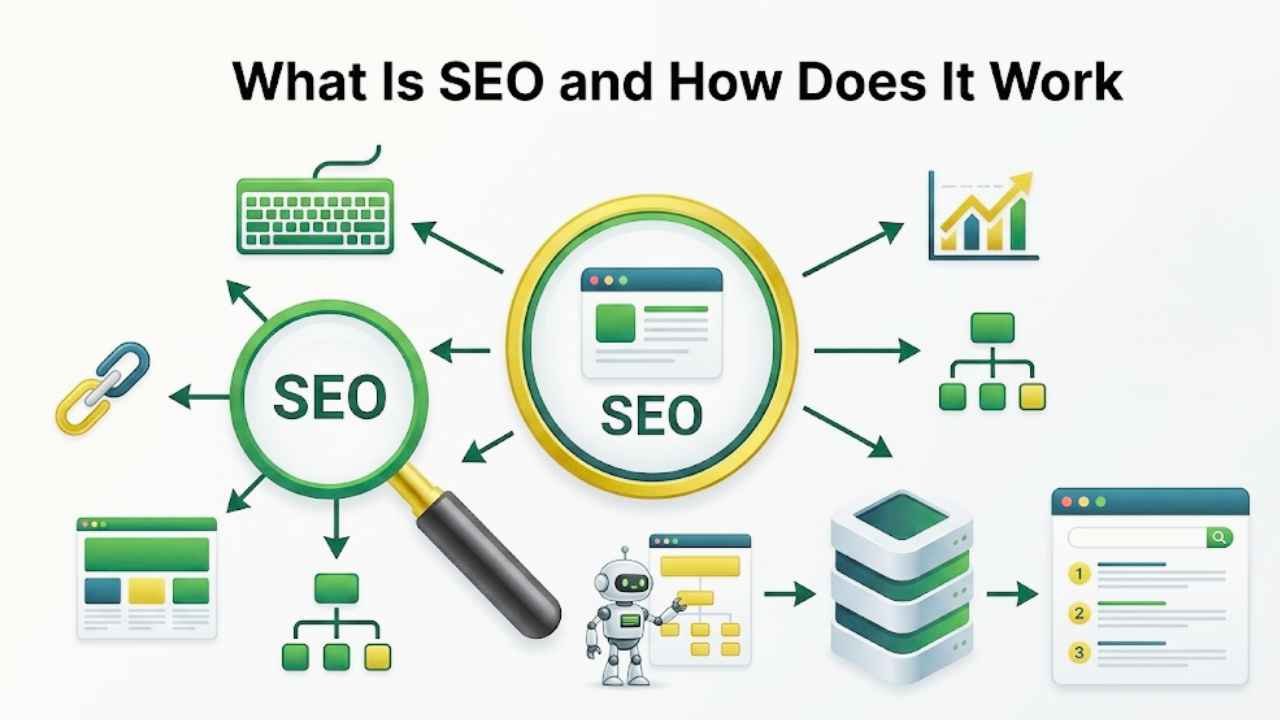
1. Crawling: Search engines deploy automated bots (called “crawlers” or “spiders”) that follow links across the web, discovering new and updated pages. If your site blocks crawlers or has broken internal links, pages may never be found.
2. Indexing: Once a page is crawled, Google analyzes its content and stores it in a massive database called the index. Pages that are thin, duplicate, or confusing to parse may be excluded from the index entirely.
3. Ranking: When a user searches, Google’s algorithm evaluates hundreds of signals to decide which indexed pages best answer the query, and in what order to display them. This is where SEO strategy has the most direct impact.
“The goal of SEO is not to trick search engines. It is to make it as easy as possible for them to understand why your page is the best answer to a specific question.”
What Is SEO and How Does It Work: The Core Components
SEO is not a single tactic. It is a system made up of four interconnected pillars.
| Pillar | What It Covers | Why It Matters |
|---|---|---|
| Technical SEO | Site speed, crawlability, mobile-friendliness | Ensures search engines can access and read your site |
| On-Page SEO | Keywords, content quality, headings, meta tags | Tells search engines what your page is about |
| Off-Page SEO | Backlinks, brand mentions, social signals | Signals authority and trustworthiness |
| Local SEO | Google Business Profile, local citations | Critical for businesses serving a geographic area |
Technical SEO and Core Web Vitals
Google’s Core Web Vitals, a set of speed and user experience metrics, are confirmed ranking signals in 2026. The three primary metrics are:
- Largest Contentful Paint (LCP): How fast the main content loads (target: under 2.5 seconds)
- Interaction to Next Paint (INP): How quickly the page responds to user input
- Cumulative Layout Shift (CLS): How stable the page layout is while loading
Mobile-first indexing means Google primarily uses the mobile version of your site for ranking. A site that performs poorly on a smartphone will rank poorly everywhere.
On-Page SEO: Content and Keywords
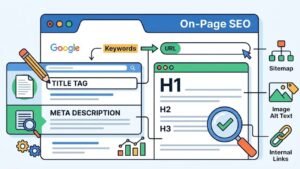
Keyword research is the foundation of on-page SEO. The goal is to identify the exact phrases your target audience types into search engines, then create content that genuinely answers those queries.
Search intent is the most critical concept here. Every query falls into one of four categories:
- Informational, the user wants to learn something (“how does SEO work”)
- Navigational, the user is looking for a specific website (“Google Search Console login”)
- Commercial, the user is researching before buying (“best SEO tools 2026”)
- Transactional, the user is ready to act (“buy SEO audit service”)
Matching your content to the correct intent type is more important than keyword density. A page optimized for informational intent will not rank for transactional queries, no matter how many times the keyword appears.
Off-Page SEO: Authority and Trust
Backlinks, links from other websites pointing to yours, remain one of the strongest ranking signals. However, quality matters far more than quantity. A single link from a respected industry publication outweighs dozens of links from low-quality directories.
In 2026, brand signals have grown in importance alongside traditional backlinks. Google increasingly measures:
- Branded search volume (how many people search your company name directly)
- Mentions of your brand across the web, even without a link
- User engagement metrics such as click-through rate and time on page.
Top Ranking Factors in 2026
Large-scale ranking factor studies point to a consistent set of priorities for sites looking to compete in organic search.
The signals that matter most:
- Content relevance and depth, comprehensive content that fully addresses a topic outperforms thin pages
- Backlink quality, authoritative, topically relevant links from trusted domains.
- Core Web Vitals, measurable page experience signals.
- E-E-A-T (Experience, Expertise, Authoritativeness, Trustworthiness), Google evaluates whether the content creator has real-world credentials and experience.
- Mobile usability, pages must function flawlessly on all screen sizes
- Structured data, schema markup helps Google understand your content and display rich results
What has NOT changed:
Fundamentals that worked five years ago still apply. Unique, helpful content written for humans, a clean site structure, and genuine backlinks from relevant sources remain the bedrock of any successful SEO strategy.
AI Overviews and the Evolving Search Landscape
Google’s AI Overviews (formerly Search Generative Experience) now appear at the top of results for many queries, summarizing answers directly on the search results page. For beginners, this creates both a challenge and an opportunity.
Pages cited inside AI Overviews tend to share specific characteristics:
- They answer questions directly and concisely near the top of the page
- They use clear headings and structured formatting
- They demonstrate E-E-A-T through author credentials and cited sources
- They cover topics with depth rather than surface-level summaries
The practical implication: writing for AI Overviews and writing for traditional rankings require the same approach, create genuinely useful, well-structured content.
Local SEO: A Priority for Location-Based Businesses
For any business serving customers in a specific city or region, local SEO is the highest-return starting point.
Core local SEO actions:
- Claim and optimize your Google Business Profile, complete every field, add photos, and collect reviews
- Build consistent citations, ensure your business name, address, and phone number (NAP) are identical across all directories
- Earn local backlinks, sponsorships, local press, and chamber of commerce listings all count
- Encourage customer reviews, review quantity and quality directly influence local pack rankings.
Local search results are highly competitive at the neighborhood level, but the barrier to entry is lower than national SEO, making it an ideal starting point for new businesses.
The Beginner SEO Workflow: Step by Step
Following a structured process prevents wasted effort and builds momentum:
- Audit your current site, use free tools like Google Search Console and Google PageSpeed Insights to identify technical issues
- Conduct keyword research, use Google’s free Keyword Planner or Ubersuggest to find queries your audience actually uses
- Map keywords to pages, assign one primary keyword (and related secondary terms) to each page
- Optimize existing content, update title tags, meta descriptions, headings, and body copy to reflect target keywords and intent
- Fix technical issues, address crawl errors, improve page speed, and ensure mobile responsiveness
- Build internal links, connect related pages to help both users and crawlers navigate your site
- Pursue backlinks, reach out to industry publications, write guest posts, or create link-worthy resources
- Track and iterate, monitor rankings, organic traffic, and conversions monthly; adjust based on data
Free tools every beginner should use:
- Google Search Console (crawl data, keyword performance)
- Google Analytics 4 (traffic and behavior)
- Google PageSpeed Insights (Core Web Vitals)
- Bing Webmaster Tools (additional crawl data)
Final Thoughts
Understanding what is SEO and how does it work is not reserved for technical specialists. The core principle is straightforward: help search engines understand your content, and make that content genuinely worth ranking.
Actionable next steps for entrepreneurs and marketers starting in 2026:
- Set up Google Search Console today, it is free and reveals exactly how Google sees your site.
- Identify five to ten keywords your ideal customer searches for, then audit whether your existing pages address those queries.
- Run a Core Web Vitals test on your homepage and fix any failing metrics before investing in content.
- Claim your Google Business Profile if you serve a local market.
- Publish one comprehensive, intent-matched piece of content per month rather than several thin posts per week.
SEO rewards consistency. Businesses that commit to the fundamentals, relevant content, technical health, and earned authority, build traffic assets that compound over time, creating a durable competitive advantage that no ad budget can replicate.