
Sixty-eight percent of Google searches in the US end without a single click. That means most people find what they need directly on the search results page, and never visit any website at all.
For anyone trying to grow web traffic, that number is both a warning and a challenge. This article, SEO: The Complete Beginner’s Guide to Search Engine Optimization, breaks down exactly how to compete in that environment, even with zero prior experience. Whether building a blog, a small business site, or an online store, the same core principles apply.
What Is SEO and Why It Still Matters in 2026
Search Engine Optimization (SEO) is the practice of improving a website so that search engines like Google rank it higher in results. Higher rankings mean more visibility, more clicks, and more potential customers or readers.
Some people assume SEO is dying because of AI tools and chatbots. The data says otherwise. Google’s own search leadership confirmed that July 7, 2026 marked the highest-ever usage of Google Search in history. Search is not shrinking, it is growing. That makes learning SEO fundamentals more valuable, not less.
At the same time, AI Overviews (Google’s AI-generated answer boxes) now appear on roughly half of all searches. Google has confirmed that only visible, clickable links in those overviews count as real impressions. Simply being mentioned is not enough. Beginners need to earn actual links and clicks, not just name recognition.
The Six-Step SEO Roadmap for Beginners
A practical framework for beginners follows six clear steps. Think of this as a monthly cycle, not a one-time checklist.
- Clarify business goals, Know what action a visitor should take on the site.
- Do keyword research, Find the exact phrases people type into Google.
- Optimize on-page elements, Improve titles, headings, and content.
- Run technical checks, Make sure the site is fast, mobile-friendly, and indexable.
- Plan content and internal links, Build a connected web of pages.
- Measure results, Use Google Search Console (GSC) and Google Analytics 4 (GA4) to track progress.
Repeat this cycle every month. SEO is not a one-and-done task.
Week-by-Week Action Plan
Breaking the roadmap into weekly milestones makes it manageable for complete beginners.
Week 1, Set Up the Technical Foundation
Before writing a single word of content, the technical foundation must be solid. This is the prerequisite for everything else.
Critical Week 1 tasks:
- Connect the site to Google Search Console and GA4
- Submit an XML sitemap to GSC
- Confirm the site uses HTTPS (the padlock icon in the browser)
- Test mobile speed using Google’s free PageSpeed Insights tool
A site that loads slowly, breaks on phones, or cannot be crawled by Google will not rank, regardless of how good the content is.
Week 2, Find the Right Keywords
Keyword research is the process of discovering what people actually search for. The goal is not to target the most popular phrases. It is to target phrases a new site can realistically rank for.
The beginner’s keyword formula:
- Use long-tail keywords (3 or more words), such as “best running shoes for flat feet” instead of “running shoes”
- Target a Keyword Difficulty (KD) score of 0-20 using tools like Ahrefs, Semrush, or free alternatives
- Start with free tools: Google Keyword Planner, Search Console, and Google’s autocomplete suggestions
- Map one primary keyword per page, never stuff multiple competing keywords onto a single page
“Long-tail keywords have lower competition and higher intent, they are the fastest way for a new site to earn its first rankings.”
Week 3, Optimize On-Page Elements
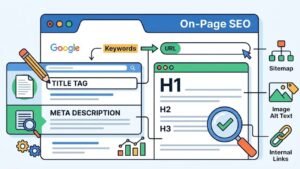
On-page SEO means making sure each page clearly communicates its topic to both users and search engines.
| Element | Best Practice |
|---|---|
| Title Tag | Include the primary keyword; keep it under 60 characters |
| Meta Description | Summarize the page in 150-160 characters; make it compelling |
| H1 Heading | One per page; include the primary keyword naturally |
| Internal Links | Link related pages together using descriptive anchor text |
| Image Alt Text | Describe the image clearly; include keywords where natural |
Focus on the top five pages first. These are usually the homepage, main service or product pages, and the highest-traffic blog posts.
Week 4, Publish Intent-Matched Content
Search intent is the reason behind a query. Someone searching “how to tie a tie” wants instructions, not a product page. Someone searching “buy silk tie online” wants to shop. Matching the page type to the intent is one of the most important skills in SEO.
For Week 4, publish one well-researched blog post that is:
- 1,200-1,800 words long
- Structured with clear H2 and H3 headings
- Includes a FAQ section at the bottom (this helps with structured data and featured snippets)
- Written to answer the searcher’s actual question, not just to include keywords
Technical SEO: The Non-Negotiable Foundation
Technical SEO covers everything that helps search engines find, crawl, and understand a site. Think of it as the plumbing behind the walls, invisible, but critical.
The beginner’s technical checklist:
- HTTPS enabled on all pages
- No broken links or redirect chains
- XML sitemap submitted to Google Search Console
- Robots.txt file not accidentally blocking important pages
- Core Web Vitals scores in the “Good” range (check via PageSpeed Insights)
- Mobile-responsive design confirmed on multiple screen sizes
Many of these checks take less than 30 minutes. They should be repeated monthly because site updates can accidentally break things.
Understanding Rankings, Volatility, and Patience
Rankings are not static. Even without a major Google algorithm update, rankings can swing significantly from week to week. In mid-2026, noticeable ranking fluctuations were observed even during periods when Google confirmed no broad core update was active.
What beginners should do:
- Track keyword positions weekly, not daily
- Look for trends over 4-8 week periods
- Do not make major changes after a single bad day of rankings
- Use Google Search Console’s Performance report to see impressions and clicks over time
Google also ran a spam update in mid-2026, reinforcing a simple truth: sites that use spammy tactics, keyword stuffing, low-quality backlinks, thin content, get penalized. Clean, policy-compliant optimization always wins long-term.
Content, E-E-A-T, and the Attention Economy
Google evaluates content quality through a framework called E-E-A-T: Experience, Expertise, Authoritativeness, and Trustworthiness. For beginners, this translates into practical habits:
- Show real experience, Include original insights, examples, or data
- Demonstrate expertise, Use accurate, well-researched information
- Build authority, Earn backlinks from reputable sites over time
- Establish trust, Include author bios, contact information, and clear sourcing
Beyond E-E-A-T, 2026 has brought a stronger focus on attention-first metrics. Search engines and analytics platforms are increasingly measuring dwell time (how long someone stays on a page) and active engagement (whether they scroll, click, and interact). A page that ranks but gets ignored sends a negative signal.
Structured data (schema markup) is another growing priority. Adding schema to pages, especially FAQ schema, article schema, and author schema, helps Google understand the content and display it in rich results. This is especially important for visibility in AI Overviews.
AI Search and What It Means for Beginners
The rise of AI Overviews has created confusion. Many beginners ask: “If AI answers the question, why would anyone click my site?”
The answer is that good SEO is also good AI search optimization. Google has stated this directly. The same signals that help a page rank in traditional results, technical quality, authoritative content, clear structure, also help it appear as a cited source in AI Overviews.
The key difference is that only clickable, visible links in AI Overviews count as impressions. Brand mentions without links do not register. This means the goal remains the same: earn real links, real clicks, and real engagement.
Measuring SEO Progress
Two free tools cover everything a beginner needs to measure:
Google Search Console (GSC)
- Shows which keywords drive impressions and clicks
- Identifies crawl errors and indexing issues
- Tracks Core Web Vitals performance
Google Analytics 4 (GA4)
- Shows how visitors behave after arriving on the site
- Tracks goal completions (sign-ups, purchases, contact form fills)
- Measures engagement rate and session duration
Check both tools at least once per week. Set up monthly reports to track trends. The data will show what is working and where to focus next.
Final Thoughts
SEO in 2026 rewards patience, consistency, and a clean technical foundation. The beginner who sets up Google Search Console on day one, targets low-difficulty long-tail keywords, matches content to search intent, and publishes high-quality pages regularly will see results, typically within three to six months for new sites.
Actionable next steps to take this week:
- Connect the site to Google Search Console and submit a sitemap today.
- Run a mobile speed test using PageSpeed Insights and fix any critical issues.
- Identify five long-tail keywords with KD scores under 20 using Google Keyword Planner or autocomplete.
- Audit the top five pages for title tags, H1 headings, and internal links.
- Plan one intent-matched blog post to publish before the end of the month.
The fundamentals covered in this complete beginner’s guide to search engine optimization have not changed despite AI disruption, they have only become more important. Start with the basics, measure everything, and improve one step at a time.