
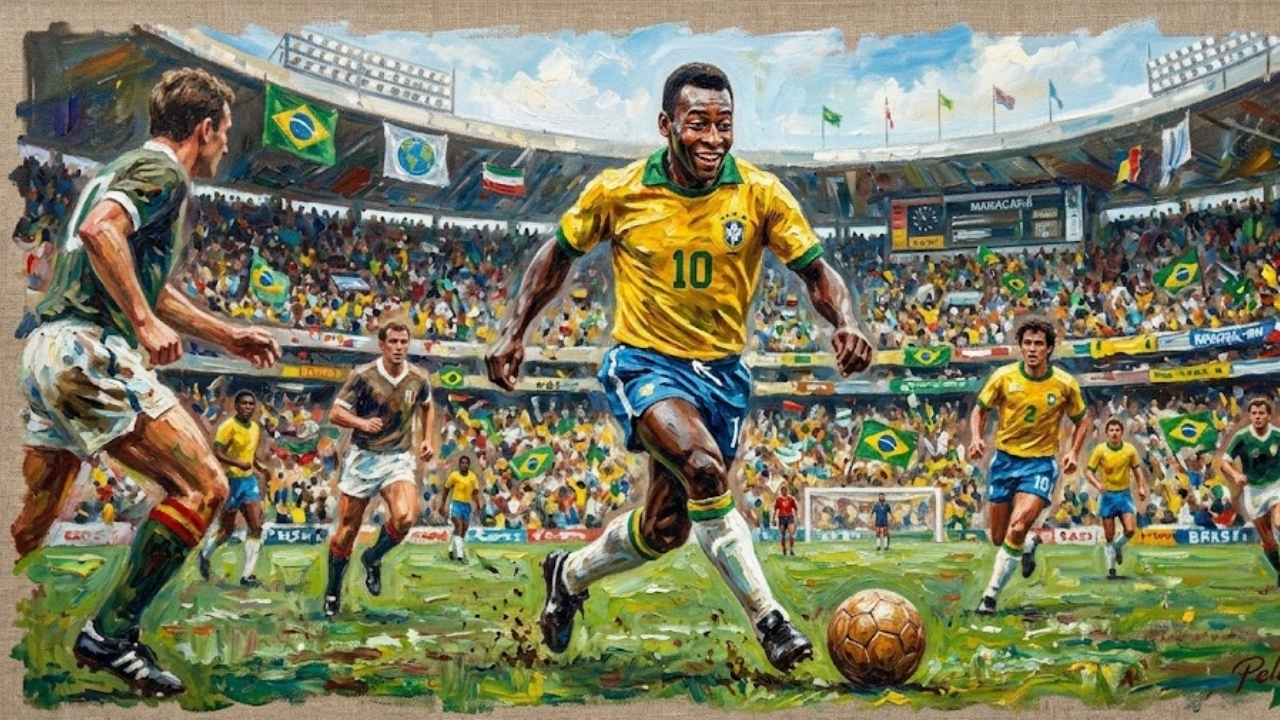
Pelé career and World Cup legacy presents an immediate problem: his record comes from a different sporting world. His goals span official competitions, international tours and friendlies. He spent his prime in Brazil rather than a European league. One of his three World Cup titles came after an injury had ended his tournament almost as soon as it began.
Remove that context and Pelé’s career can be exaggerated or unfairly diminished. Put it back, and the case becomes stronger. He was the decisive young star of Brazil’s first World Cup victory, the creative center of its celebrated 1970 side, and the defining player of a Santos team that beat leading South American and European opposition. Above all, he remains the only man to have won three FIFA World Cups as a player.
From Bauru to the Santos first team
Edson Arantes do Nascimento was born on October 23, 1940, in Três Corações, Minas Gerais. His father, João Ramos do Nascimento—known as Dondinho—had played professionally. The family later moved to Bauru in São Paulo state, where Pelé developed before joining Santos as a teenager.
His senior debut was a friendly against Corinthians de Santo André on September 7, 1956. Pelé was 15, Santos won 7–1, and he scored. The distinction between that match and his official debut is easy to lose in short biographies. His first appearance in a senior competition came on April 26, 1957, when he scored in a 3–1 Rio–São Paulo Tournament victory over São Paulo.
Less than three months later, he made his Brazil debut. He was 16 years, eight months and 14 days old when he scored in a 2–1 defeat by Argentina at the Maracanã on July 7, 1957.
Santos’ golden age was more than a domestic story
Pelé’s regular Santos career ended with his farewell against Ponte Preta on October 2, 1974. He did wear the shirt once more, however, appearing in a 1–1 match against Bahia in December 1975 after he had joined the New York Cosmos. The familiar 1974 date marks the public farewell, not his literal final appearance for the club.
During his Santos years, the club won ten Campeonato Paulista titles, five consecutive Taça Brasil championships from 1961 to 1965 and the 1968 Roberto Gomes Pedrosa tournament. Those six national titles are now recognized in Santos’ Brazilian championship record. The team also won the Copa Libertadores and Intercontinental Cup in both 1962 and 1963.
The Intercontinental Cup results answer one of the cheaper arguments used against Pelé: that he was never tested against Europe’s best. Santos defeated Eusébio’s Benfica 8–4 on aggregate in 1962. Pelé scored a hat-trick in the 5–2 second-leg victory in Lisbon. The following year, Santos overcame AC Milan in a three-match contest.
Pelé never spent a season in a European league, and that remains a genuine difference between his career and those of later stars. It is not proof that he avoided elite opposition. Football’s economy was less concentrated in Europe, Brazil’s domestic game was exceptionally strong, and Santos toured relentlessly. Those tours also explain why friendly matches occupy such a large place in Pelé’s statistics: they were sporting contests, public spectacles and an important source of club income.
Pelé Career and World Cup Legacy: Four Tournaments, Three Titles
Pelé scored 12 goals in 14 World Cup appearances. The headline is impressive, but the shape of the record matters more. His four tournaments were not repeated versions of the same triumph. They showed emergence, injury, physical punishment and, finally, mastery.
1958: Brazil finds its young king
A knee injury kept the 17-year-old out of Brazil’s first two matches in Sweden. He entered the side against the Soviet Union, then scored the only goal in the quarter-final against Wales. A second-half hat-trick followed in Brazil’s 5–2 semi-final victory over France.
In the final, Pelé scored twice as Brazil beat host nation Sweden 5–2. His first goal—lifting the ball over a defender and volleying it into the net—became one of the defining images of his career. He remains the youngest scorer, youngest hat-trick scorer and youngest final scorer in men’s World Cup history. He was also the youngest player to become a world champion.
Brazil had never won the trophy and was still marked by its decisive final-round defeat at the 1950 tournament. The 1958 side was hardly a one-player team: Garrincha, Didi, Vavá and Nilton Santos were among its outstanding figures. Pelé nevertheless gave the victory its enduring face—a teenager whose best work came in the knockout rounds.
1962 and 1966 require more honest accounting
Pelé began Chile 1962 by scoring one goal and helping create another in a 2–0 victory over Mexico. He was injured during the next match, against Czechoslovakia, and did not play again. Brazil retained the trophy through a side led in attack by Garrincha, Vavá and Pelé’s replacement, Amarildo.
The medal counts, but the context should travel with it. Pelé was a legitimate member of the winning squad, not the driving force of the entire campaign. Using 1962 as though it were a repeat of his 1958 performance weakens rather than strengthens the historical case for him.
England 1966 brought the opposite problem. Pelé scored against Bulgaria but was subjected to heavy challenges and suffered a right-knee injury. He missed the defeat by Hungary, returned against Portugal and was targeted again as Brazil went out in the group stage. Substitutions were not permitted at that World Cup. Comparing attackers across eras without accounting for that lack of protection produces a misleadingly tidy picture.
1970: the complete footballer
By Mexico 1970, Pelé was 29 and no longer depended on the explosive movement of his youth. Brazil surrounded him with Jairzinho, Tostão, Rivellino, Gérson and captain Carlos Alberto. The team won all six matches; Pelé supplied four goals and six assists. FIFA still lists the assist total as a record for one World Cup.
Several of his most revealing actions did not result in goals. His header produced Gordon Banks’ famous save for England. He tried to score from inside his own half against Czechoslovakia. In the semi-final against Uruguay, he allowed Tostão’s pass to run one side of goalkeeper Ladislao Mazurkiewicz while he ran around the other, only to send the final shot narrowly wide. Each moment showed how early he saw possibilities.
Pelé headed Brazil in front in the 4–1 final win over Italy. Late in the match, he waited for Carlos Alberto’s overlapping run and rolled the ball into his path for the final goal. The pass was simple; the pause before it was the mark of a player in control of the whole move.
Mexico 1970 was also the first World Cup broadcast around the globe in color. Pelé’s yellow No. 10 shirt entered homes far beyond the audiences reached by Santos’ tours. His final Brazil appearance came a year later, in a 2–2 draw with Yugoslavia at the Maracanã on July 18, 1971. He finished with 77 goals in 92 recognized internationals.
Pelé was a Creator as Well as a Scorer
Describing Pelé simply as a striker leaves too much out. He could lead the attack, drop into midfield or work behind another forward. He finished with either foot, timed headers superbly and stayed balanced through contact. A first touch might remove a defender; the next could release a teammate rather than produce a shot.
Short highlight reels favor bicycle kicks and dribbles. Longer footage shows the less decorative parts of his game: moving the ball early, creating space with an off-ball run and drawing defenders out of position. The flair was functional. He was not decorating matches for their own sake.
Direct comparisons with Diego Maradona, Lionel Messi or Cristiano Ronaldo cannot be resolved by adjusting old statistics for modern conditions. Pitches, laws, tactics, travel and training all changed. Pelé’s anticipation, coordination, two-footed finishing and speed of decision are more useful evidence than imagined projections of how many goals he might score today.
Three Goal Totals—and Three Different Questions
Readers will encounter several career figures, each based on a different definition:
- Guinness World Records lists 1,279 goals in 1,363 matches from September 1956 to October 1977, followed by two goals in special appearances.
- Santos uses 1,282 goals in 1,365 career matches. The club credits Pelé with 1,091 goals in 1,116 appearances for Santos.
- A frequently cited official-match count is 757 goals: 680 for clubs and 77 for Brazil. Historical databases may still classify individual club fixtures differently.
The goal celebrated as his 1,000th was a penalty against Vasco da Gama at the Maracanã on November 19, 1969. It was a major public event, but the exact count depends on including match categories that modern statistical comparisons often exclude.
The fair way to compare Pelé with a modern scorer is to label the dataset. Friendlies should not be quietly mixed with competition-only totals, but they should not be dismissed as meaningless either. Santos often faced first-class opponents on tour, and those games belonged to the working calendar of the period. The disagreement changes the headline figure. It does not turn an ordinary scorer into a great one.
Cosmos Years Changed American soccer’s Ambition
Pelé came out of retirement to join the New York Cosmos in 1975. At 34, he was past his physical peak, and the North American Soccer League was not operating at the level of Europe or South America’s strongest competitions. The transfer’s larger value was cultural.
The Cosmos became a destination for crowds, celebrities and other international stars. Pelé helped the club win the 1977 NASL title, then ended his career on October 1 in an exhibition against Santos at Giants Stadium. The reported attendance was 75,646. He scored from a free kick while playing the first half for the Cosmos and wore the Santos shirt after halftime.
Pelé could not solve the league’s weak foundations; the NASL folded after the 1984 season. His spell nevertheless showed promoters, broadcasters and spectators what top-level star power could do for soccer in the United States. It would be too neat to credit him directly for the 1994 World Cup or Major League Soccer, but both projects were easier to imagine after the Cosmos had demonstrated the size of the possible audience.
Public Figure was Harder to Classify
Pelé became one of football’s first truly global celebrity brands. Film appearances, advertising and public work kept him visible long after retirement. He served as a UNESCO Goodwill Ambassador and, from 1995 to 1998, as Brazil’s Extraordinary Minister for Sport. Law No. 9,615, enacted during his tenure and widely known as the Pelé Law, became best known for reforms to the relationship between clubs and professional players. Pelé was its political sponsor, not its sole drafter.
In 1999, national Olympic committees voted him Athlete of the Century even though he had never competed at the Olympic Games. The choice reflected his reach beyond football as much as his results within it.
His political symbolism is less comfortable. Pelé was a Black Brazilian of unmatched international visibility in a country shaped by racial inequality. Critics considered him too cautious during the military dictatorship of 1964–1985, whose government used the 1970 victory for nationalist messaging. Documents later released by Brazilian authorities also showed that military officials monitored him and investigated his activities in the 1970s.
Neither “dissident” nor “regime spokesman” explains the full record. His caution can be criticized without pretending that he controlled how the state used his image—or that the state regarded him as entirely safe.
Pelé died in São Paulo on December 29, 2022, at the age of 82.
Final Thoughts
The most reliable way to judge the Pelé career and World Cup legacy is to resist one-number arguments. Separate official goals from all-match totals. Distinguish a winner’s medal from a tournament-defining performance. Then look at the range of his work: scorer, creator, aerial threat, improviser and organizer of attacks.
On that fuller record, the mythology is not doing the heavy lifting. Pelé drove Brazil’s first World Cup victory, returned 12 years later as the creative authority in one of the tournament’s greatest teams, and made Santos a name recognized across continents. His three World Cup titles remain unmatched, but the stronger reason to remember “O Rei” is how much football history sits behind them.