
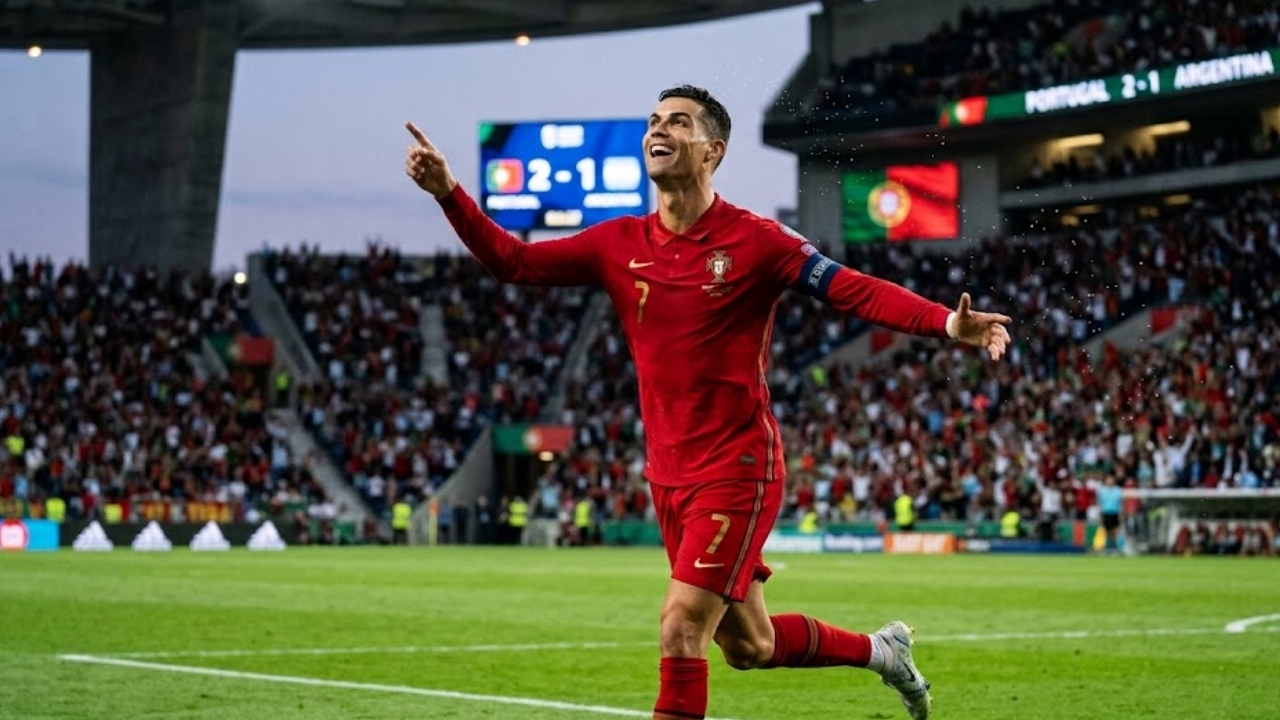
Anyone searching for one definitive Cristiano Ronaldo goal total soon encounters a problem: there is no single number accepted by every record keeper. Ronaldo is still playing, some databases classify regional competitions differently, and Real Madrid credits him with one more goal than Spain’s official league records do.
Using competitive senior matches and figures available through August 28, 2026, the widely reported total is 977 goals for club and country. This examination of Cristiano Ronaldo career records explains where that number comes from, which achievements carry the most historical weight and where comparisons need context.
Ronaldo’s career statistics at a glance
| Team | Period | Competitive Appearances | Goals |
| Sporting CP | 2002–2003 | 31 | 5 |
| Manchester United | 2003–2009, 2021–2022 | 346 | 145 |
| Real Madrid | 2009–2018 | 438 | 450 |
| Juventus | 2018–2021 | 134 | 101 |
| Al Nassr | 2023–present | Ongoing | 130 |
| Portugal | 2003–present | 233 | 146 |
Real Madrid records 451 goals. Competition-based totals use 450 because a September 2010 free-kick against Real Sociedad was officially credited to Pepe after striking the defender before entering the net.
The Al Nassr appearance figure has been left open deliberately. Live databases do not all treat Arab Club Champions Cup matches in the same way. The 130-goal figure, however, was the widely reported total after Ronaldo scored against Al Riyadh on August 21, 2026.
A Sporting prospect rebuilt at Manchester United
Ronaldo made his competitive Sporting CP debut against Inter in a Champions League qualifier on August 14, 2002. He was 17 and had played only a handful of senior matches when he scored twice on his first league start against Moreirense that October.
The early version of Ronaldo was a touchline winger: quick, inventive and willing to attack the same defender repeatedly. The footwork drew attention, although the final pass or shot did not always justify the build-up.
His performance against Manchester United in an August 2003 preseason match gave the English club a close look at that potential. United’s players urged Sir Alex Ferguson to sign him, and the club completed a €17.5 million transfer within days. The friendly accelerated the move, but it should not be mistaken for the entire scouting process behind it.
Ferguson handed Ronaldo the No. 7 shirt at 18. His first seasons mixed spectacular dribbling with poor choices, inconsistent crossing and a tendency to hold the ball too long. Gradually, he became stronger and more direct. He started attacking space behind defenders rather than always waiting for the ball at his feet.
The change was complete by 2007/08. Ronaldo scored 42 goals in 49 appearances, including 31 in the Premier League and eight in the Champions League. Manchester United won both competitions, and he headed in the opening goal against Chelsea in the Champions League final. The Ballon d’Or followed later that year.
Ronaldo left for Real Madrid in 2009 with 118 goals in 292 United appearances. His 2021 return added another 27 goals in 54 games, but the team never found a convincing balance between his finishing and its wider tactical needs. The second spell ended by mutual agreement in November 2022.
His combined Manchester United record stands at 145 goals in 346 appearances, including 103 goals in 236 Premier League matches.
Real Madrid: the numbers that changed the argument
Real Madrid paid €94 million, widely reported at the time as £80 million, to sign Ronaldo in 2009. It was a world-record transfer fee. What followed made even that price appear reasonable.
Ronaldo scored 450 officially attributed goals in 438 competitive appearances. Real Madrid’s count of 451 includes the disputed Real Sociedad strike. The same disagreement produces two La Liga totals: 311 in the competition records and 312 in Real Madrid’s archive.
The difference matters for precise statistical work, but not for the larger judgment. Ronaldo remains Real Madrid’s leading scorer by a clear margin and averaged more than a goal per match over nine seasons.
He scored 105 Champions League goals for the club, often when knockout ties were at their most unstable. A hat-trick erased Wolfsburg’s two-goal advantage in 2016. The following year, he scored five times across two quarter-final matches against Bayern Munich and then delivered another hat-trick against Atlético Madrid in the semi-final.
Madrid won four Champions League titles during his time in Spain: 2014, 2016, 2017 and 2018. The last three came consecutively. Ronaldo also collected two La Liga titles, two Copa del Rey trophies, two Spanish Super Cups, three UEFA Super Cups and three FIFA Club World Cups.
Four of his five Ballon d’Or victories came as a Real Madrid player. More than any other stage of his career, this was the period in which production, trophies and decisive performances arrived together.
Juventus: excellent output, incomplete project
Ronaldo moved to Juventus in 2018 and scored 101 goals in 134 appearances. He won two Serie A titles, one Coppa Italia and two Italian Super Cups. His 29 league goals in 2020/21 also made him Serie A’s leading scorer.
Those are outstanding numbers for a forward in his mid-thirties. Yet the transfer was partly judged by a different standard. Juventus had signed the Champions League’s most prolific player to improve its chances in Europe, but the club did not advance beyond the quarter-finals during his three seasons.
Calling the entire move a failure ignores his domestic output. Calling it an unqualified success ignores why Juventus committed so heavily to signing him.
Al Nassr: longevity with necessary context
Ronaldo joined Al Nassr at the end of 2022. His arrival gave the Saudi Pro League a much larger international profile and preceded a wave of high-profile recruitment from European clubs.
He set a Saudi Pro League single-season record with 35 goals in 2023/24, then retained the Golden Boot with 25 in 2024/25. The following season brought a different reward: Ronaldo scored 28 league goals as Al Nassr won the 2025/26 title, ending the club’s seven-year wait.
He had already helped Al Nassr win the 2023 Arab Club Champions Cup, a regional UAFA tournament rather than an AFC or FIFA competition. That distinction explains why some trophy lists include it while others leave it out.
In August 2025, Ronaldo became the first player to reach 100 competitive goals for four clubs: Manchester United, Real Madrid, Juventus and Al Nassr. His contract with the Saudi club runs until June 2027.
Saudi league goals should not be treated as directly interchangeable with goals from the Champions League or Europe’s strongest domestic divisions. The defensive depth and competitive environment are different. Even with that qualification, scoring 130 times for Al Nassr and remaining productive into his forties is far outside the normal career pattern for an elite forward.
Portugal: the records came with trophies
Ronaldo made his senior Portugal debut against Kazakhstan on August 20, 2003. By July 2026, he had reached 233 appearances and 146 goals—both records in men’s international football.
His first major tournament, Euro 2004, ended with host nation Portugal losing the final to Greece. Twelve years later, Ronaldo captained the country to its first senior men’s international title at Euro 2016.
He scored three goals during that campaign, including two in the crucial group-stage draw with Hungary and one against Wales in the semi-final. Injury forced him out early in the final against France, but Portugal won 1–0 after extra time.
Further international honours followed in the UEFA Nations League. Portugal won the inaugural edition in 2019 and captured the trophy again in 2025.
Ronaldo’s European Championship record covers six tournaments, 30 appearances and 14 goals. He scored at five editions between 2004 and 2020, although he did not score at Euro 2024.
The 2026 World Cup was his sixth and, by his own confirmation, final appearance at the tournament. He scored three goals, becoming the first man to score at six World Cups. His final World Cup record—11 goals in 27 matches—also moved him past Eusébio as Portugal’s leading scorer in the competition.
The missing honour is the World Cup itself. Portugal reached the semi-finals in 2006 but did not return to that stage during Ronaldo’s next five tournaments. That gap belongs in comparisons with players who led their countries to the title. It does not erase more than two decades of international production.
The Cristiano Ronaldo career records that matter most
Ronaldo accumulated hundreds of smaller milestones, but a shorter group explains his historical standing:
- 146 international goals and 233 appearances: Both are records in men’s international football.
- 140 Champions League goals in 183 matches: He leads the competition in both categories.
- 17 Champions League goals in 2013/14: Still the highest total in a single season.
- 67 Champions League knockout-stage goals: A better measure of high-pressure production than group-stage totals alone.
- Four goals in Champions League finals: The competition record.
- Six European Championships: He holds the tournament records for appearances and goals.
- Six World Cups with at least one goal: No other male player has scored across six editions.
- Five Ballon d’Or awards and four European Golden Shoes: Only Lionel Messi has won more Ballon d’Or awards.
Ronaldo won five Champions League finals—one with Manchester United and four with Real Madrid. He was the first player to reach five victories in the Champions League era, although Dani Carvajal and Luka Modrić have since moved ahead with six.
His 2013/14 campaign deserves particular weight. Ronaldo’s 17 goals helped Real Madrid secure La Décima, the European Cup the club had spent 12 years pursuing.
What Ronaldo actually won
Career trophy totals vary because publishers disagree over whether to count one-match super cups and regional tournaments. The itemized record is more useful:
- Sporting CP commonly credits him with the 2002 Portuguese Super Cup.
- Manchester United brought three Premier League titles, one FA Cup, two League Cups, one Community Shield, one Champions League and one Club World Cup.
- With Real Madrid, he won 16 trophies, including four Champions Leagues and two La Liga titles.
- Juventus added five domestic trophies.
- His Al Nassr honours are the Arab Club Champions Cup and Saudi Pro League.
- Portugal won Euro 2016 and two Nations League titles with Ronaldo.
This list prevents a familiar mistake: presenting one large trophy number without explaining which competitions were included.
How Ronaldo remained productive for so long
Ronaldo did not preserve one playing style for 25 years. He repeatedly removed parts of his game that had become less effective.
The Sporting teenager and early United winger wanted long one-on-one duels. At his physical peak, he became a left-sided forward capable of running behind a defence, shooting from distance and overpowering centre-backs in the air.
Later, his game narrowed toward the penalty area. He attempted fewer extended dribbles, spent less time building attacks near the touchline and concentrated on finding space between the posts. His timing before a cross became more valuable than his ability to beat several players.
There was a trade-off. Late-career Ronaldo offered less defensive pressure and fewer creative combinations away from goal. Managers had to decide whether his finishing justified asking other players to cover more ground.
For much of his career, it did. His movement, heading, penalty-taking and ability to generate a clean shot under pressure survived after much of his explosive speed had gone.
How to read Ronaldo statistics without being misled
Readers, journalists and researchers should make three checks before quoting a career total:
- Look at the cut-off date. Ronaldo remains active, so a correct number can become outdated within days.
- Check the definition of a competitive match. Al Nassr totals can vary depending on how a database handles regional competitions.
- Identify which Real Madrid figure is being used. A total based on 451 Madrid goals will be one higher than a total using official league attribution.
Context also matters. International goals, Champions League knockout goals and Saudi Pro League goals answer different questions. Combining them produces a career total; separating them produces a more useful evaluation.
A legacy built across different versions of one player
Ronaldo’s strongest claim to historical greatness is not simply the volume of his goals. It is the number of football environments in which he found a way to keep scoring.
He became a league champion in England, Spain, Italy and Saudi Arabia. He is Real Madrid’s leading scorer, the Champions League’s leading scorer and the leading scorer in men’s international football. His European success covered two clubs, while his Portugal career stretched across six European Championships and six World Cups.
The record is not spotless. He never won the World Cup. His second Manchester United spell ended badly. Juventus did not achieve its European objective, and his Saudi statistics need an appropriate competitive frame.
Those qualifications sharpen the assessment rather than weaken it. Ronaldo’s legacy rests on production, adaptation and an appetite for decisive moments sustained far beyond the normal lifespan of a world-class forward.
Final Thoughts
Cristiano Ronaldo career records will continue to move until he plays his final match. Any publication using his overall or Al Nassr totals should add a visible cut-off date and check the latest competitive fixture before publishing.
The larger verdict requires less maintenance. Ronaldo evolved from an exciting but inefficient winger into the defining scorer of the Champions League era and the most prolific player in men’s international football. That body of work is already secure.