
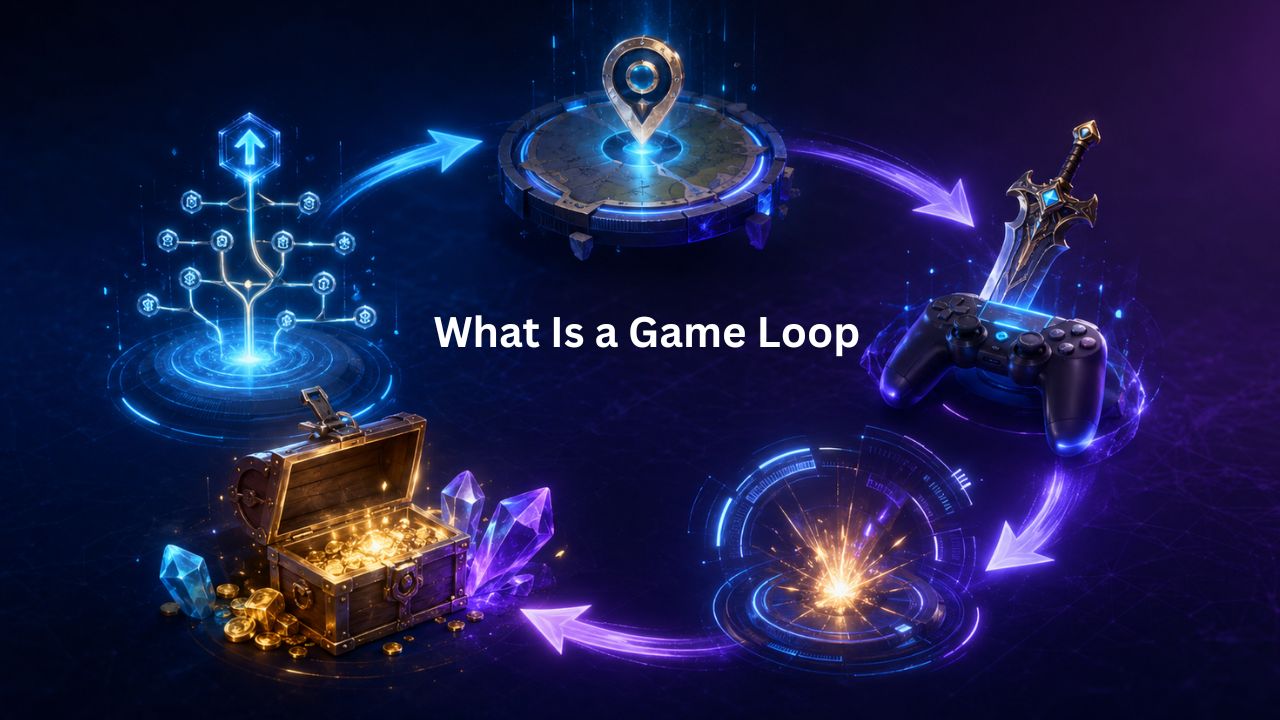
What is a game loop? In game design, a game loop is the repeating cycle of core actions a player takes—such as exploring, overcoming a challenge, receiving a reward, and upgrading—that drives continuous engagement. While programmers use the term for the technical code loop (process input, update, render), game designers use it to define the psychological rhythm of play.
Players don’t experience a feature list; they experience repeated actions. When moving, fighting, or building yields weak feedback and uninspired choices, even the most polished title falls flat. Understanding how to structure primary, secondary, and tertiary game loops is the key to turning isolated mechanics into a satisfying, endlessly replayable experience.
What Is a Game Loop in Design and Programming?
In game design, a loop connects player actions, game responses, and changed conditions. The player reads a situation, chooses, receives feedback, and decides again. That cycle may last seconds, a full match, or several sessions.
In programming, the term refers to the runtime cycle: process input, update state, render the next frame, repeat. Robert Nystrom’s technical explanation lays out that structure. Engines divide it into more stages; Unity’s Player loop documentation describes an ordered sequence of systems.
The two meanings are related, but they answer different questions:
| Meaning | What Repeats | Main Question |
| Technical game loop | Input, simulation, state updates, rendering | Does the game run correctly and consistently? |
| Core gameplay loop | The main actions players perform repeatedly | Is repeated play readable and satisfying? |
| Progression or meta loop | Upgrades, unlocks, collection, rank, story advancement | Does one session create a worthwhile reason to return? |
An engine can run correctly while its gameplay feels dull. A paper prototype can also reveal a promising decision cycle before final art or production code exists.
The Working Parts of a Strong Core Loop
“Action, reward, repeat” is too thin for useful design work. It treats players as reward collectors and hides the decisions that make games expressive.
A more useful loop contains five connected parts:
- A readable situation or goal. The player understands enough to act: an enemy approaches, crops need watering, or a route is blocked.
- An action with some agency. The player moves, aims, combines, spends, waits, negotiates, or uses another meaningful verb.
- Immediate feedback. Animation, sound, numbers, camera response, dialogue, or a changed world state shows what happened.
- A consequence. The action alters resources, risk, position, knowledge, relationships, or future options.
- A new decision. The changed state creates the next problem or opportunity.
Rewards need not be currency or loot. Information matters in a mystery game; a cleaner racing line rewards learning in a driving game.
The important connection is between consequence and next choice. If an action changes nothing about how the player thinks or behaves, repetition becomes busywork. A neat diagram cannot prove that the activity feels good in play.
Games Run Several Loops at Once
The timescale matters. Many games layer several cycles rather than relying on one loop. The moment-to-moment loop covers aiming, placing a tile, timing a jump, or choosing a dialogue response. This is where control feel and immediate feedback matter most.
The core loop organizes those verbs into a repeatable activity. Combat cycles through threats, targets, actions, and positioning; puzzles cycle through inspection, testing, and revision.
A session loop shapes one play period. The meta loop reaches across sessions through equipment, narrative progress, collections, rank, or new strategies.
These layers should support one another. Excessive meta progression can damage a good core activity, while exciting upgrades cannot give a weak action durable appeal.
Four Familiar Games, Reduced to Their Loops
These are simplified design readings, not official diagrams.
Super Mario: Movement Creates the Next Problem
In a traditional side-scrolling Mario course, the player reads terrain, runs or jumps, avoids hazards, collects items, and heads for the goal. Nintendo’s manuals identify movement, coins, checkpoints, and power-ups as basic systems. Collectibles cannot rescue unreliable jumping.
Stardew Valley: Limited Time Turns Chores into Plans
Stardew Valley is slower but no less structured. Players divide a finite day among farming, fishing, mining, foraging, combat, and relationships. Those activities improve skills and open later options. Watering a large field consumes time that could have gone to the mine or the town.
Hades: Failure Feeds the Next Attempt
Hades cycles through encounters, combat, reward choices, build development, and a deeper escape attempt. Supergiant describes changing combinations of Olympian powers, challenges, builds, and story events. Death ends a run, but knowledge, talents, weapons, and narrative interactions give the next one a different context.
Rocket League: A Stable Ruleset Produces Changing Situations
Rocket League demonstrates the opposite kind of depth. Its official premise is arcade-style soccer with cars, but every touch changes the ball, spacing, and available response. A small verb set stays interesting because opponents, momentum, and execution keep reorganizing the problem.
Why Repetition Can Stay Engaging
Repetition alone does not create engagement. Repetition with learning, choice, and changing context can.
Good feedback helps players build a mental model: an attack has a certain reach, or an enemy becomes vulnerable after a specific move. Improvement becomes visible.
A 2006 paper reported four studies of video-game motivation. In Studies 1–3, perceived autonomy and competence were associated with enjoyment and preference for future play. In an online multiplayer-community survey, autonomy, competence, and relatedness each independently predicted enjoyment and intended future play. This is a diagnostic lens, not proof that a particular loop will retain players.
- Competence: Can players understand the rules, improve, and see it?
- Autonomy: Do choices express a plan, style, or acceptable risk?
- Relatedness: Do cooperation, rivalry, recognition, or shared goals create connection?
Stable rules can produce varied situations. New enemy combinations, shortages, maps, or opponents make familiar verbs demand fresh judgment. Randomness helps only when players can respond.
Strong loops also place goals at different distances. The next jump matters now; finishing the level matters within the session; mastering a route may take several sessions.
The Mechanics–Dynamics–Aesthetics framework makes a related distinction. Mechanics are components and rules; dynamics are runtime behavior; aesthetics are intended emotional responses. Designers specify mechanics, but players encounter the result. Generous-looking progression may still feel irrelevant in play.
A Good Game Loop Supports Retention, but Cannot Guarantee It
Player retention asks whether people return after an initial session or event. GameAnalytics defines exact Day N retention as the percentage of users associated with an install day who return exactly N days later. Other products may use return windows or custom events. Before comparing numbers, document what counts as a new user, a return, and a day.
A satisfying loop cannot carry the product alone. The opening must teach its verbs without smothering the player. Session length should suit the platform and audience, while progression should add possibilities rather than longer chores.
Crashes, long loads, network problems, and input delay can interrupt good play. Returning players also need to recover their goals and controls quickly; reconstructing the game after every break is needless work.
Unity presents daily reward calendars as a reason to sign in again. That documents their purpose, not universal effectiveness. Claiming a reward does not show that a player values the core activity. Unclear feedback, repetitive decisions, and a slow opening deserve attention first.
A weak Day 1 result might reflect confusing onboarding, technical failure, misleading store presentation, or an unsatisfying loop. The number identifies a symptom. Event funnels, playtests, support reports, and player comments help locate the cause.
How to Design a Game Loop Before Building the Whole Game
A useful answer to “What is a game loop in this prototype?” begins with verbs, not features. Write what the player repeatedly does. “Explore, assess, choose a tool, act, read the result” is more useful than “open world with crafting and quests.”
Draw the smallest honest loop. If it jumps from “fight” to “upgrade,” identify what the fight produces and how the upgrade changes the next one.
Prototype the risky interaction early. A tactics game needs decisions with placeholder art. A platformer needs movement, collision, camera behavior, and a few obstacles. Shops, achievements, and cosmetics can wait; polishing an untested activity is wasted effort.
During playtests, watch for specific evidence:
- Can a new player state the immediate objective?
- Do they predict the result of an action before taking it?
- After feedback appears, do they understand why the result occurred?
- Does the result change their next choice?
- Where do they wait or repeat a solved action?
- When they stop, was the cause confusion, frustration, fatigue, or completion?
Do not explain every hesitation; assistance can hide a communication failure. Test the intended input method too. A loop that reads well with a mouse may become awkward on a controller or touchscreen.
Once the loop works, progression should widen decisions. A new weapon might favor distance, timing, or crowd control; a numerical upgrade that merely shortens the same task adds less depth.
Common Loop Problems That Rewards Cannot Hide
- The consequence is vague: Damage numbers appear, yet enemies barely react. Crafting consumes materials, but the interface does not show what improved. Better feedback matters more here than a larger reward.
- Execution repeats without decisions: Once an optimal sequence is known, the game keeps asking for it unchanged. New constraints, combinations, timing demands, or trade-offs add more than tougher health bars.
- Progression replaces play: Players repeat an activity for the next unlock, while that unlock changes little about later decisions. Early rewards can hide thin play; slower progression exposes it.
- Failure creates dead time: Long reloads, repeated dialogue, distant checkpoints, and slow rematches add waiting after the mistake has already been punished. Failure can carry weight without wasting time.
- The team measures only successful players: Completion data says little about people who left during the tutorial or hit a crash. The exits deserve as much attention as the completions.
- The diagram describes the economy, not the play: “Earn, spend, upgrade” could describe hundreds of games. Put the verbs requiring attention and skill at the center.
Final Thoughts
Asking what is a game loop gives teams a practical test: identify repeated actions, inspect feedback, trace consequences into the next decision, and connect short cycles to longer progression.
A strong loop helps players understand the game, make consequential choices, improve, and meet changing situations through familiar rules. Retention still depends on onboarding, performance, pacing, progression, and audience fit.
For a new project, build the smallest version that contains the central verbs, one meaningful choice, clear feedback, and a failure state. Let unfamiliar players try it without a running explanation. If those few minutes feel weak, fix the loop before adding progression, shops, or content. That is the practical value of asking what is a game loop early rather than after production has gathered momentum.