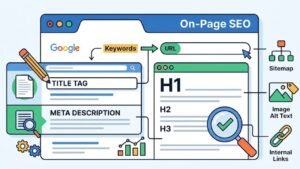
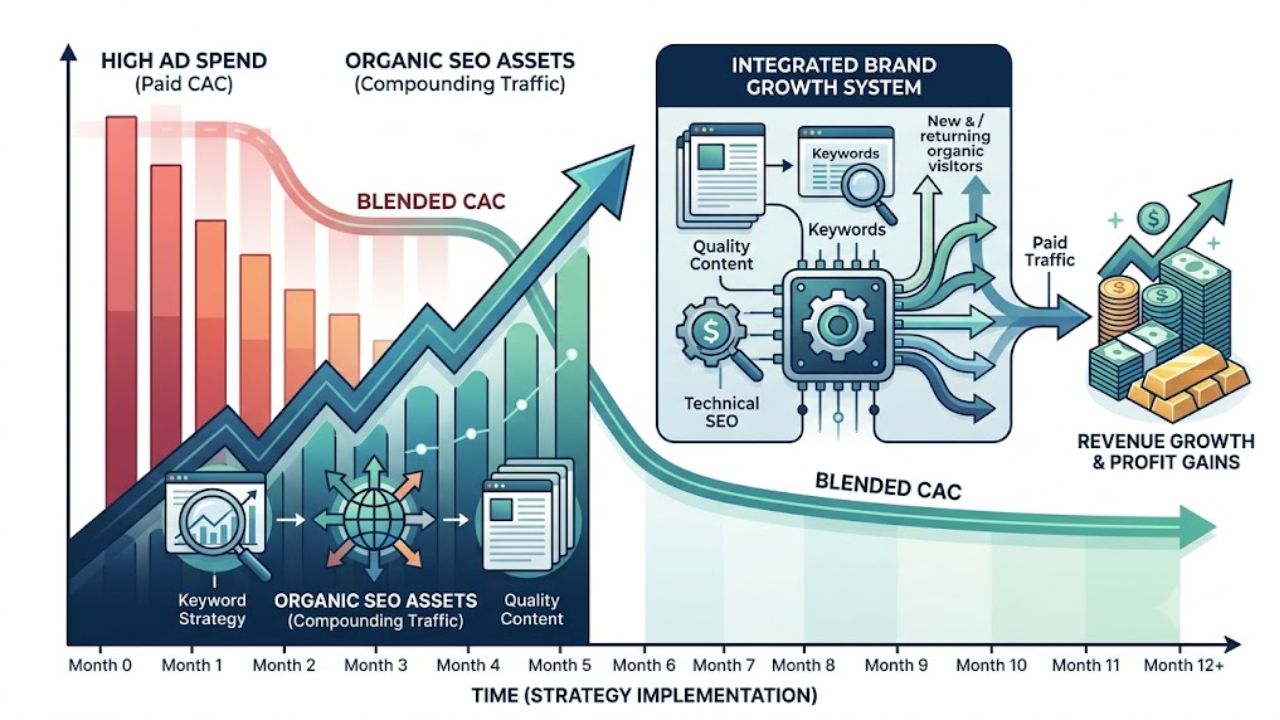
SEO for brand growth is the strategic practice of using search engine optimization to build long-term brand authority, lower customer acquisition costs (CAC), and capture high-intent buyers.
While paid acquisition on platforms like Meta or Google offers quick early traction, ad costs inevitably rise and retargeting pools saturate. Relying solely on performance ads is like renting an audience—the moment budgets are trimmed, traffic stops.
Organic search operates as a compounding capital asset. By aligning your content with search intent and category positioning rather than chasing isolated keywords, you create a sustainable discovery engine. This approach builds entity authority, stabilizes blended CAC, and establishes the market trust needed to scale revenue predictably.
Moving Beyond Tactical SEO
For over a decade, search engine optimization was treated as a mechanical volume game. Agencies handed clients spreadsheets packed with high-volume terms, generated thousands of words of surface-level copy, and bought low-quality backlinks on obscure blogs.
That approach is obsolete. Search engines now evaluate web pages using machine-learning models built to identify genuine brand authority and domain expertise. Google’s ranking systems specifically prioritize content that demonstrates Experience, Expertise, Authoritativeness, and Trustworthiness (E-E-A-T). Algorithms no longer look at keywords in isolation—they attempt to measure how thoroughly a brand understands its category.
When you treat SEO for brand growth as an executive priority rather than a technical side task, your primary objective changes. Instead of chasing vanity search volume on generic terms that never convert, you focus on occupying search real estate for queries that high-intent buyers use when researching real business problems.
The 4 Pillars of Brand-Led Search
Building an organic engine that consistently moves pipeline revenue requires execution across four connected disciplines.
1. Structural Architecture and Topic Clusters
Publishing random articles across loosely related industry topics makes it difficult for search engines to identify your core specialization. To establish domain authority, structure your site into tight topic clusters:
- Pillar Pages: Comprehensive primary resources that explain a foundational capability or core industry topic in depth.
- Sub-Topic Assets: Focused pieces that address specific technical questions, workflow edge cases, or implementation details.
- Internal Linking: Logical links connecting sub-topic pages back to the primary pillar using descriptive anchor text. This signals clear topical hierarchy to search crawlers.
This structure allows search algorithms to parse your site’s expertise systematically, raising the ranking potential for every page within that cluster.
2. Technical Infrastructure and Performance
Even exceptional content will fail to rank if your platform’s technical foundation creates friction for visitors. Search engines explicitly down-rank pages that load slowly, react sluggishly, or shift visually while loading.
Focus on three core technical benchmarks:
- Core Web Vitals: Maintain strong scores across Largest Contentful Paint (LCP) for loading speed, Interaction to Next Paint (INP) for responsiveness, and Cumulative Layout Shift (CLS) for visual stability.
- Mobile Parity: Ensure your mobile layout delivers full structural and content parity with desktop versions, as search engines index mobile pages first.
- Structured Data: Use JSON-LD schema markup (Organization, Product, Article) to help search algorithms accurately identify your brand as a distinct entity.
3. Digital PR and Authority Acquisition
Manual outreach emails asking for “guest posts” or low-tier link exchanges deliver negligible returns today. Sustainable authority comes from digital PR and primary research:
- Publish proprietary survey data or industry benchmarks that trade journalists cite as primary sources.
- Secure commentary placements for company leadership in recognized business and vertical trade outlets.
- Build direct relationships with industry analysts who cover your product category.
A single link or contextual citation from a respected industry publication carries far more weight than dozens of low-quality directory listings.
4. Search Intent Alignment
Traffic that doesn’t convert is simply a server expense. Align every page with what the visitor actually wants to achieve:
- Informational Queries: The reader is diagnosing a problem. Give them thorough guides and diagnostic frameworks alongside low-friction offers like email newsletters or templates.
- Commercial Queries: The reader is comparing options. Build honest head-to-head comparison pages, product teardowns, and buyer guides with clear demo request paths.
- Transactional Queries: The reader is ready to buy. Keep product landing pages, pricing grids, and case studies streamlined and free of UX friction.
The Financial Impact on Blended CAC
The primary commercial argument for organic search is its long-term impact on blended Customer Acquisition Cost.
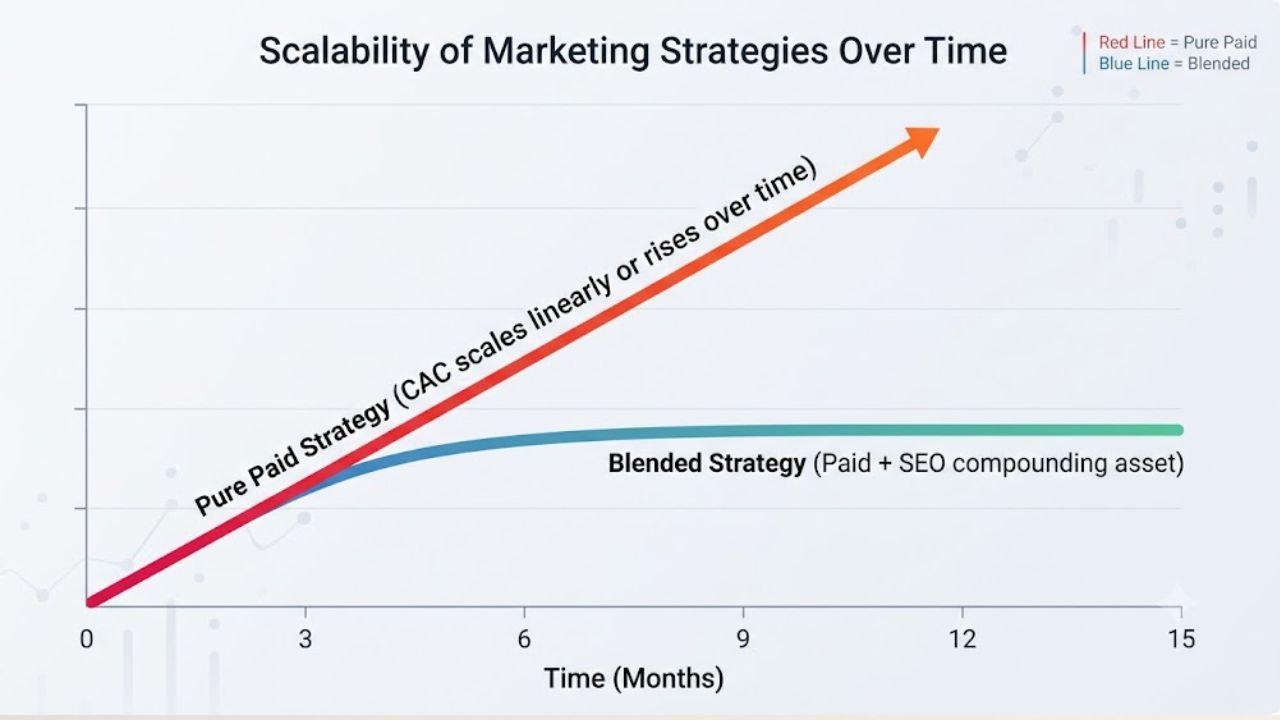
When customer acquisition relies entirely on paid media, CAC tends to scale linearly or increase over time as ad auctions become competitive. Layering in organic search alters this curve. Initial investments in content and technical infrastructure create an asset that attracts qualified prospects indefinitely without incurring an additional cost per click.
Cost Per Acquisition ($)
Furthermore, prospects who discover your brand through educational content during early research stages enter your sales pipeline with baseline trust. In practice, this often leads to shorter sales cycles and higher customer retention rates compared to cold paid traffic.
Practical Execution: Building a High-Intent Search Cluster
When shifting from a paid-only strategy to a balanced organic model, avoid attempting to cover your entire industry at once. Pick one core capability and build out from there.
- Target Problem-Specific Queries: Skip broad vanity keywords with high search volume and vague intent. If you sell B2B compliance software, avoid spending early resources trying to rank for “data security.” Instead, target precise queries like “SOC 2 compliance workflows for mid-market SaaS.”
- Audit Competitor Content: Search your target terms in an incognito window and analyze the top three results. Identify where they rely on surface-level summaries or outdated data, and determine what proprietary frameworks or technical details your team can offer instead.
- Draft Scan-Friendly Copy: Write directly for busy professionals. Address the main question in the first two paragraphs, then use clear section headers, bullet points, and concise tables to organize details logically.
- Include Contextual Next Steps: Avoid leaving readers at a dead end. Offer logical next steps like an inline link to a relevant case study, a downloadable implementation template, or a prompt to speak with a specialist.
Common Scaling Pitfalls
- Publishing AI-Generated Volume Without Oversight: Flooding a site with thin, automated content that lacks primary research or editorial review rarely succeeds. Search engines routinely de-index low-value content, which can degrade site-wide authority.
- Siloing SEO from Sales: Search strategists need direct visibility into sales objection logs, support tickets, and discovery call recordings. The highest-converting keyword opportunities come straight from questions prospects ask during sales calls.
- Expecting Instant Returns: Unlike paid ads, which generate traffic immediately upon launch, organic search is a compounding investment. New content typically takes weeks or months to index, gain authority, and stabilize in competitive search positions. Evaluating an organic initiative after 30 days usually leads to canceling a viable strategy prematurely.
Final Thoughts
Relying exclusively on paid performance media to drive business growth is a margin-diluting strategy over time. Rising ad costs and platform privacy changes make pure-paid models increasingly volatile.
Building an engine around SEO for brand growth establishes a durable, owned channel that captures demand continuously. By combining deep subject-matter expertise with clean technical execution and proper search intent alignment, you create a marketing asset that scales category authority and revenue long into the future..