

More than half of the most-played video games on the planet right now center on one simple idea: beating another human being, not a computer. From battle royales to chess apps, that idea has a name, and it shapes how millions of people play every single day.
If you have ever watched a teenager rage-quit after losing to a “random stranger online,” or heard a gamer say “let’s queue for ranked,” you have already brushed up against this concept without knowing its name. So what is PvP in gaming, exactly? This guide breaks it down in plain language, compares it to its opposite, and shows you why understanding this one term unlocks so much of modern gaming culture.
What Is PvP in Gaming: The Core Definition
At its heart, PvP in gaming means “Player versus Player.” It describes any game mode, match, or feature where you compete directly against another real person rather than against the game’s built-in artificial intelligence.
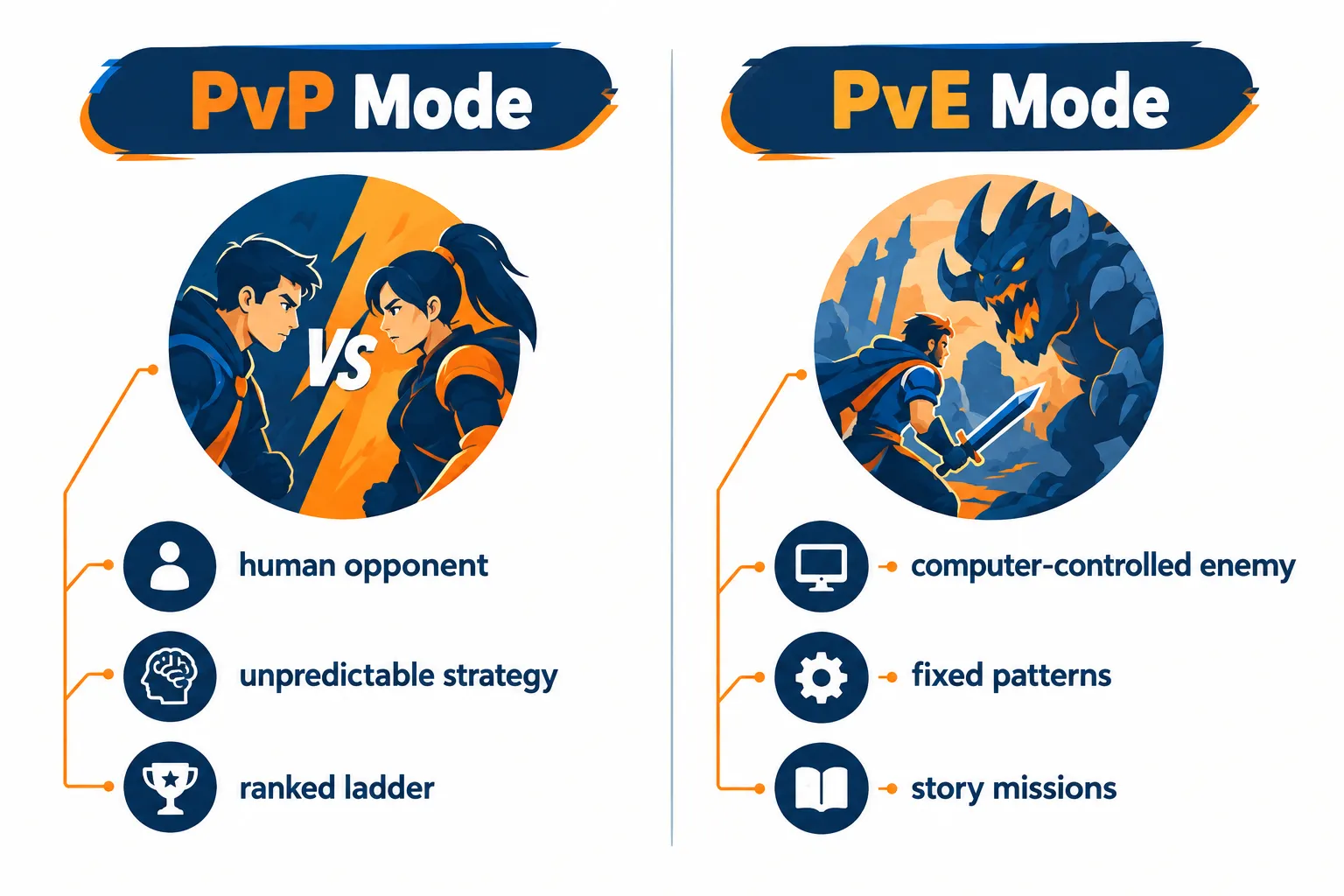
Dictionary and encyclopedia sources define PvP as a structured or unstructured contest between human-controlled characters within a shared game environment. The key word is human. A boss fight against a dragon controlled by the game’s code is not PvP. A duel against your friend using that same dragon character is.
This distinction matters because it changes everything about how a match feels. Computer opponents follow patterns. Humans adapt, bluff, and improve. That unpredictability is exactly why PvP has become one of the most popular formats in gaming history.
“PvP turns a video game into a sport. The rules stay the same, but the opponent never does.”
Where the Term Came From
The abbreviation PvP grew out of early online multiplayer games and text-based virtual worlds in the 1990s, where developers needed a quick way to label zones or servers where players could attack each other. As internet gaming spread through genres like first-person shooters, fighting games, real-time strategy titles, and eventually mobile apps, the term stuck. Today it appears in game menus, patch notes, and community forums across nearly every genre imaginable.
PvP vs PvE: The Fundamental Contrast
Understanding what is PvP in gaming becomes much easier once you compare it side by side with its counterpart, PvE, or “Player versus Environment.”
In PvE, you fight against enemies, puzzles, or challenges that the game itself creates and controls. Think of a dungeon boss, a wave of zombies, or a maze full of traps. The environment is scripted. If you learn the pattern, you can master the fight through practice alone.
In PvP, the opponent is a thinking, adapting human being sitting behind a screen somewhere else. That person can outsmart you, change strategy mid-match, or exploit a weakness you did not know you had.
Here is a simple breakdown:
| Feature | PvP | PvE |
|---|---|---|
| Opponent | Real human player | Computer-controlled AI |
| Predictability | Low, changes every match | Higher, often follows patterns |
| Skill ceiling | Rises with opponent skill | Rises with game difficulty |
| Common formats | Ranked matches, tournaments, duels | Campaigns, raids, quests |
| Emotional stakes | Competitive, sometimes tense | Cooperative, exploratory |
Many modern games do not force you to choose one or the other. They blend both, and some even add a third category called PvC.
PvP, PvE, and PvC: How Hybrid Games Mix Modes
PvC stands for “Player versus Computer.” While it sounds similar to PvE, PvC often refers more narrowly to a single-player match against a bot, such as a practice match before you jump into real PvP. Many fighting games and card games use PvC as a low-pressure warm-up mode.
Large multiplayer games frequently combine all three formats into one package:
- A shared open world where PvE quests and PvP zones exist side by side.
- Practice arenas using PvC bots to learn mechanics before facing real players.
- Seasonal events that temporarily turn a PvE area into a PvP battleground.
This hybrid design keeps games fresh. Players who enjoy calm exploration can stick to PvE. Players who crave competition can seek out PvP zones without switching games entirely.
Synchronous vs. Asynchronous PvP: A Modern Nuance
One thing beginners often miss is that not all PvP happens in real time. There are actually two major formats, and knowing the difference helps explain why some PvP games feel slow-paced while others feel intense and immediate.
- Synchronous PvP means both players are online and playing at the exact same moment. Think of a first-person shooter match, a fighting game round, or a live chess game. Every move happens in real time, and both sides react instantly.
- Asynchronous PvP means players are not online together at all. One player attacks a base, sets up a battle, or submits a move, and the game calculates the result later, sometimes hours afterward. Many mobile strategy games use this format because it fits busy schedules. You can play a “PvP match” during your lunch break, and your opponent might not see the result until that evening.
Neither format is better than the other. Synchronous PvP delivers raw excitement and immediate feedback. Asynchronous PvP offers flexibility for players who cannot commit to matching schedules.
How PvP Scoring, Ranking and Structure Work
From a game design standpoint, PvP is more than just “fighting another player.” Good PvP systems need structure to stay fair and rewarding over time. Designers typically build in several layers:
- Matchmaking, pairing players of similar skill so matches feel balanced.
- Ranking systems, tiers like Bronze, Silver, Gold, or numeric ratings that track skill over time.
- Scoring rules, points awarded for kills, objectives, wins, or survival time.
- Seasons, resetting periods that let players climb the ladder again and earn new rewards.
- Leaderboards, public rankings that show top performers, fueling competition and bragging rights.
Without these systems, PvP would feel random and unfair. New players would constantly face veterans, and there would be little reason to keep improving. Ranking and scoring turn PvP into a long-term goal rather than a single match.
A Real Example: Structured PvP in Guild Wars 2
A helpful case study is the World versus World mode found in Guild Wars 2. In this format, entire server communities are grouped into teams and placed on a large map filled with keeps, towers, and camps. Teams fight for territory over days or weeks, not just single matches.
Points accumulate based on how much territory a team controls and how many enemy players they defeat. This structure shows how far PvP has evolved beyond simple one-on-one duels. It can scale into massive, ongoing wars involving hundreds of players working toward a shared competitive goal, blending strategy, teamwork, and individual skill all at once.
Common Confusion New Players Have About PvP
Newcomers and parents trying to understand gaming terminology often stumble over a few recurring points. Here are the most common questions, answered simply.
Is PvP always violent or combat-based?
Not always. While PvP is common in shooters and fighting games, it also appears in racing games, sports simulations, trivia apps, and card games. Any format where you compete directly against a human counts as PvP.
Is PvP the same as multiplayer?
No. Multiplayer simply means more than one person can play together. You can have cooperative multiplayer, where everyone fights the same computer enemies as a team. That is still PvE, just with friends.
Can PvP be turned off?
In many games, yes. Some titles let players toggle PvP zones on or off, or offer entirely separate PvE-only servers for people who prefer a relaxed experience.
Why do some players avoid PvP entirely?
PvP tends to be more stressful because losses feel personal. Losing to an unpredictable AI pattern stings less than losing to another player who outsmarted you directly. This is a completely normal reaction, and it is why many games offer both options.
PvP Beyond Gaming: A Cultural Shorthand
The influence of this term has stretched well past video games. “PvP” now shows up in business meetings, sports commentary, and everyday conversation as a quick way to describe direct head-to-head competition, as opposed to a team simply working against a general challenge or market condition. When someone says a negotiation “turned into total PvP,” they mean it became a direct contest between two sides rather than a cooperative effort.
This spread of meaning shows just how deeply the concept resonates. Direct competition between two thinking parties, whether in a game or a boardroom, creates a distinct kind of tension that purely environmental challenges rarely match.
Final Thoughts
Understanding what is PvP in gaming gives you a real advantage, whether you are picking a game for your child, joining friends online for the first time, or simply trying to follow gaming conversations without feeling lost. PvP means competing against real human opponents, while PvE means facing computer-controlled challenges. Many modern games blend both, and PvP itself splits further into real-time and delayed formats, each supported by ranking and scoring systems that keep competition fair and engaging.
If you are new to PvP, start small. Try a practice mode against bots first, look for games with beginner-friendly ranked tiers, and do not be discouraged by early losses. Every skilled PvP player started as a beginner facing unpredictable human opponents for the first time. The next step is simple: pick one game, find its PvP mode, and jump into your first match with a clear understanding of exactly what you are getting into.