

More than half of all active video game sessions worldwide involve some form of cooperative or solo play against computer-controlled enemies rather than other humans. That single fact explains why one term shows up in nearly every online game menu, forum post, and Discord chat: PvE.
If a friend just invited you to a “PvE dungeon run” and you nodded along without really knowing what that meant, you are not alone. Understanding what is PvE in gaming is one of the fastest ways to feel confident jumping into any multiplayer title, from massive online role-playing games to modern looter-shooters.
This guide breaks down the term in plain language, compares it to its well-known counterpart, and shows beginners exactly where to start.
What Is PvE in Gaming: The Basic Definition
At its core, PvE stands for Player versus Environment. It describes any part of a video game where the player, or a group of players, faces off against challenges created and controlled by the game itself. That includes computer-controlled monsters, traps, puzzles, and scripted story events. There are no real people on the other side trying to outsmart you. Instead, you are testing your skills against the rules and design choices built into the software.
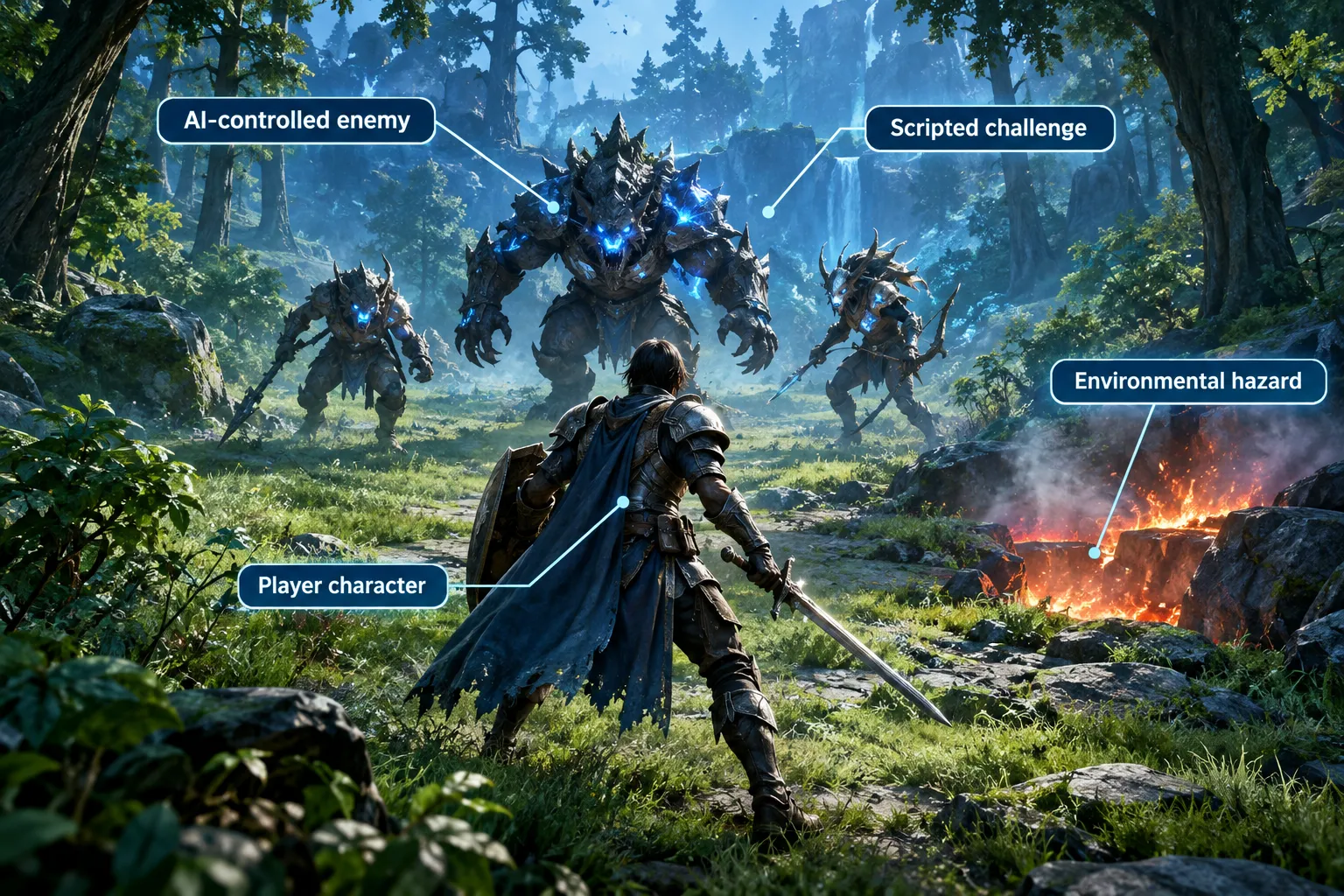
This is the most common and consistent definition used across gaming encyclopedias, official glossaries, and beginner guides. Whether the source is a dictionary entry, a game studio’s help page, or a cybersecurity company explaining online gaming terms to parents, the answer stays the same: PvE means fighting the game, not fighting people.
Some communities use a related term, PvM, short for Player versus Monster. It means almost the same thing as PvE and is often used interchangeably, especially in older or fantasy-themed games. You may also see PvC, or Player versus Computer, used the same way. All three terms point to the same basic idea: you are up against artificial intelligence, not a human being sitting behind another keyboard or controller.
PvE vs PvP: Understanding the Core Difference
Once you understand what is PvE in gaming, the next logical question is how it differs from PvP. The distinction is simple but important, especially for anyone choosing a game mode for the first time.
| Feature | PvE (Player vs Environment) | PvP (Player vs Player) |
|---|---|---|
| Opponent | Computer-controlled enemies | Real human players |
| Predictability | Follows programmed patterns | Unpredictable human strategy |
| Pressure level | Generally lower, self-paced | Often higher, competitive |
| Common content | Quests, dungeons, raids, bosses | Duels, arenas, ranked matches |
| Can be played solo | Yes, often designed for solo or co-op | Rarely, usually requires opponents |
“PvE is about beating the game’s design. PvP is about beating another person’s mind.”
Neither mode is better than the other; they simply serve different goals. PvE rewards patience, exploration, and learning enemy patterns. PvP rewards quick reflexes, adaptability, and reading human behavior. Many popular games, including massive online role-playing games and shooter titles, offer both PvE and PvP modes, letting players pick a lane depending on their mood or skill comfort level.
Common Types of PvE Content in Modern Games
PvE is not one single activity. It is an umbrella term covering many kinds of gameplay. Beginners often get confused because the same label applies to very different experiences.
Here are the most common forms of PvE content found in today’s games:
- Story quests and missions, Narrative-driven tasks that move the plot forward, usually completed solo or with a small group.
- Dungeons, Enclosed areas filled with enemies, traps, and puzzles, often designed for a team of three to five players.
- Raids, Large-scale, high-difficulty encounters requiring a bigger group, careful coordination, and specific character roles.
- Boss fights, Intense battles against a single powerful enemy with unique attack patterns and phases.
- Scripted events, Time-limited or story-triggered scenarios, such as defending a location or surviving a wave of enemies.
- Open-world exploration challenges, Environmental puzzles, hidden treasures, and roaming AI enemies scattered across a map.
All of these share one trait: the challenge comes from the game’s design, not from another player’s decisions. That is the defining thread that ties every type of PvE content together.
Why Beginners Should Start With PvE in Gaming
For someone new to online multiplayer games, jumping straight into PvP can feel overwhelming. Human opponents adapt, bluff, and punish mistakes in ways a scripted enemy never will. This is exactly why so many gaming guides recommend starting with PvE first.
PvE gives new players room to breathe. It lets you:
- Learn the controls and combat systems without a real person capitalizing on every mistake.
- Understand character builds, skills, and gear at a comfortable pace.
- Enjoy the story and world-building most games are designed around.
- Practice teamwork in a lower-stakes setting before facing competitive players.
Game designers intentionally build PvE with a difficulty curve. Early missions are easy. Later dungeons and raids get progressively harder, teaching new mechanics one step at a time. This structure is one reason PvE is often described as the tutorial layer of online gaming, even in games that are not technically calling it a tutorial.
For parents trying to understand what their kids are doing online, PvE is generally the calmer, more cooperative side of gaming culture. It is built around solving problems together, not competing aggressively against strangers.
PvE Terminology You Should Know
Walking into a PvE-focused conversation without knowing the vocabulary can feel like reading a foreign language. Here are common terms beginners will run into:
- Boss, A uniquely powerful enemy, often at the end of a dungeon or mission.
- Mechanic, A specific pattern or rule a boss or encounter follows that players must react to.
- Wipe, When an entire group is defeated during a PvE encounter, usually forcing a restart.
- Tank, Healer, DPS, Common team roles in cooperative PvE content. Tanks absorb damage, healers restore health, and DPS (damage per second) characters focus on defeating enemies.
- Grinding, Repeating PvE content to earn experience, loot, or currency.
- Loot, Items, weapons, or rewards earned from defeating PvE enemies or completing missions.
Knowing these terms will make joining any PvE group chat, guild, or party far less intimidating. Most experienced players are happy to explain further, but arriving with a basic vocabulary shows you understand what is PvE in gaming and how team roles fit into it.
How to Get Started With PvE in Gaming
If you are ready to try PvE for the first time, a gradual approach works best. Rushing into high-difficulty group content before learning the basics often leads to frustration for both new players and their teammates.
A simple starting path looks like this:
- Play the single-player campaign or story mode first. This is almost always classified as PvE, since you are only facing computer-controlled opponents.
- Complete early solo side quests. These are usually low-risk and teach core mechanics.
- Try a small group dungeon. Look for beginner-friendly or “normal difficulty” options before attempting harder versions.
- Communicate with your team. Even basic PvE content benefits from simple callouts like “enemy incoming” or “need healing.”
- Work up to raids or endgame content. These require more coordination, but by this stage, the mechanics will feel familiar.
Most online games clearly label their PvE playlists, servers, or menu options, so finding this content is usually straightforward. If unsure, checking a game’s settings menu or official website for terms like “PvE mode,” “co-op mode,” or “story mode” will point you in the right direction.
Final Thoughts
PvE, or Player versus Environment, is one of the foundational building blocks of modern gaming. It describes any content where players face computer-controlled enemies and scripted challenges instead of real human opponents, from single-player story campaigns to massive cooperative raids. Understanding what is PvE in gaming makes it far easier to choose the right mode, follow along in multiplayer conversations, and build confidence before ever stepping into competitive PvP.
For beginners, the best next step is simple: open a game’s mode selection screen, look for PvE, co-op, or story options, and start with the easiest available content. Progress at a comfortable pace, learn the basic terminology, and add teammates once the fundamentals feel natural. That steady approach turns an unfamiliar acronym into one of the most rewarding parts of the gaming experience.