
A blank page used to cost writers hours. Now it costs minutes. User-review platforms like G2 and Capterra have watched the AI writing software category swell into one of the fastest-growing software groups they track, with hundreds of products competing for the same blinking cursor. That growth is good news and bad news: the best AI writing tools can genuinely cut drafting time in half, but the sheer number of options makes choosing one feel like a second job.
This guide cuts through the noise. Instead of listing fifty apps, it maps the small group of tools that content professionals actually keep in their stack in 2026, and explains which job each one is built for.
How the Best AI Writing Tools Are Grouped
There is no single “best” tool, because writing is not a single task. Drafting a 2,000-word guide, tightening a client email, and spinning out forty ad variations are three different problems. The smartest content teams run a small stack of two to four tools rather than forcing one app to do everything.
Here is how the market sorts out:
Category What it does best Leading tools General assistants Drafting, outlining, research, rewriting ChatGPT, Claude Editing and tone Grammar, clarity, brand voice, polish Grammarly Marketing at scale Ad copy, emails, product descriptions, templates Jasper, Copy.ai, Writesonic, Anyword SEO content Briefs, keyword coverage, content scoring Surfer SEO, Frase, Writesonic Research writing Source-backed summaries, literature review Consensus, Unriddle (Anara AI) Embedded suite AI Writing inside docs, email, and wikis Gemini, Microsoft Copilot, Notion AI
A tool stack beats a tool. Pair one strong general assistant with one specialist, and most content workflows get faster immediately.
General-Purpose AI Writing Tools: ChatGPT and Claude
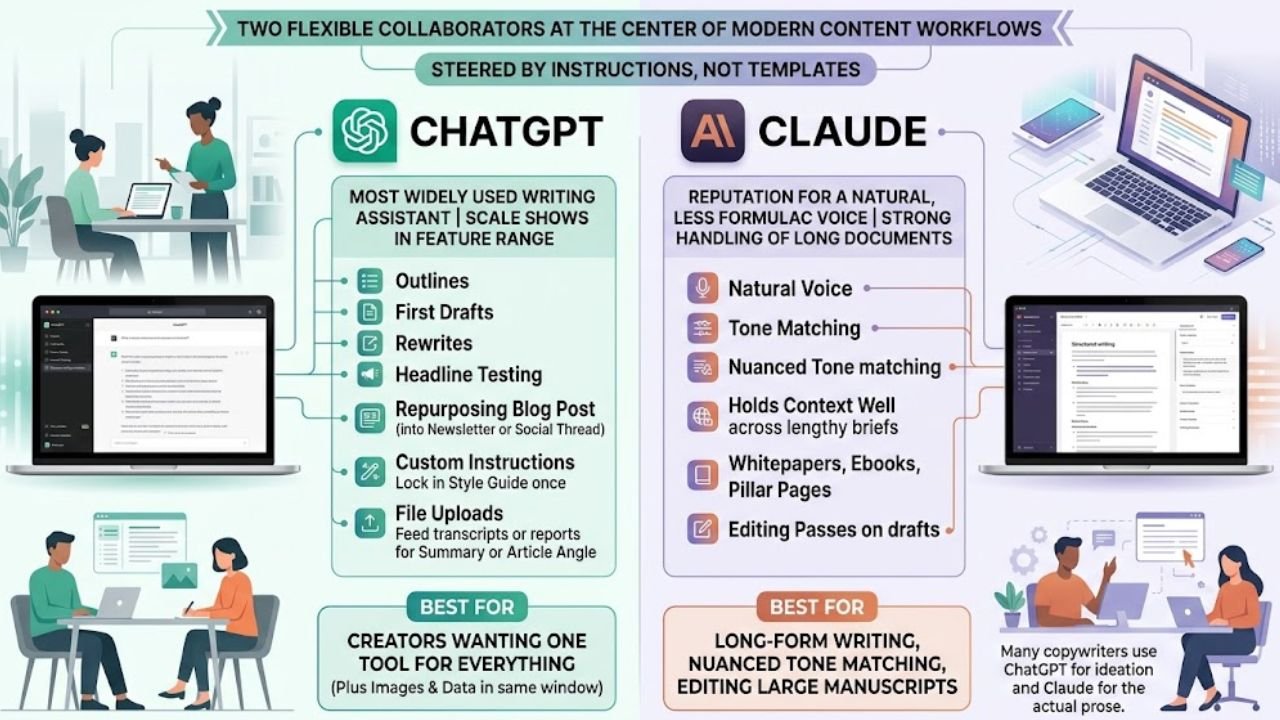
These two sit at the center of nearly every modern content workflow. They are not templates, they are flexible collaborators you steer with instructions.
ChatGPT
ChatGPT is the most widely used writing assistant in the world, and that scale shows in its feature range. It handles outlines, first drafts, rewrites, headline testing, and repurposing a blog post into a newsletter or social thread. Custom instructions let you lock in a style guide once instead of re-explaining it every session, and file uploads mean you can feed it a transcript or report and ask for a summary or article angle.
Best for: creators who want one tool that does a bit of everything, plus image and data work in the same window.
Claude
Claude has earned a reputation among writers for a more natural, less formulaic voice and strong handling of long documents. It holds context well across lengthy briefs, which makes it a favorite for whitepapers, ebooks, pillar pages, and editing passes on existing drafts. Many copywriters use ChatGPT for ideation and Claude for the actual prose.
Best for: long-form writing, nuanced tone matching, and editing large manuscripts.
Grammarly: The Editing Layer Most Writers Keep
Grammarly is the one tool that shows up in almost every content stack regardless of industry, and it consistently ranks near the top of user-review charts on both G2 and Capterra. Its job is not to write for you, it is to make what you wrote clearer.
What it does well:
- Catches grammar, spelling, and punctuation errors in real time across browsers, docs, and email
- Flags wordy or unclear sentences and suggests tighter versions
- Offers tone detection, so you can see whether a message reads as confident, friendly, or blunt before sending it
- Supports brand style guides and shared team vocabularies on business plans
- Includes generative drafting and rewriting features, which closed the gap with pure AI writers
For small business owners and solo creators who publish regularly but do not have an editor, Grammarly functions as a cheap, always-on second reader. The free tier covers core corrections; paid plans unlock the clarity, tone, and brand-voice layers.
Marketing-Focused AI Writing Tools for Scale
When the task is volume, fifty product descriptions, a six-email nurture sequence, ad variations for three audiences, purpose-built marketing platforms beat a blank chat box. They come with templates, brand-voice training, and team workflows.
Jasper
Jasper is positioned squarely at brand and marketing teams. Its strength is brand voice consistency: you train it on existing content, and it keeps new output on-message across campaigns and contributors. Workflow features, campaign generation, and approval-friendly collaboration make it a common pick for agencies and mid-size marketing departments.
Copy.ai
Copy.ai has shifted toward go-to-market workflow automation. Beyond short-form copy generation, it chains steps together, research a prospect, draft an email, personalize a landing page, which appeals to sales-adjacent content teams.
Writesonic
Writesonic is the versatile middle ground: article generation, SEO optimization, and chat-based research in one subscription. It is often recommended to bloggers and small teams who want SEO features without paying for a separate optimization tool.
Anyword
Anyword’s differentiator is predictive performance scoring. Instead of guessing which headline will convert, you get a data-backed score based on past performance patterns. Performance marketers running paid campaigns find this especially useful.
Tool Standout strength Typical user Jasper Brand voice at scale Brand and agency teams Copy.ai Workflow automation GTM and sales content teams Writesonic All-in-one writing plus SEO Bloggers, small businesses Anyword Copy performance prediction Paid media and CRO marketers
SEO-Driven AI Writing Tools That Target Search Intent
Great prose that nobody finds is a wasted afternoon. SEO-focused AI writing tools connect drafting to what people actually search for.
Surfer SEO builds data-driven content briefs from live search results, then scores your draft in real time against competing pages for terms, headings, and depth. Writers use it as a guardrail rather than a generator, it tells you what a ranking page on your topic usually covers.
Frase leans into research speed. It pulls competing articles, extracts their structure and common questions, and assembles an outline in minutes. For teams producing comparison posts and FAQ-heavy content, it compresses hours of SERP analysis into a single screen.
Writesonic overlaps here too, bundling keyword guidance into its article workflow for users who prefer one subscription over two.
A practical pattern that works well:
- Build the brief in Surfer or Frase.
- Draft against that brief in Claude or ChatGPT.
- Edit and tone-check in Grammarly.
- Score the final draft back in Surfer before publishing.
Research and Academic Writing
Not all content is marketing. For writers who need claims backed by literature, two tools have gained real traction.
Consensus searches academic papers and returns evidence-based answers with links to the underlying studies, useful for health, finance, and science content where accuracy matters more than speed. Unriddle (Anara AI) helps readers work through dense PDFs, surfacing key findings, definitions, and related sources so a 40-page report becomes usable in an afternoon.
For any topic where a wrong claim damages trust, source-grounded tools are not optional extras, they are the fact-checking layer.
Embedded AI in Everyday Productivity Tools
Some of the most-used AI writing tools are not standalone apps at all. They live where work already happens.
- Gemini in Google Workspace drafts and refines inside Docs and Gmail, which removes copy-paste friction entirely.
- Microsoft Copilot does the same across Word, Outlook, and Teams, and is often already included in an organization’s existing license.
- Notion AI summarizes meeting notes, drafts inside wiki pages, and answers questions using your own workspace content.
For small teams, these can cover 70 percent of daily writing needs without adding a new subscription. Check what your existing suite already includes before buying anything new.
Pricing and Free Plans: What to Expect
As of late 2026, the landscape is friendly to testers. Nearly every major tool offers a free tier or trial, and mainstream paid plans for individuals typically land in the low-to-mid double digits per month, with team plans scaling by seat.
Practical budgeting advice:
- Start free: ChatGPT, Claude, Grammarly, Copy.ai, and Writesonic all have usable free entry points.
- Pay for the bottleneck: If research eats your week, buy the SEO tool. If consistency across writers is the problem, buy the brand-voice platform.
- Watch for overlap: Paying for three tools that all generate blog posts is the most common waste in content budgets.
- Check annual discounts: Most vendors shave a meaningful percentage off for yearly commitments.
What Comes Next (Analyst Expectations)
These are forward-looking predictions, not certainties. Analysts and vendor roadmaps point in a consistent direction:
- Agentic workflows will move beyond drafting toward multi-step execution, research, write, optimize, schedule, with human approval checkpoints.
- Brand voice training will become table stakes rather than a premium feature.
- Built-in detection and provenance signals will grow as publishers tighten quality standards.
- Consolidation is likely, with general assistants absorbing features that are currently sold as separate products.
The strategic takeaway: favor tools that fit a workflow you control, and avoid locking a whole operation into one vendor.
Final Thoughts
The best AI writing tools in 2026 are not the ones with the longest feature lists, they are the ones that remove a specific bottleneck from your workflow. ChatGPT and Claude handle the writing itself. Grammarly handles the polish. Jasper, Copy.ai, Writesonic, and Anyword handle volume and brand consistency. Surfer SEO and Frase connect all of it to search demand.
Frequently Asked Questions (FAQs) About AI Writing Tools
Can AI writing tools replace human writers?
No. They accelerate drafting and editing, but judgment, original reporting, and brand nuance still come from people. The strongest results come from a writer directing the tool.
Do search engines penalize AI-assisted content?
Search engines reward helpful, accurate, original content regardless of how it was produced. Thin, unedited output tends to underperform, not because AI wrote it, but because it adds nothing new.
How many AI writing tools does one person need?
Usually two. One general assistant for drafting and one specialist for your biggest bottleneck, whether that is editing or SEO.