
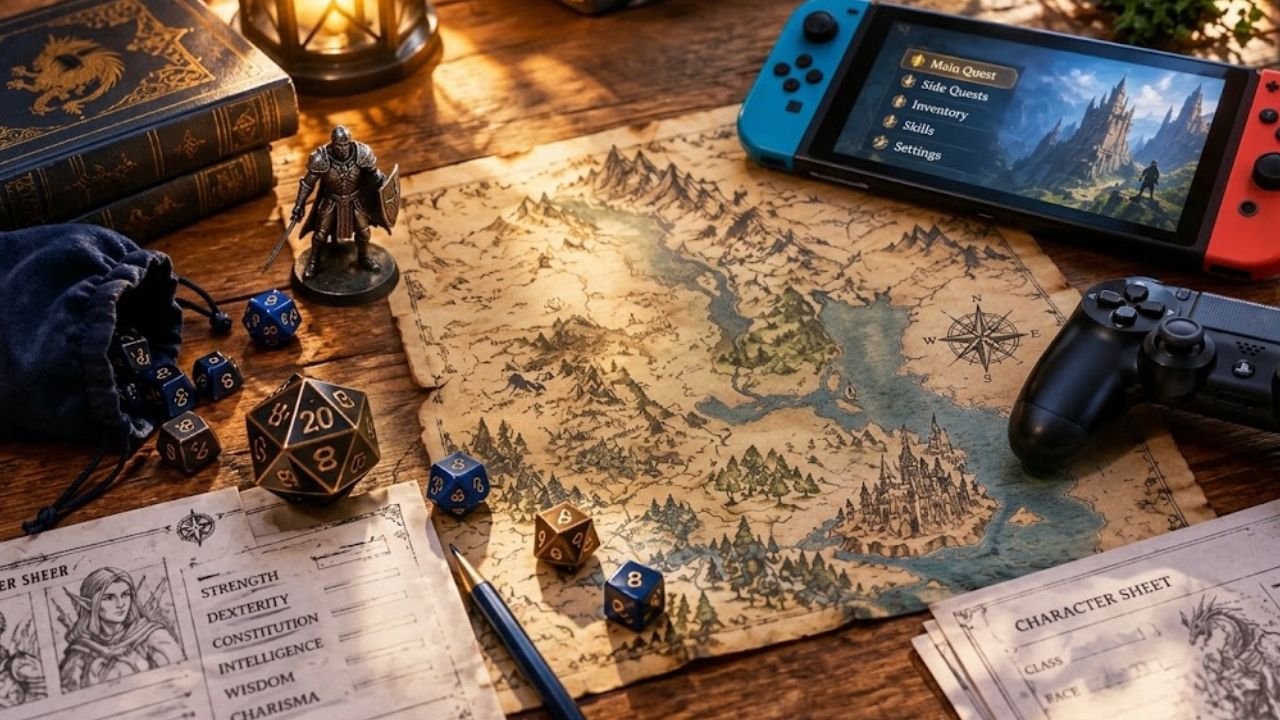
A single tabletop game invented in 1974 ended up shaping nearly every blockbuster video game released since. Experience points, skill trees, loot drops, dialogue choices, all of it traces back to the role-playing genre. So when people ask what is an RPG game, the honest answer is bigger than one genre: it is the blueprint that modern gaming borrowed from.
An RPG, short for role-playing game, is a game where you take control of a character, make decisions as that character, and watch them grow stronger and change over time through a story.
That simple idea has produced some of the most beloved games ever made, from Dungeons & Dragons around a kitchen table to Final Fantasy, Pokémon, Baldur’s Gate 3, and The Elder Scrolls V: Skyrim. This guide breaks down the terminology, the mechanics, and the main types of RPGs in plain language.
What Is an RPG Game: The Simple Definition
Dictionaries and game scholars land in roughly the same place: a role-playing game is a game in which participants adopt the roles of fictional characters and guide their actions within a story, following an agreed set of rules.
Break that into three parts and the whole genre makes sense:
- You play a role. You are not just moving a game piece. You are a knight, a space smuggler, a monster trainer, or a detective with a personality and a past.
- You make choices. Where to go, who to trust, which skills to learn, whether to fight or talk your way out.
- Your character grows. Through practice and success, your character becomes measurably more capable, stronger, smarter, better equipped.
A platformer asks “can you make this jump?” An RPG asks “who is your character, and what will they become?”
That last part, persistent character growth, is the clearest dividing line. In most action games, you end the game with the same abilities you started with. In an RPG, progress is baked into the character itself.
A Short History: From Dice to Open Worlds
The modern genre began in 1974 with Dungeons & Dragons, a tabletop game that combined war-gaming rules with collaborative storytelling. Players described what their characters tried to do, rolled dice to see whether they succeeded, and a referee called the Game Master described the results.
When home computers arrived, developers translated those rules into code. Early titles like Ultima and Wizardry copied D&D’s math almost directly. Japanese studios then took the formula in a more story-driven, cinematic direction, producing Dragon Quest and Final Fantasy. Those two traditions, Western RPGs built around player freedom and Japanese RPGs built around authored narrative, still shape the genre today.
By the 2020s, RPGs had become one of gaming’s most commercially dominant forms. Titles like Baldur’s Gate 3 brought tabletop rules to a mainstream audience and proved that deep, rules-heavy role-playing could win game-of-the-year awards and sell millions of copies.
How RPGs Actually Work: The Core Gameplay Loop
Most RPGs, regardless of setting or art style, run on the same repeating cycle. Learning this loop is the fastest way to feel comfortable with any RPG you pick up.
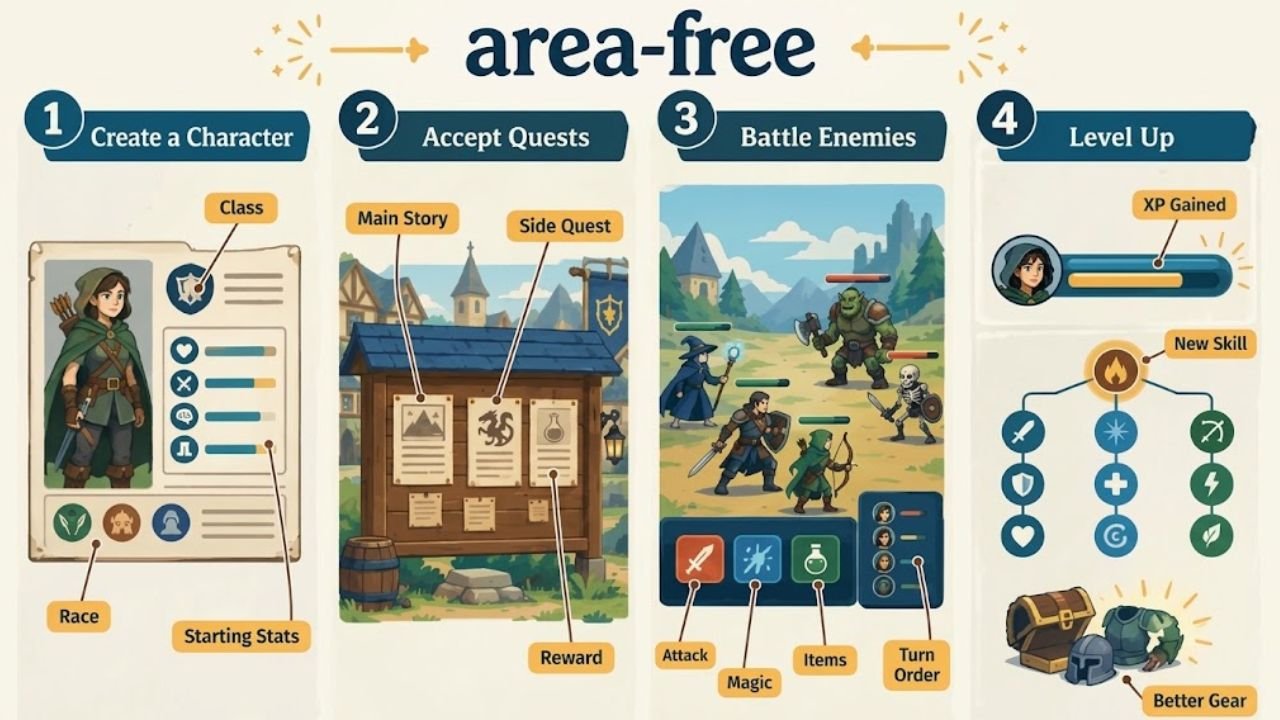
- Step 1: Create or meet your character. You either build one from scratch (choosing appearance, class, and starting stats) or step into a pre-written protagonist.
- Step 2: Explore and accept quests. Quests are tasks, deliver a letter, clear a cave, uncover a conspiracy. Main quests drive the story; side quests are optional and usually offer rewards and world-building.
- Step 3: Face challenges. Historically that meant combat, but it increasingly means persuasion, stealth, crafting, puzzles, or negotiation.
- Step 4: Earn rewards. Success grants experience points (XP), money, and items.
- Step 5: Level up and customize. Enough XP raises your character’s level, which grants new abilities, higher stats, or skill points to spend.
- Step 6: Repeat at a higher difficulty. Stronger characters face bigger threats, deeper story beats, and more complex choices.
Key Mechanics That Define the Genre
When someone asks what is an RPG game from a mechanical standpoint, these are the building blocks to point to.
| Mechanic | What It Does | Common Example |
|---|---|---|
| Character creation | Lets you choose class, background, and appearance | Picking a mage, rogue, or warrior |
| Stats and attributes | Numbers that define capability | Strength, Intelligence, Agility, Charisma |
| Experience and leveling | Converts success into permanent growth | Hitting Level 10 and unlocking a new spell |
| Skill trees | Branching menus for specializing your build | Choosing fire magic over healing magic |
| Inventory and loot | Gear that changes your performance | Finding a rare sword with bonus damage |
| Quests | Structured goals that carry the story | A village elder asking for help |
| Dialogue choices | Conversation options that alter outcomes | Lying, threatening, or telling the truth |
| Party management | Recruiting and directing companions | A four-person team with different roles |
Stats, Builds, and Why Numbers Matter
Every RPG character is, underneath the art, a set of numbers. A high Strength score means heavier weapons hit harder. High Charisma might unlock conversation options a brawler never sees. The specific combination of stats, skills, and gear a player assembles is called a build, and experimenting with builds is a big part of the genre’s long-term appeal.
Classes and Roles
A class is a character archetype that bundles abilities together. Classic examples:
- Warrior / Fighter, high health, close-range damage, absorbs hits
- Mage / Wizard, powerful ranged magic, fragile in a fight
- Rogue / Thief, stealth, speed, lockpicking, critical strikes
- Cleric / Healer, keeps the party alive, support abilities
- Ranger / Archer, ranged attacks, tracking, animal companions
In team-based RPGs, these roles are often described as tank (takes damage), damage dealer or DPS (deals damage), and support or healer.
Tabletop RPGs vs Video Game RPGs
Both formats share the same DNA, but they feel very different in practice.
| Tabletop RPG | Video Game RPG | |
|---|---|---|
| Rules enforced by | A human Game Master and rulebooks | Software |
| Tools needed | Dice, character sheets, pencils, friends | A console, PC, or phone |
| Freedom of action | Nearly unlimited, you can try anything | Limited to programmed options |
| Story source | Created live by the group | Written by developers |
| Typical session | 2 to 4 hours, in a group | Solo or online, any length |
| Best for | Social creativity, improvisation | Visuals, convenience, playing alone |
Academic researchers often describe tabletop role-playing as a complex form of social, rule-based collaborative storytelling, part game, part improvised theater. Video RPGs trade some of that freedom for polished worlds, music, and visual spectacle that no table can match.
Main Types of RPGs Beginners Will Encounter
The genre has splintered into many subgenres. Here are the ones most worth knowing.
- JRPG (Japanese RPG), Strong authored stories, defined characters, often turn-based combat. Examples: Final Fantasy, Persona, Dragon Quest.
- WRPG (Western RPG), Heavy customization, open worlds, consequence-driven choices. Examples: Skyrim, Fallout, The Witcher 3.
- Action RPG (ARPG), Real-time combat with reflex-based fighting plus RPG progression. Examples: Diablo, Elden Ring, Kingdom Hearts.
- Tactical RPG, Grid-based, chess-like battles. Examples: Fire Emblem, XCOM, Final Fantasy Tactics.
- MMORPG, Massively multiplayer online worlds with thousands of players. Examples: World of Warcraft, Final Fantasy XIV.
- CRPG (Computer RPG), Faithful digital adaptations of tabletop rules. Examples: Baldur’s Gate 3, Divinity: Original Sin 2.
- Roguelike RPG, Randomly generated runs where death resets progress. Examples: Hades, Slay the Spire.
Combat Is No Longer the Only Answer
One of the clearest shifts in the genre is the move away from violence as the default solution. Modern RPGs increasingly let players finish major encounters, sometimes entire games, through conversation, deception, stealth, trade, or kindness. Games built around farming, relationships, cooking, or detective work use the same stat-and-progression skeleton without a sword in sight. That makes the genre far more approachable than its dungeon-crawling reputation suggests.
Why RPGs Appeal to So Many Players
- Ownership. The character feels like yours because you shaped them.
- Visible progress. Numbers going up is deeply satisfying and easy to understand.
- Meaningful choice. Decisions change the story, which makes playthroughs feel personal.
- Depth over duration. A single RPG can hold 60 to 100 hours of content.
- Social connection. Tabletop groups and online guilds build real friendships.
Educators and researchers have also taken notice. Role-playing formats are used in classrooms to practice problem-solving, teamwork, vocabulary, and empathy, and therapists have adopted tabletop sessions as a structured setting for building social confidence.
A Note for Parents
RPGs vary widely in content. Some are family-friendly monster-collecting adventures; others contain mature themes, violence, or gambling-style loot mechanics. A few practical steps:
- Check the rating. ESRB in North America, PEGI in Europe, both list specific content descriptors.
- Watch for time commitment. RPGs are long by design. Set clear stopping points.
- Review online features. MMORPGs include chat with strangers; check parental controls.
- Look at monetization. Some free-to-play RPGs push randomized paid rewards.
The upside: RPGs tend to reward reading, planning, resource management, and patience more than almost any other genre.
How to Choose Your First RPG
| If you want… | Try this style |
|---|---|
| A relaxed, story-first start | Turn-based JRPG |
| Total freedom to explore | Open-world Western RPG |
| Fast, reflex-based action | Action RPG |
| Thoughtful, puzzle-like battles | Tactical RPG |
| To play with friends in person | Tabletop RPG starter set |
| Short sessions | Roguelike RPG |
Two beginner tips: pick turn-based combat first if reaction-heavy fighting feels stressful, since it lets you think between moves. And do not feel obligated to complete every side quest, the main story is the intended path.
Final Thoughts
So, what is an RPG game? At its heart, it is a game about becoming someone else and watching that person grow. Every defining feature, stats, levels, quests, loot, dialogue trees, exists to support that one idea. Whether the rules live inside a hardcover book or inside a console, the experience is the same: you make choices, the world responds, and your character carries the consequences forward.
Three practical next steps:
- Pick one subgenre from the table above that matches how you like to spend time, and choose a single well-reviewed title in it.
- Learn three terms before you play, XP, stats, and class. Those cover most tutorial jargon.
- If the social side appeals, buy a tabletop starter set or join a beginner one-shot session. No experience is required, and most groups welcome newcomers.
The genre now shapes nearly all of gaming, from shooters with skill trees to sports games with career modes. Understanding RPGs is less about one genre and more about understanding how modern games are built.