
Fewer than half of small and midsize businesses rate their own sales performance as strong, even in a market flooded with new tools and data . That gap between ambition and execution is not a talent problem. It is a management problem. Companies that scale successfully do not simply hire harder-working salespeople. They build sales management strategies that turn individual effort into a repeatable, measurable system.
This article breaks down the practical strategies growing businesses need to move from ad-hoc selling to a structured revenue engine. It covers process design, technology, team structure, and the customer retention practices that now sit squarely inside the sales manager’s job description.
Why Sales Management Strategies Matter More Than Ever
Growth used to hide a lot of sins. When markets were expanding quickly, a motivated sales team could hit targets even without a clean process. That cushion has shrunk. Research on B2B growth economics shows that the bar for what counts as “good performance” has risen sharply, and companies that rely on individual heroics instead of systems are falling behind peers who invest in structured sales management.
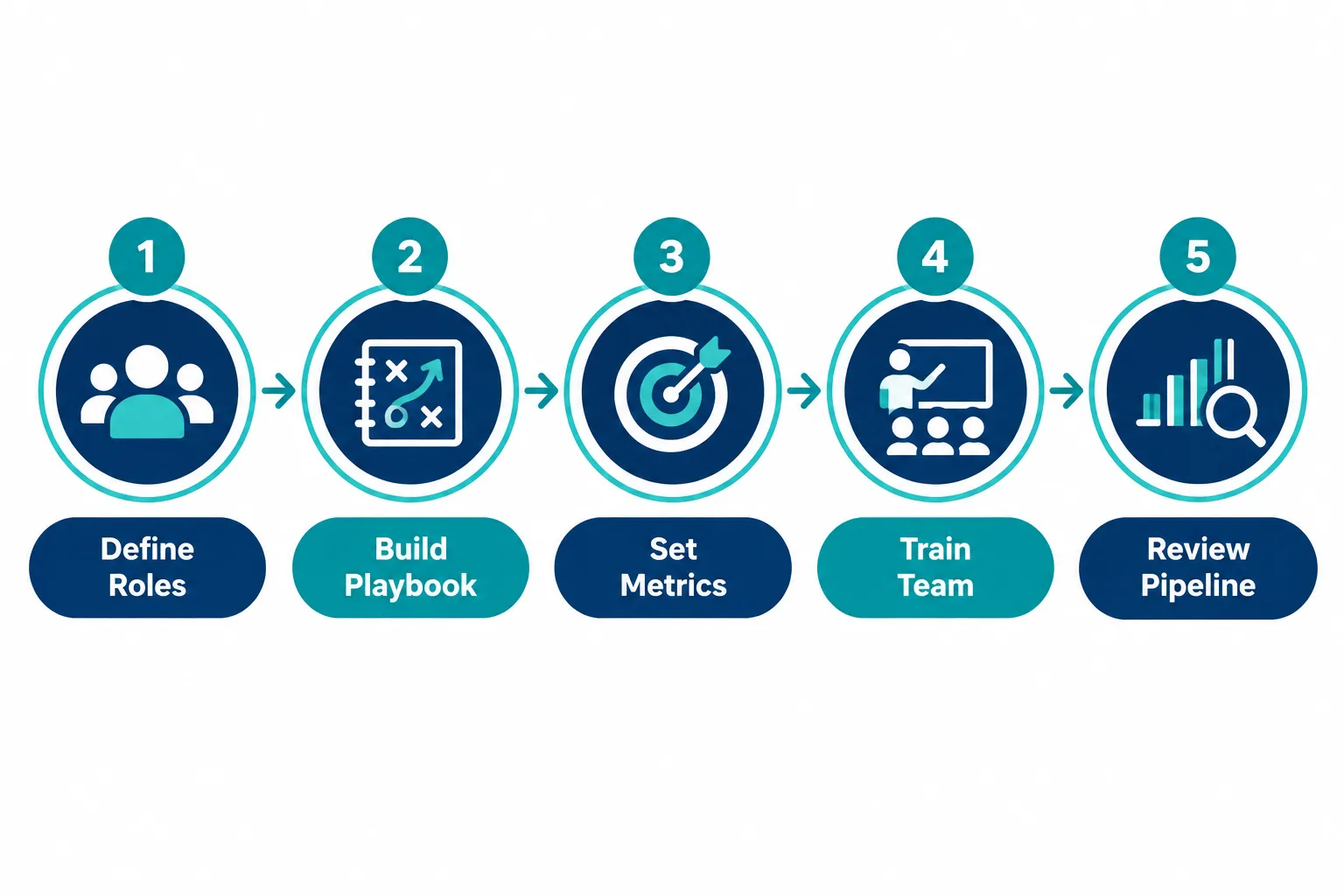
For SMBs, this shows up as a familiar pattern: strong quarters followed by unpredictable slumps, top reps who cannot be replaced, and a sales director stitching together reports from three disconnected spreadsheets. Effective sales management strategies fix this by creating consistency. They define what “good” looks like at every stage of the deal, so results depend less on who is selling and more on how the team sells.
This matters for three groups inside a growing company:
- Owners and founders need revenue they can forecast, not revenue they hope for.
- Sales directors need visibility into pipeline health without micromanaging every deal.
- New sales managers need a framework they did not have to invent from scratch.
Building a Standardized Sales Process and Playbook
The single biggest shift separating high-performing SMBs from the rest is the presence of a documented, standardized sales process. A playbook is not a binder that sits unused. It is a working reference that defines exactly what happens at each stage of the buyer journey, what a rep says, what a manager checks, and what “moving to the next stage” actually requires.
A strong playbook typically includes:
- Ideal customer profile criteria, who the team should be targeting and why.
- Stage-by-stage qualification rules, what must be true before a deal advances.
- Objection-handling scripts, common pushback and approved responses.
- Deal review checkpoints, when a manager steps in to coach or approve.
- Definition of “closed-won”, the exact conditions that count as a sale.
A sales process that lives only in a top performer’s head is not a strategy. It is a liability waiting for that person to leave.
Growing businesses should treat the playbook as a living document. Review it quarterly, update it when the market shifts, and retire tactics that no longer convert. This is one of the most cost-effective sales management strategies available because it requires no new headcount or software, just discipline.
Data-Driven Management and Accountability
High-growth B2B organizations are distinguished by how deliberately they use data and accountability structures, not just by how much data they collect. Many SMBs already gather activity numbers, call counts, email opens, deal stages, but few translate that into decisions. The strategy gap is not data volume. It is data discipline.
Effective sales managers track a small set of leading and lagging indicators rather than drowning teams in dashboards. A practical scorecard might include:
| Metric Type | Example Metric | Why It Matters |
|---|---|---|
| Leading | Qualified meetings booked | Predicts future pipeline |
| Leading | Average response time to leads | Predicts conversion rate |
| Lagging | Win rate by stage | Reveals where deals stall |
| Lagging | Average deal cycle length | Reveals forecasting accuracy |
| Retention | Customer renewal rate | Reveals long-term revenue health |
Accountability works best when it is paired with coaching, not punishment. Weekly one-on-ones that review the scorecard, rather than just the quota number, help reps understand which behaviors actually move the needle. This combination, clear metrics plus consistent coaching cadence, is one of the more underused sales management strategies among smaller companies, largely because it takes managerial time rather than budget.
Sales Organization Design and Role Clarity
As businesses grow past a handful of reps, role confusion becomes one of the most common breakdowns. Emerging guidance for growing companies points to sales organization design and role clarity as a rising priority heading into late 2026, particularly as teams add specialized functions like sales development, account management, and customer success.
Common role structures for growing SMBs include:
- Sales Development Representatives (SDRs) who prospect and qualify leads.
- Account Executives (AEs) who own the deal from qualified lead to close.
- Customer Success Managers (CSMs) who manage the post-sale relationship.
- Sales Managers who coach, forecast, and remove obstacles for the team.
Splitting these roles, even informally at first, prevents the common trap where one generalist rep is expected to prospect, close, and manage renewals simultaneously. Role clarity also makes compensation design easier, since each function can be measured against metrics that actually reflect its job.
A simple test for whether role clarity is missing: ask five reps to describe their primary responsibility in one sentence. If the answers vary wildly, the organization needs clearer structure before it can scale further.
CRM and Technology as the Backbone of Sales Management
Customer relationship management software has moved from “nice to have” to the operational core of small-business sales management. A CRM is where the playbook, the pipeline, and the performance data all live together. Without one, sales management strategies exist only on paper.
Choosing the right CRM depends on company size and complexity rather than brand recognition. Buyers should evaluate:
- Ease of adoption, will the team actually use it daily?
- Pipeline visibility, can managers see stage-by-stage deal health at a glance?
- Integration options, does it connect with email, calendar, and marketing tools?
- Scalability, will it still work at triple the current deal volume?
Beyond the CRM itself, a broader sales-tech stack is increasingly recommended as a blueprint for growth-stage companies, layering automation, analytics, and communication tools on top of the CRM foundation. The right stack should expand deliberately as the business grows rather than being purchased all at once, since underused software is a common source of wasted budget in SMBs.
AI, Automation, and the Modern Sales-Tech Stack
Artificial intelligence has shifted from an experimental add-on to a core requirement for competitive small-business sales teams. This is particularly significant for SMBs, which typically cannot match the headcount of larger competitors but can use automation to close the productivity gap.
Practical, proven applications for growing sales teams include:
- Automated lead scoring to prioritize which prospects reps contact first.
- AI-assisted email drafting to speed up outbound outreach without losing personalization.
- Conversation intelligence that flags coaching moments from recorded sales calls.
- Forecasting models that flag at-risk deals before they slip.
A layered sales-tech stack by growth stage typically looks like this:
- Early stage, CRM plus email/calendar integration.
- Growth stage, add automation for lead routing and follow-up sequences.
- Scaling stage, add AI-driven forecasting and conversation analytics.
The key strategic point is sequencing. Businesses that add advanced AI tools before mastering basic CRM hygiene tend to see poor adoption, because the underlying data feeding the AI is incomplete or inconsistent.
Sales and Marketing Alignment and Omnichannel Engagement
Buyers now research across multiple channels before ever speaking to a rep, which is why sales-marketing alignment, social selling, and omnichannel engagement have become central to small-business strategy heading into 2026. When sales and marketing operate in silos, leads get chased twice, messaging contradicts itself, and marketing-qualified leads arrive with no context for the sales team.
Alignment strategies that work at SMB scale include:
- Shared lead definitions so marketing and sales agree on what counts as “qualified.”
- Joint pipeline reviews where marketing sees which campaigns actually convert.
- Consistent messaging across channels, including social selling activity from individual reps.
- Feedback loops so sales tells marketing which content actually helps close deals.
Social selling deserves particular attention. Buyers increasingly evaluate a company through its reps’ public presence before ever filling out a contact form. Sales managers should treat social activity as a coached skill, similar to cold calling, rather than leaving it entirely to individual initiative.
Post-Sale Support and Retention as a Sales Management Function
One of the clearest shifts in how growing businesses think about sales management is the inclusion of post-sale support, customer success, and retention inside the sales function itself, rather than treating them as separate departments. Acquiring a customer is only half the revenue story. Keeping them, and expanding the relationship, is now treated as a core sales management responsibility.
Retention-focused strategies for growing sales organizations include:
- Structured handoffs from AE to customer success manager with documented account context.
- Regular check-ins tied to usage or satisfaction signals, not just renewal dates.
- Expansion playbooks that identify upsell and cross-sell opportunities systematically.
- Churn-risk scoring that flags accounts needing intervention before renewal conversations start.
This matters financially. Retained and expanded accounts typically cost far less to serve than new acquisition, and a sales manager who ignores this stage is leaving revenue on the table that took no new pipeline to generate.
What 2026-2028 Sales Organizations Will Look Like
Forward-looking research suggests the next few years will bring sales organizations that are more AI-driven, more data-integrated, and increasingly collaborative across geographies. For growing businesses, this means three practical shifts to prepare for now:
- Data integration across CRM, marketing, and customer success platforms will become table stakes, not a competitive edge.
- AI-assisted forecasting and coaching will move from early-adopter territory into standard practice.
- Distributed and global sales teams will require sales management strategies that work asynchronously, not just in shared office hours.
Businesses that start building these habits today, clean data, integrated tools, documented processes, will have a significant head start over competitors still relying on informal, individual-driven selling.
Final Thoughts
Growing a business past its early, founder-led sales stage requires a deliberate shift from personality-driven selling to process-driven management. The strategies outlined here, standardized playbooks, data-backed accountability, clear role design, the right CRM and automation stack, marketing alignment, and retention ownership, are not independent initiatives. They reinforce each other. A playbook without a CRM has no memory. A CRM without accountability metrics is just a filing cabinet. Retention without a sales-marketing feedback loop misses signals that could have prevented churn.
Start with one gap at a time. Audit whether the sales process is actually documented. Check whether the CRM is being used consistently or just tolerated. Ask whether customer success has a real seat at the sales table. Small, consistent improvements to sales management strategy compound faster than most owners expect, and they build the kind of predictable revenue engine that makes the next stage of growth possible.