Only about 10% of new e-commerce stores survive past their third year, and most failures trace back to one mistake: picking the wrong product. Learning how to find products to sell online is no longer a guessing game. In 2026, it is a structured, data-driven process that separates profitable sellers from those who burn their budgets on dead inventory.
This guide breaks down exactly how to research, validate, and source winning products, whether you are just starting out or looking to expand an existing store.
Why Product Research Is the Foundation of E-Commerce Success
Picking a product by gut feeling used to work when ad costs were low and competition was thin. That era is over. Today, how to find products to sell online requires treating research like a business function, with tools, criteria, and repeatable workflows.
The core question is not just “will people buy this?” It is “can this product generate enough margin to cover ads, shipping, returns, and still leave profit?” Practitioner consensus in 2026 points to a clear benchmark: a product must support a 3-4x markup over landed cost. If a product costs $8 to source and ship, it needs to sell for at least $24-$32 to remain viable after paid traffic.
That single filter eliminates most impulse picks before any money is spent.
How to Find Products to Sell Online Using Trend Platforms
The most powerful free tool for product discovery right now is TikTok. The TikTok Creative Center shows which products are driving real purchase behavior, not just views. In Q2 and Q3 2026, category leaders on TikTok Shop include personal care devices, compact kitchen tools, home organization products, and novelty lifestyle accessories.
Key signals to look for on TikTok:
- Videos with high engagement AND a direct product link in the caption
- Products appearing in multiple creator videos within a short window (viral velocity)
- Comment sections filled with “where can I buy this?” questions
- Products priced between $10 and $30, the sweet spot for impulse purchases on the platform
Google Trends is a complementary tool. Search a product name and check whether interest is rising, flat, or declining. A rising trend with low existing competition is the ideal scenario. Pair this with Google Shopping results to see how many sellers are already active and at what price points.
Seasonality matters more than most beginners realize. A product trending in October may be dead by February. Build a simple seasonality map: note which months drive peak demand for each product category you are considering. This prevents over-ordering and missed timing windows.
Validating Demand Before You Source
Trend data tells you what is popular. Validation tells you whether it is profitable and sustainable.
Three validation signals that matter most:
- Live ad activity, Search the Meta Ad Library and TikTok Creative Center for active ads on the product. If multiple sellers are running paid ads for months (not just weeks), the product has proven margin. No one runs ads at a loss for long.
- Amazon review volume and recency, A product with thousands of reviews and recent purchase activity confirms sustained demand. Read the negative reviews carefully, they reveal product weaknesses that a better version could fix.
- Competitor store analysis, Use tools like Similarweb or browser extensions to estimate traffic on stores selling the product. High traffic with a simple product page is a green flag.
“The best product research is not about finding something no one has heard of. It is about finding something people already want, and delivering it better or faster.”
AI-driven research tools have become standard in 2026. Platforms that aggregate trend data, ad performance, and supplier pricing into a single dashboard now compress what used to take days of manual research into hours. These tools are no longer optional for serious sellers, they are table stakes.
Sourcing: Where to Find Reliable Suppliers
Once a product passes demand validation, the next step is finding a supplier who can deliver it at a cost that supports the 3-4x margin target.
Common sourcing channels in 2026:
| Source | Best For | Speed |
|---|---|---|
| Alibaba / AliExpress | Private label, bulk orders | Slower (2-4 weeks) |
| Domestic wholesalers | Faster shipping, lower MOQ | Fast (3-7 days) |
| TikTok Shop suppliers | Trending products, dropship | Variable |
| Trade shows (virtual/in-person) | Exclusive relationships | Varies |
For dropshippers, domestic suppliers are increasingly preferred because faster delivery times reduce refund rates and improve customer reviews, both of which directly affect ad performance and store rankings.
When evaluating any supplier, request samples before committing to a bulk order. Check packaging quality, actual dimensions, and whether the product matches its listing photos. A bad first shipment can destroy a store’s review profile before it gains traction.
Building a Research Workflow That Scales
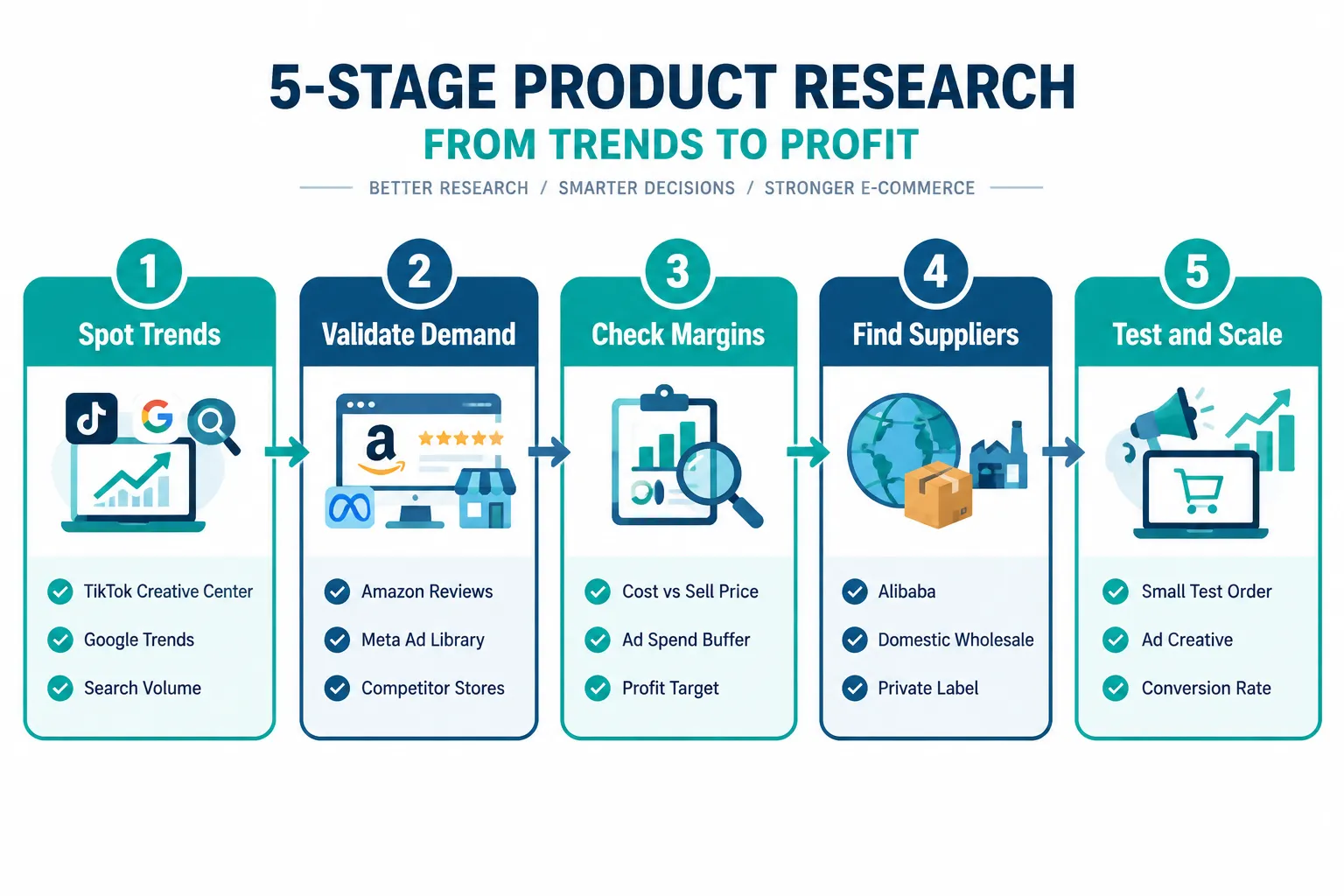
Knowing how to find products to sell online consistently, not just once, requires a repeatable system. Here is a practical workflow used by experienced sellers in 2026:
- Step 1, Spot trends: Browse TikTok Shop trending products, TikTok Creative Center, and Pinterest trends daily or weekly. Flag products that appear multiple times across unrelated creators.
- Step 2, Validate demand: Cross-check flagged products on Google Trends, Amazon Best Sellers, and the Meta Ad Library. Confirm that active ads exist and that search volume is stable or growing.
- Step 3, Check margins: Calculate landed cost (product + shipping + import fees). Apply the 3-4x rule. If the math does not work at a competitive retail price, move on.
- Step 4, Find suppliers: Source at least two to three competing suppliers for each product. Compare quality, minimum order quantities, and lead times.
- Step 5, Test and scale: Start with a small test order or a dropship arrangement. Run a limited ad campaign with a tight budget. Only scale spend once the conversion rate and return rate are acceptable.
AI tools can assist at nearly every stage, from generating product descriptions to analyzing competitor ad copy and predicting seasonal demand shifts.
What to Expect in Late 2026 and Beyond
The e-commerce landscape is shifting toward what analysts call “shoppertainment”, the blending of entertainment and shopping, driven largely by short-form video. Products that photograph and demonstrate well on video will have a structural advantage over commodities that do not.
Snackable, visually interesting products in the $10-$30 range are expected to dominate impulse-driven channels through 2027. AI-assisted discovery, where platforms recommend products to buyers based on watch history and behavior, means that well-optimized product listings will surface more often without paid ads.
Store and funnel design are now inseparable from product selection. A great product with a slow-loading, confusing store will underperform a mediocre product on a clean, fast, trust-optimized page. Product research and conversion optimization must be treated as one system.
Final Thoughts
Finding the right product to sell online in 2026 is a skill that combines data literacy, market awareness, and disciplined financial thinking. The sellers who win are not the ones who stumble onto a viral product by luck, they are the ones who run a structured research process every week.
Actionable next steps:
- Set up a daily 15-minute TikTok Shop and Creative Center review habit
- Build a simple spreadsheet to track product candidates with margin calculations
- Subscribe to at least one AI-powered product research tool and learn its core features
- Validate every product with live ad data before spending on inventory
- Map seasonality for every product category in your niche before ordering
Start with one product, validate it thoroughly, and build from there. The process compounds over time.